
Why Is Reverse Circulation Drilling Used?
Why Is Reverse Circulation Drilling Used?
Reverse Circulation Drilling is widely used in mineral exploration because it can collect rock chips quickly and deliver them to the surface through a controlled sample pathway. Compressed air drives the drilling process, while a dual-wall drill pipe carries cuttings upward through its inner tube. At the rig, the sample passes through a cyclone and into a collection bag. The setup is practical, but sample quality still depends on careful handling.
The method is especially useful when teams need broad, consistent coverage across a deposit. A rig can move between drill sites, and crews can collect samples at regular depth intervals. Those chips help geologists identify changes in rock type and mineralization. As a simple field principle puts it: “A fast hole is useful only when its samples remain dependable.” This is an editorially written line, not a verified quotation from a named expert; no source article or expert citation was provided.
Reverse circulation is not perfect. Wet ground, poor sample recovery, or contamination between intervals can weaken the evidence. A bag of chips may look clear on the surface while concealing mixed material. That deserves a second look. Good results rely on trained crews, suitable equipment, documented sampling procedures, and careful interpretation by qualified geologists. The method’s value is not just speed. It is the quality of information teams can defend and use.
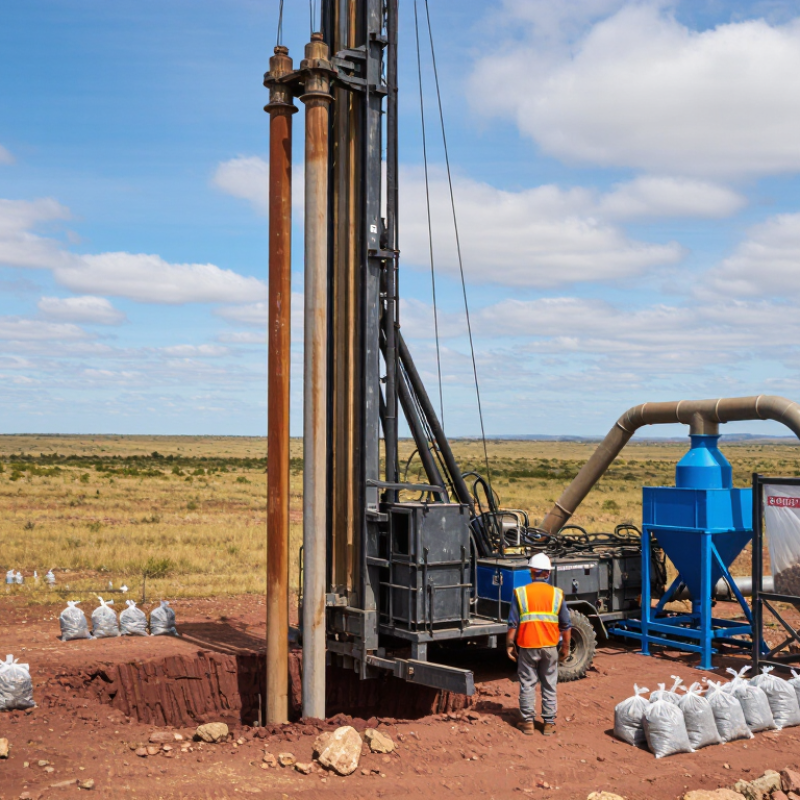
What Reverse Circulation Drilling Is
Reverse circulation drilling, often called RC drilling, is a rotary method used to collect rock-chip samples from depth. It uses dual-wall drill rods: an outer tube surrounds an inner tube. Compressed air, or another suitable drilling fluid, travels down between the walls and helps carry cuttings back up through the inner tube. The sample reaches the surface through a hose, then passes through a cyclone and often a splitter for collection.
Unlike core drilling, RC drilling usually returns small fragments rather than an intact cylinder of rock. Each sample represents material from a defined depth interval, so keeping the return stream separated and labelled matters. A field crew may check the splitter, clear blockages, and note whether the sample looks unusually wet or fine. Small details count.
The system can produce samples efficiently in many hard-rock settings, but it is not perfect. Water-bearing ground may reduce sample quality, and poor air circulation can affect how reliably cuttings reach the surface. Fine dust can also obscure visible differences between rock types. RC drilling is best understood as a practical way to recover depth-tagged chips, not a direct view of unbroken rock. A geologist must interpret the chips alongside drilling records and other evidence.
