
Why Choose Battery Liquid Cooling Pipes for EV Batteries?
Electric vehicles depend on stable battery temperatures for safety, performance, and service life. During fast charging or steep climbs, cells generate considerable heat inside a compact battery pack. A Battery Liquid Cooling Pipe carries coolant through carefully designed channels, helping remove that heat more evenly than passive air cooling.
The detail matters. Engineers consider pipe material, wall thickness, flow resistance, bending radius, and connection reliability. A well-designed system can keep temperature differences between cells under better control. This supports consistent power delivery and reduces stress on sensitive battery components. It also helps manufacturers manage limited space beneath the vehicle floor. Every millimeter matters.
Still, no cooling pipe is perfect.
Field experience shows that performance depends on the entire thermal system, not one component. Coolant quality, pump control, sealing, vibration resistance, and installation accuracy all influence long-term results. A pipe may transfer heat efficiently in laboratory testing, yet perform differently after years of road vibration and temperature changes. That gap deserves honest attention.
Choosing the right Battery Liquid Cooling Pipe therefore requires more than comparing product images or advertised flow rates. Buyers should review thermal data, pressure testing, corrosion resistance, connector design, and compatibility with the battery architecture. Independent validation can provide stronger confidence than unsupported claims. Practical testing remains essential.
This article examines why liquid cooling pipes are increasingly used in EV batteries. It considers their thermal role, design benefits, manufacturing requirements, and possible limitations. The goal is not to present cooling pipes as a universal solution. Instead, it offers a realistic basis for selecting safer, more dependable thermal management components.
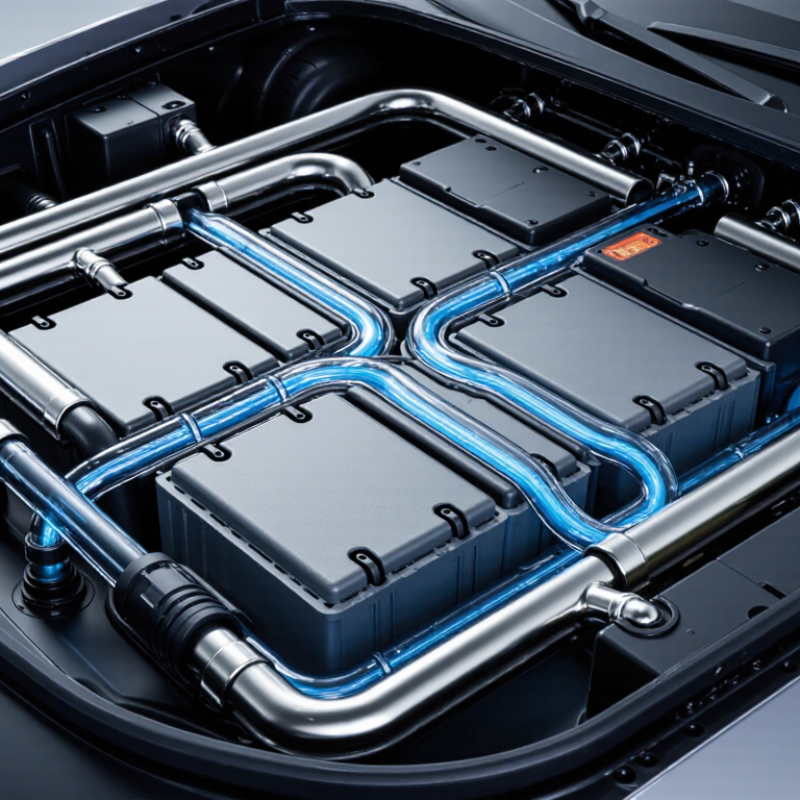
What Are Battery Liquid Cooling Pipes in EV Battery Systems?
Battery liquid cooling pipes are hollow channels designed to carry coolant through an EV battery pack. They sit close to battery cells, modules, or cooling plates. Their purpose is to move heat away during charging, acceleration, and repeated high-power use. The coolant absorbs heat from the battery area and transfers it to a heat exchanger or chiller.
These pipes are commonly made from lightweight metals or engineered polymers. The selected material must resist corrosion, pressure changes, vibration, and temperature cycling. Their shape also matters. Flat channels can improve contact with cooling surfaces, while flexible sections help absorb movement during vehicle operation. Seals, connectors, and bends require careful design because even a small leak can damage electrical components.
In practical testing, a pipe layout may look efficient on a drawing but perform unevenly inside a crowded pack. Coolant can favor shorter paths, leaving distant cells warmer. Engineers therefore check flow resistance, temperature differences, pressure, and joint reliability under real driving conditions. Sensors may reveal a few degrees of variation that simulation missed. That is not a failure; it is useful evidence. Poor routing can also complicate maintenance and increase assembly time. Clearances around cables and cell restraints must remain visible and accessible. A reliable cooling pipe system is not simply a tube carrying liquid. It is part of a controlled thermal network, and small design choices can affect battery life, safety, and charging consistency.
