
Why Choose a Jacquard Driving Board for Textile Machines?
Choosing the right control component can determine how smoothly a textile machine performs over long production cycles. A Jacquard Driving Board translates pattern instructions into precise actuator movements, helping control hooks, needles, or electronic selection systems. Its performance affects pattern accuracy, fabric consistency, response speed, and machine downtime.
Small details matter. A stable board should communicate reliably with the machine’s controller, maintain accurate timing, and tolerate vibration, heat, and continuous operation. In practical settings, technicians often inspect connectors, signal quality, cooling conditions, and firmware compatibility before installation. These checks can prevent skipped patterns, irregular designs, and unexpected stops during weaving.
Reliability is not only about buying the newest model. It depends on matching the board with the machine architecture, drive system, voltage range, and production requirements. A technically advanced board may still perform poorly when wiring, software, or mechanical timing is unsuitable. That point is easy to overlook.
Real-world experience also shows that maintenance records provide valuable evidence. Repeated alarms, unstable communication, or heat marks may reveal deeper compatibility problems. Operators should compare supplier specifications with actual machine conditions and request clear testing information. Independent technical advice can strengthen that decision.
No component is perfect. Even a well-designed Jacquard Driving Board may require calibration, replacement parts, or periodic inspection. However, the right choice can improve control accuracy and reduce avoidable interruptions. Understanding these benefits helps textile manufacturers evaluate whether this technology fits their equipment, fabric designs, and long-term production goals.
Jacquard Driving Boards: Definition, Structure, and Control Functions
Why Choose a Jacquard Driving Board for Textile Machines?
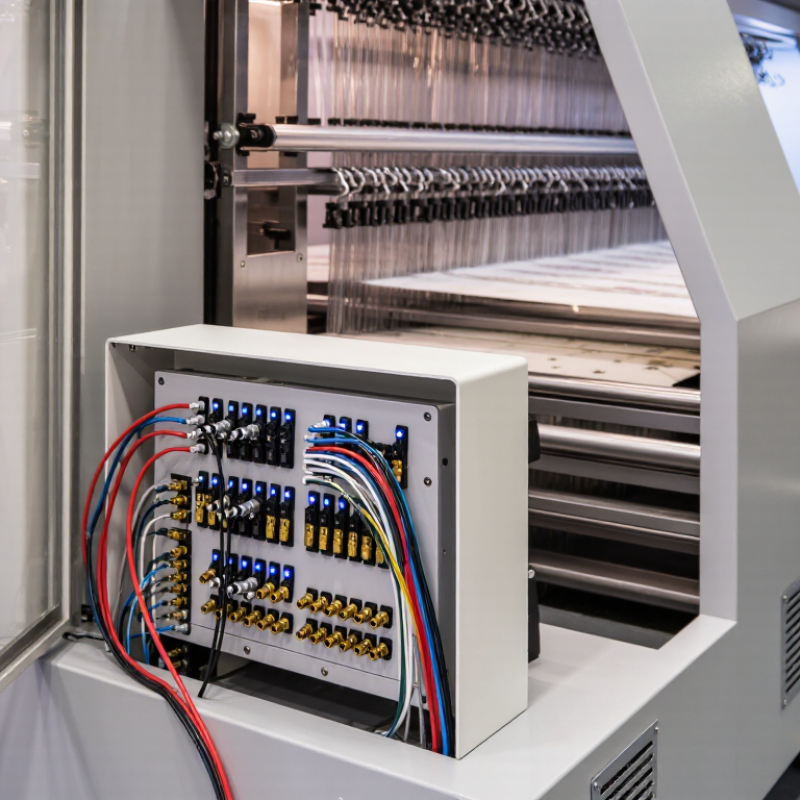
A Jacquard driving board is the control interface between pattern software and textile machine actuators. It converts digital design data into timed electrical signals. Each signal raises, lowers, or selects individual warp threads during weaving. This precise control creates detailed motifs, textured surfaces, and repeated patterns.
The board usually contains a processing unit, power regulators, driver circuits, communication ports, and protection components. Some systems also include feedback sensors for position and fault monitoring.
During operation, the processor reads pattern instructions and synchronizes them with the main shaft. The driver circuits then manage solenoids or other actuators with carefully controlled voltage and timing. Fast switching matters here. Delays can produce broken motifs or uneven fabric edges.
In practical maintenance, technicians inspect connectors, heat marks, and signal stability before replacing major parts. A clean enclosure helps prevent dust from affecting cooling and contact quality. However, no driving board solves every production problem. Incorrect pattern files, worn actuators, or poor calibration can create similar symptoms. This is where careful testing matters. Measure signals under operating conditions, not only on a workbench. I have found that small timing differences may remain unnoticed until the fabric is examined under strong light. Regular parameter checks, stable power input, and documented maintenance improve reliability, although occasional adjustment is still necessary.
