
Why Choose a Fingerprint Smart Lock for Your Business?
A busy office often starts with small access decisions: who can enter the stockroom, when a contractor’s access should end, and what happens when a key goes missing. A Fingerprint smart lock can make routine entry quicker by allowing approved users to unlock a door with a registered fingerprint. Staff do not need to carry another key or remember a separate code. No shared keys. For managers, user permissions and access records may also make day-to-day access easier to oversee, depending on the lock’s features.
Convenience is only part of the decision. Fingerprint readers can struggle with wet, dusty, or worn fingers, and performance varies by model, installation, and maintenance. A biometric reader is not a complete security plan. Businesses should consider door strength, emergency access, power backup, and how the lock stores and protects fingerprint data. Check whether permissions can be changed promptly when staff roles change, and confirm that the system works with the door and access process already in place. Ask the supplier about support, updates, and what happens during a power or network outage. Small details matter. A carefully selected lock can support a smoother entry routine, but it will not solve every access problem. Compare real operating needs with the product’s documented capabilities, and leave room to revise the setup after staff use it.
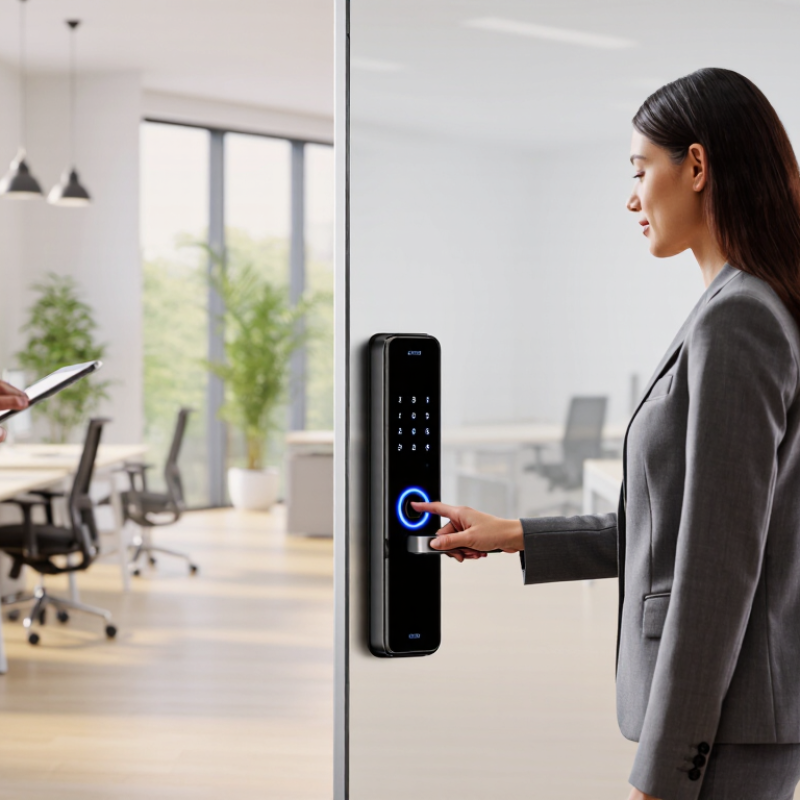
What Is a Fingerprint Smart Lock?
A fingerprint smart lock is an electromechanical lock that checks a person’s fingerprint before releasing its bolt or latch. A sensor captures ridge details and compares them with an enrolled biometric template. Depending on the model, templates and access records may be stored locally or managed through connected software. Do not assume every lock handles data the same way. Check its storage, backup-entry options, and audit-log controls before installation.
For a business, the practical change is simple: staff can unlock a door with a finger instead of carrying or sharing a metal key. NIST’s Digital Identity Guidelines, SP 800-63B, say biometrics should be used with a physical authenticator and are not secret by themselves. A fingerprint reader is therefore one part of an access system, not a complete security plan. Keep a controlled backup method, and remove access promptly when someone leaves.
There is a human factor. Verizon’s 2024 Data Breach Investigations Report found that 68% of breaches involved a non-malicious human element. That figure does not measure smart locks, but it shows why reducing routine credential handling can matter. It cannot prevent every mistake. A wet finger, worn sensor, or power outage may also interrupt entry, so test those scenarios at the actual door. Small detail. A lock that works reliably at reception may struggle near a loading bay.
