
What Is a Hybrid Grid Tie Inverter?
A Hybrid Grid Tie Inverter connects solar panels, batteries, household loads, and the utility grid in one coordinated system. It converts the panels’ direct current into usable alternating current for home appliances. When solar production exceeds demand, the system can charge a battery or export surplus electricity. When clouds reduce output, stored energy can support selected loads.
That balance matters.
Unlike a standard grid-tie inverter, a hybrid model can manage energy storage and backup operation. However, backup capability is not automatic. The inverter may require a separate battery, protected load panel, and approved transfer equipment. During a grid outage, certified systems isolate the home from utility lines. This prevents dangerous backfeeding and supports safe maintenance.
Real-world performance depends on battery chemistry, inverter capacity, wiring, software settings, and local sunlight. A system that looks powerful on paper may still struggle with pumps, compressors, or electric heating. Load measurements should guide the design. So should realistic nighttime usage.
It is not magic.
This guide explains how a Hybrid Grid Tie Inverter works, where it fits, and what its limitations mean. It also considers efficiency, monitoring, battery safety, installation quality, and long-term maintenance. Manufacturer documentation and qualified electrical professionals remain essential references. Some systems perform differently than expected, especially when settings are poorly matched. That uncertainty deserves attention, not marketing language.
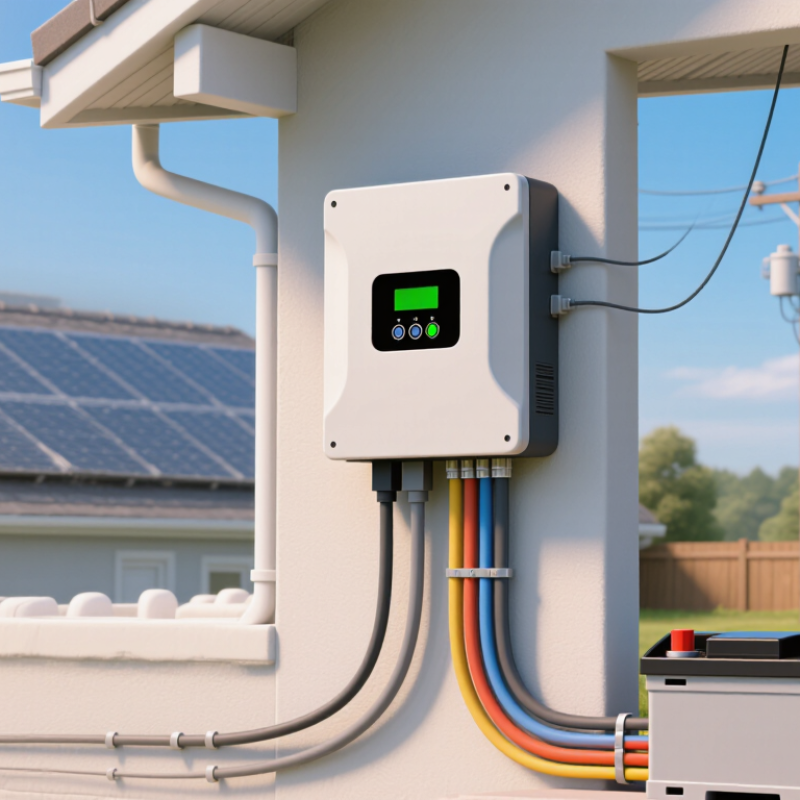
What Is a Hybrid Grid-Tie Inverter?
What Is a Hybrid Grid-Tie Inverter?
A hybrid grid-tie inverter connects solar panels, batteries, household loads, and the utility grid. Unlike a standard grid-tie inverter, it can manage stored energy as well. During sunny hours, solar power may run appliances and charge the battery. Excess electricity can flow to the grid, depending on local rules and system settings. At night, the battery can supply selected loads, reducing grid consumption.
The inverter constantly balances power flow. It changes direct current from panels or batteries into usable alternating current for household circuits. During a grid outage, a properly configured system can isolate backup circuits from the utility network. This safety function is essential. Without it, exported electricity could endanger repair workers. A qualified installer should verify wiring, protection devices, battery limits, and local interconnection requirements. From practical system planning, the hardest part is often choosing which loads deserve backup. A refrigerator and internet router may be more useful than an electric heater. The answer is not always obvious.
Tips: Check the inverter’s battery compatibility, backup capacity, and transfer time. Ask whether it supports automatic load management. Keep batteries in a dry, ventilated location. Review performance data after installation, because real household demand may differ from estimates. I once assumed a larger battery solved every problem. It did not. Poor load scheduling can still waste energy, even with advanced equipment.
