
What Are the Top Types of Pallet Rack?
Warehouse space is costly, and the right Pallet Rack system can change how many loads a facility stores and retrieves each day. Yet no single design fits every operation. Product dimensions, pallet condition, inventory turnover, forklift access, ceiling height, and floor capacity all matter. A layout that looks efficient on paper may slow down real picking.
Industry data offers useful context. MHI’s 2024 Annual Industry Report found that 55% of surveyed supply chain professionals were using robotics and automation, with 88% expecting to use them within five years. The report does not compare rack types. It does show why storage design should account for changing equipment and workflows, rather than today’s needs alone. Small details matter.
This guide compares the main options: selective rack, double-deep rack, drive-in and drive-through rack, push-back rack, pallet flow rack, and cantilever rack. Each supports different load profiles, access patterns, and storage densities. Selective systems offer direct access to individual pallets; denser systems may require trade-offs in accessibility or inventory rotation. The best choice depends on actual operating data—not a headline capacity figure. Rack loads, clearances, and equipment compatibility also need careful verification with qualified professionals. A comparison cannot replace a site assessment, and that limitation is worth stating. The following overview explains where each type can work well, what compromises to expect, and which questions to ask before choosing a system.
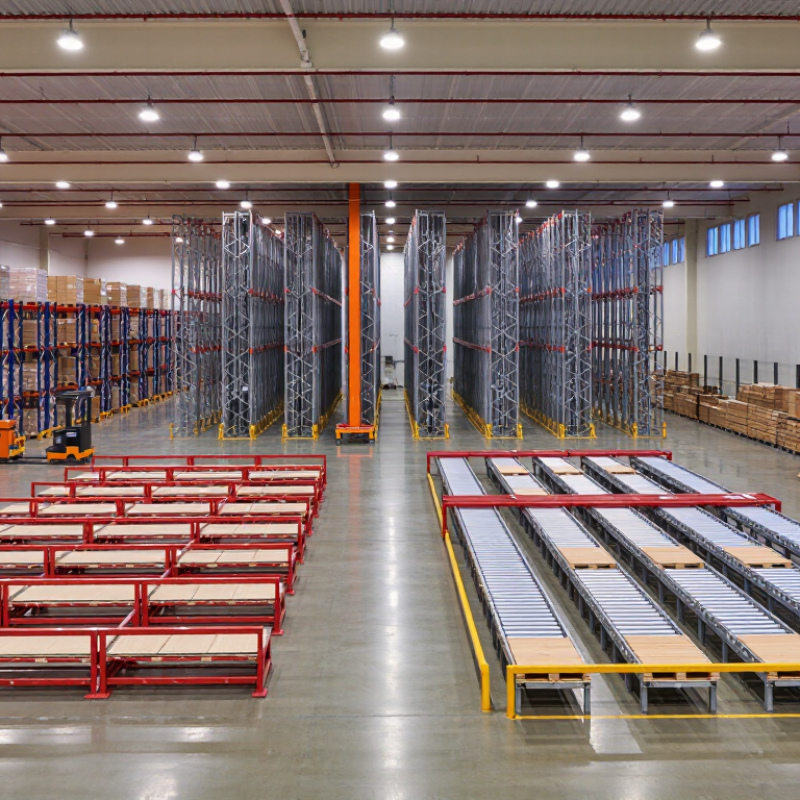
What Defines a Pallet Rack and Its Main Components?
A pallet rack is a steel structure that stores palletized goods above the floor and keeps loads accessible for handling equipment. A common selective-rack bay has two upright frames joined by horizontal beams. Each beam pair supports a pallet level; the frames transfer the load to the floor.
Simple, but not casual.
Upright frames contain vertical columns and diagonal or horizontal bracing. Beams connect the frames and usually lock into their columns with connectors. Base plates spread forces at floor level, while anchors help secure the frame. Wire decking, row spacers, and column guards may also be fitted, depending on the layout and hazards.
Small parts matter. A bent connector or unseated beam can change how the structure carries a load.
The Rack Manufacturers Institute’s ANSI MH16.1 specification addresses the design, testing, and use of steel storage racks. MHI’s 2024 Annual Industry Report found that 55% of surveyed supply-chain professionals planned to increase technology investment. That shift makes clear rack dimensions and load information especially useful when planning around automation.
Still, a capacity label is not the whole story: beam span, pallet weight distribution, installation, and damage all affect safe use. A label can be easy to misread. Check the rack’s configuration and condition, not just its stated capacity.
