
Who Are the Top Wooden Door Manufacturers in China?
China’s wooden door industry serves a vast and changing building market. Wooden Doors are used in homes, hotels, offices, and renovation projects, where buyers weigh durability, finish, lead time, and price. The choice is rarely just about appearance.
Official figures offer useful context. China’s National Bureau of Statistics reported that new housing starts fell 20.4% in 2023, compared with the previous year. This shift makes manufacturers’ production flexibility and domestic distribution worth examining, alongside product design and export experience. The figure describes housing construction, not wooden door sales. That distinction matters.
Market research provides another lens. Mordor Intelligence’s coverage of China’s doors market tracks demand and competitive developments across product categories. Yet broad market estimates do not establish a definitive ranking of individual wooden door makers. Company claims also vary in scope. Still, comparisons can be grounded in practical evidence: factory capacity, material sourcing, quality-control processes, certifications, customization options, and delivery performance. A polished showroom is not enough.
This overview identifies leading Chinese manufacturers and explains what separates them. It considers established brands and export-oriented producers, while noting that “top” depends on the buyer’s needs. Some firms excel at large orders; others may suit bespoke projects better. That can be hard to judge from a catalogue. Readers should verify current specifications and assess samples before choosing a supplier.
What Defines a Leading Wooden Door Manufacturer in China?
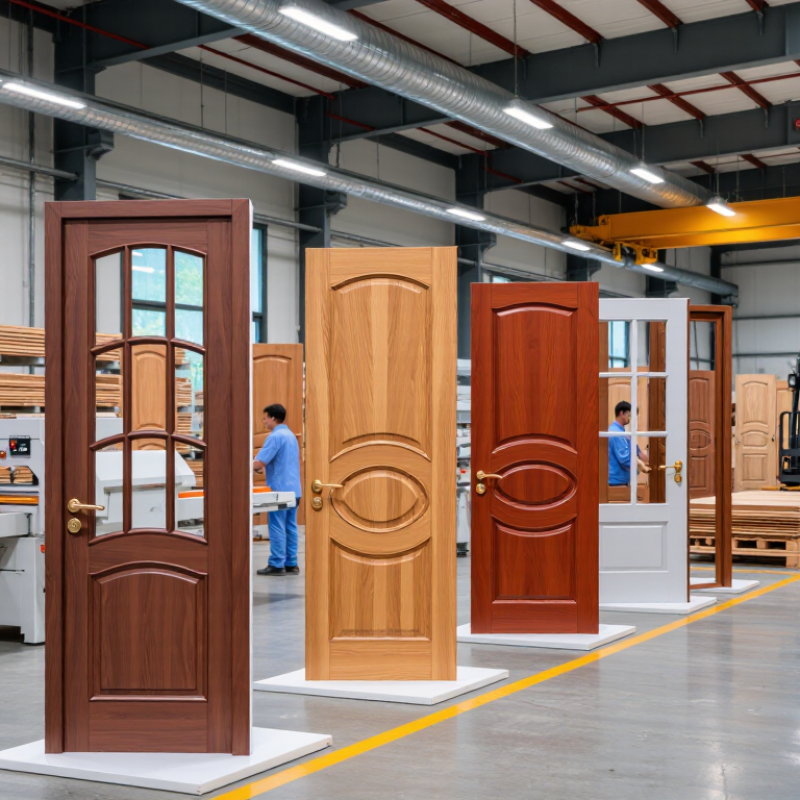
A leading wooden door manufacturer in China is defined by more than attractive finishes or a large catalogue. Look for documented control of timber sourcing, kiln drying, bonding, and coating. Ask for batch-level moisture records and independent test reports for dimensional stability, adhesion, and formaldehyde emissions. A door that looks smooth in a showroom may still warp after a humid summer. Production consistency matters.
Credible environmental information also matters. FAO’s Global Forest Resources Assessment 2020 estimated annual deforestation at 10 million hectares in 2015–2020, making traceable wood sourcing an important question for buyers. The 2019 Global Status Report for Buildings and Construction attributed 39% of global energy-related carbon emissions to buildings and construction. These figures do not measure door factories specifically, but they underline why material choices and manufacturing waste deserve scrutiny. No factory is flawless; transparent corrective-action records are more convincing than broad sustainability claims.
Tips: Request recent test reports, warranty terms, and written specifications for the exact door construction. Compare core material, veneer thickness, edge sealing, and installation requirements. If a supplier cannot explain how it controls moisture, pause before ordering.
