
What Are the Top Types of Technical Chargers?
Choosing a Technical Charger is not just a matter of picking the highest wattage. The right type depends on the device, charging speed, portability, and operating environment. A compact USB-C Power Delivery adapter suits many phones and laptops. A multiport charger can serve several devices from one desk outlet. Wireless chargers reduce cable clutter, while vehicle chargers keep equipment powered on the road. Industrial and bench chargers serve different needs, including controlled charging and monitoring.
USB-IF President Jeff Ravencraft has emphasized that USB Type-C is designed to support a broad range of devices. That matters, but the connector alone does not guarantee compatible charging speed. Check the charger’s output, supported charging protocols, and the device maker’s requirements. Look for clear power ratings and built-in temperature and overcurrent protections. Small details count. A warm adapter behind a crowded desk, or a cable that limits power, can change the experience.
This guide compares the leading charger types by their practical strengths, limits, and best-fit uses. It will examine wall, multiport, wireless, vehicle, and specialized charging options. Not every “fast” charger is fast for every device. That distinction is easy to overlook, and worth questioning before buying. The aim is a clear, technically grounded overview—not a claim that one charger fits everyone.
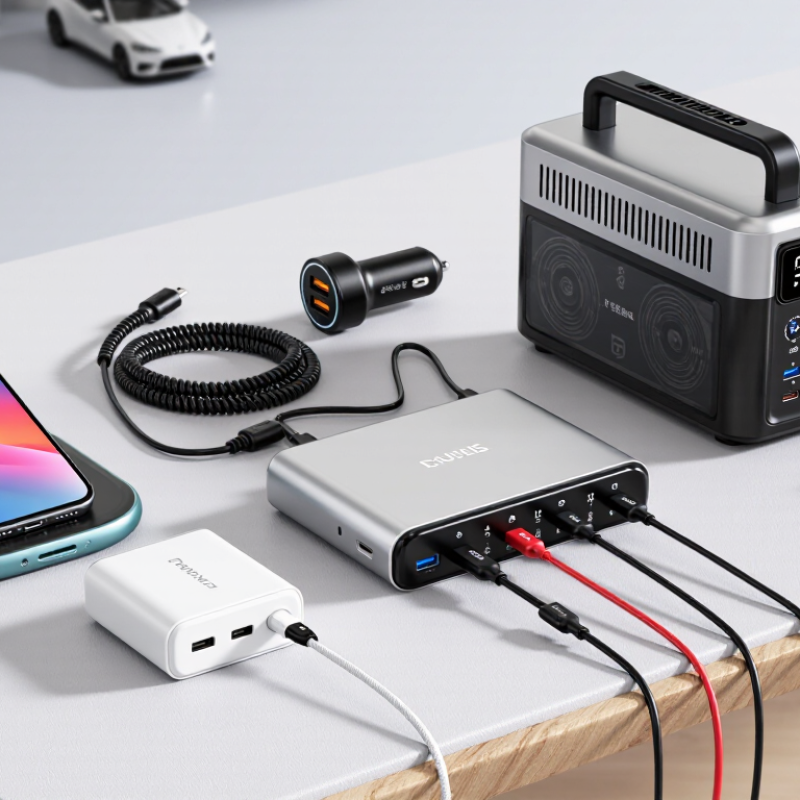
How Technical Chargers Convert Power for Electronic Devices
What Are the Top Types of Technical Chargers?
A technical charger is a small power-conversion system, not merely a plug. Its AC-to-DC circuit first rectifies household current, then switches it at high frequency. A transformer adjusts the voltage, and control circuits smooth the output. Inside, tiny components work hard.
USB-C Power Delivery chargers negotiate voltage and current with a device before increasing output. USB-IF’s USB Power Delivery 3.1 specification supports power levels up to 240 watts, enough for some high-performance laptops. Wireless chargers convert power differently: a coil creates a magnetic field, and a receiving coil in the device turns it back into electricity. That transfer creates heat, so alignment matters.
Other common types include compact GaN chargers, multiport desktop units, and vehicle chargers that convert a car’s DC supply. Gallium nitride lets some designs switch efficiently at higher frequencies, reducing component size. Yet small does not always mean cool-running. The U.S. Department of Energy’s Level VI requirements cap no-load consumption at 0.1 watt for many external supplies rated up to 49 watts. That figure concerns power drawn when devices are disconnected; it does not guarantee every charger performs equally under load. Labels can be confusing, and real-world efficiency varies with output level, cable quality, and heat.
| Charger Type | Typical Power Input | How It Converts Power | Typical Output or Charging Method | Common Uses | Key Consideration |
|---|---|---|---|---|---|
| Switch-mode AC-to-DC adapter | Mains AC; many models accept a broad range such as 100–240 V AC | Rectifies AC to DC, switches it at high frequency, then transforms and regulates it to a lower DC voltage. | Regulated DC, commonly 5–20 V depending on the adapter and connected device. | Phones, tablets, routers, and other electronic equipment. | Output voltage, current capacity, connector, and safety certifications must suit the device. |
| USB-C Power Delivery charger | Mains AC through an AC-to-DC adapter | A switching power supply creates regulated DC; the charger and device communicate to select a supported USB Power Delivery voltage and current. | Common fixed voltage levels include 5, 9, 15, and 20 V; supported power depends on both devices and the cable. | Compatible phones, tablets, laptops, and other USB-C devices. | The negotiated output is limited by the capabilities of the charger, device, and cable. |
| USB-A regulated charger | Mains AC through an AC-to-DC adapter | Converts mains power to low-voltage DC and supplies it through a USB-A port; some designs use charging signals to support higher current. | Typically 5 V DC; available current varies by charger and charging standard. | Older or compatible phones, accessories, and small electronics. | A USB-A port does not by itself guarantee a particular fast-charging capability. |
| Wireless inductive charger | Low-voltage DC from an AC adapter or another power source | Electronics create alternating current in a transmitter coil. A nearby receiver coil picks up the magnetic field, and the device rectifies and regulates the induced power. | Power is transferred across a short gap; the delivered level depends on the compatible charging system, alignment, and thermal limits. | Compatible phones, earbuds, and other small devices. | Coil alignment and heat affect efficiency; some energy is lost during transfer. |
| Lithium-ion battery charger | A suitable DC source, often supplied by an AC-to-DC adapter | A charge-control circuit monitors battery voltage and current. Many lithium-ion cells use a constant-current phase followed by a constant-voltage phase, with termination and protection controls. | A controlled charging current and voltage selected for the particular battery chemistry and cell configuration. | Portable electronics, rechargeable tools, and battery packs. | Use the correct charging profile; battery voltage and chemistry determine safe limits. |
| Solar charge controller | Variable DC from a solar panel | Regulates panel power to charge a battery safely. PWM controllers switch the panel connection; MPPT controllers adjust the electrical operating point and convert excess voltage into charging current. | Controlled DC matched to the battery’s charging requirements; available power varies with sunlight and panel conditions. | Off-grid systems, portable solar setups, and solar-powered battery charging. | Controller type, panel ratings, and battery chemistry must be compatible. |
| Linear charger or regulator-based charger | DC at a voltage above the required charging voltage | Uses a linear control element to reduce and regulate voltage or current; excess energy is mainly dissipated as heat. | A controlled, relatively low-power DC charging output. | Small devices and circuits where low electrical noise and simple design are useful. | Generally less efficient and more heat-sensitive than a comparable switching charger. |
Note: Actual charging speed and output depend on the device, battery, charger, cable, charging protocol, and operating temperature.
