
China Top Twin Screw Air Compressor Manufacturers
China’s Twin Screw Air Compressor manufacturers serve factories where reliable airflow affects production, energy use, and equipment life. The technology uses two rotating screw elements to compress air continuously, making system design and operating conditions important. The U.S. Department of Energy’s Improving Compressed Air System Performance sourcebook reports that compressed air can account for around 10% of electricity used in manufacturing. The share varies by facility, but the cost deserves attention. Small details matter.
For buyers comparing Chinese manufacturers, the headline power rating is only a starting point. Review delivered airflow, working pressure, motor efficiency, cooling design, noise levels, and service support. The International Energy Agency’s analysis of electric motor-driven systems estimated that they consume about 69% of industrial electricity. That broader figure helps explain why compressor motor performance matters, though it is not a compressor-specific benchmark. Ask suppliers for test conditions and performance documentation, and compare models under equivalent duty cycles. ISO 1217 provides acceptance-test methods for displacement compressors, offering a useful reference when reviewing reported performance. A polished catalog is not enough. Real operating data, maintenance access, and parts availability can change the ownership experience. Some comparisons remain imperfect; published ratings may not reflect a plant’s actual load profile. This guide introduces China’s leading Twin Screw Air Compressor manufacturers and the practical evidence buyers can use to assess them.
Twin Screw Air Compressors: Design and Operating Principles
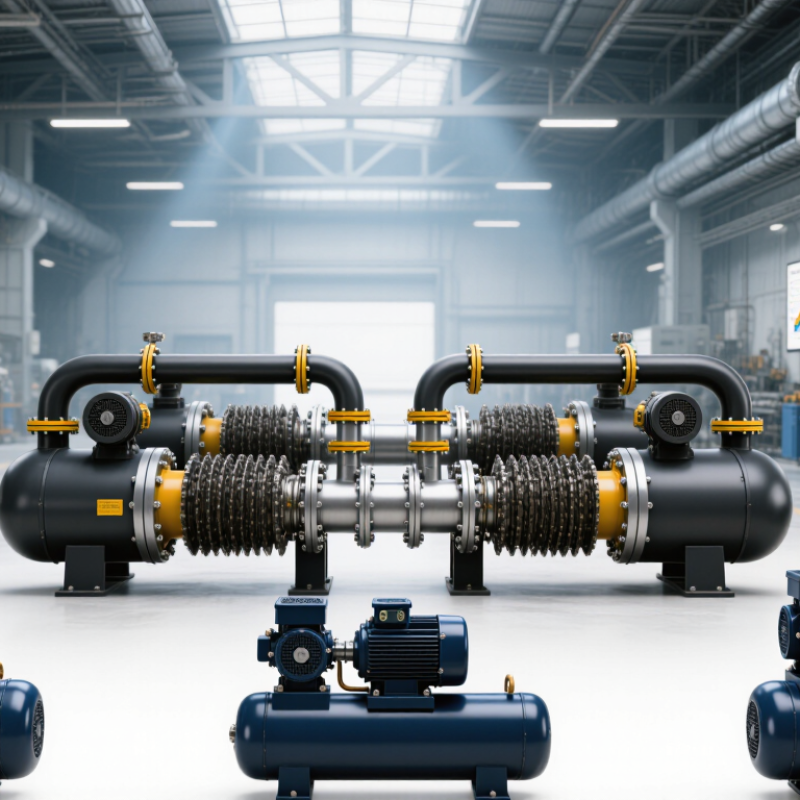
A twin screw air compressor uses two intermeshing helical rotors inside a close-fitting housing. Air enters through the inlet port and fills the spaces between the rotor lobes. As the rotors turn, these pockets move along the casing and become smaller. The shrinking volume raises the air pressure before it reaches the discharge port. Small clearances matter. Rotor shape, alignment, and casing temperature all influence how efficiently the machine compresses air.
In oil-injected designs, oil helps seal gaps, lubricate moving parts, and carry away heat. A separator removes most of this oil from the compressed air downstream. Oil-free designs keep oil out of the compression chamber, often using timing gears to maintain rotor spacing. Their heat management and clearances require careful attention. The two designs serve different air-quality needs, so neither is automatically the better choice.
In operation, listen for changes in sound and watch discharge temperature, pressure, and filter condition. These readings can reveal restricted airflow, excess heat, or wear before performance drops sharply. Heat changes the picture. A compressor that runs well in a cool test room may behave differently in a hot, dusty plant. That detail is easy to underestimate, and rotor design alone does not determine real-world efficiency.
China Top Twin Screw Air Compressor Manufacturers - Twin Screw Air Compressors: Design and Operating Principles
| System or Component | Design | Operating Principle | Technical Notes |
|---|---|---|---|
| Compression air end | A casing contains two intermeshing helical rotors, commonly described as male and female rotors. | Air enters through the inlet, becomes trapped in spaces between the rotor lobes and casing, and is compressed as those spaces move toward the discharge port and decrease in volume. | Compression is continuous rather than delivered in separate piston strokes. Rotor profile, clearances, speed, and built-in volume ratio affect performance. |
| Inlet and capacity control | An inlet filter removes airborne particles; a control valve regulates airflow into the air end. | At full load, the inlet is open to admit air. During reduced demand, the controller may modulate the inlet, unload the compressor, or vary motor speed, depending on the machine design. | Actual control sequences vary by model. Inlet throttling and unloading can reduce power, but their efficiency depends on operating conditions and system demand. |
| Oil-injected design | Oil is introduced into the compression chamber and then separated from the compressed air downstream. | Oil lubricates, seals rotor clearances, and removes heat during compression. An oil separator and downstream filtration reduce oil carryover. | Suitable for many general-purpose compressed-air applications. Required air purity may call for additional filtration or treatment equipment. |
| Oil-free design | The compression chamber is not lubricated with oil. Many designs use timing gears to maintain rotor clearance, with bearings lubricated separately. | The rotors compress air without oil being injected into the compression space. Cooling and sealing arrangements depend on the design and number of compression stages. | “Oil-free” describes the compression process; it does not by itself guarantee that the complete air system contains no contaminants. Air quality should be specified and verified for the application. |
| Drive and speed control | A motor drives the rotors directly or through a transmission. Some units use a variable-frequency drive (VFD). | A fixed-speed unit operates at a set speed when loaded. A VFD adjusts motor speed to better match changing air demand within the machine’s approved operating range. | Motor frequency, supply voltage, cooling, and permissible speed range are model-specific. Compare performance using declared operating conditions rather than motor power alone. |
| Cooling and aftercooling | Air- or water-cooled heat exchangers remove heat from the compressor and, where fitted, cool the discharge air. | Compression raises air temperature. Cooling lowers the temperature and helps condense moisture, which can then be removed by a separator or drain. | Cooling capacity and discharge temperature depend on ambient conditions, inlet temperature, pressure, and load. A dryer may be needed to achieve a specified pressure dew point. |
| Oil separation and air treatment | Oil-injected packages commonly include a separator vessel and element. Filters, dryers, and drains may be installed downstream. | The separator removes most injected oil from the air stream; additional treatment equipment addresses residual oil, particles, and water vapor as required. | Choose treatment equipment to meet the required air-quality class and pressure dew point at the point of use. Filter and separator elements require maintenance. |
| Operating pressure and performance | Pressure rating and delivered airflow are specified for each compressor configuration. | Airflow, power consumption, and temperature change with pressure, speed, inlet conditions, and control mode. | Use the manufacturer’s performance data at the required discharge pressure and inlet conditions. ISO 1217 provides test methods for displacement compressors; results depend on the stated test conditions. |
| Monitoring and protection | Controls typically monitor operating variables such as pressure, temperature, motor status, and service intervals. | The controller starts, stops, loads, or unloads the package and can initiate a protective shutdown when configured limits are exceeded. | Alarm and shutdown limits are model-specific. Regular inspection of filters, drains, cooling surfaces, and service items supports reliable operation. |
Selection note: This table describes common twin-screw compressor designs and operating principles, not a ranking of manufacturers. Performance, construction, and included equipment vary by model; confirm specifications against the relevant product documentation and test conditions.
