
Top 10 Substation Voltage Levels for Global Buyers
substation voltage levels shape how electricity moves from power plants and transmission corridors to local networks. For global buyers, the right level affects transformer selection, insulation requirements, equipment footprint, and connection costs. Common systems range from 11 kV and 33 kV distribution to 132 kV, 220 kV, and 400 kV transmission. Higher levels, including 765 kV, serve specific grid conditions; they are not universal defaults.
The investment stakes are substantial. The International Energy Agency’s 2023 report, Electricity Grids and Secure Energy Transitions, says annual grid investment needs to rise from about $330 billion to more than $600 billion by 2030 in its net-zero pathway. IEA Executive Director Fatih Birol has said, “There is no energy transition without transmission.” That matters. But voltage alone does not determine a sound purchase: load, distance, fault levels, local grid practice, and future expansion all count. A 132 kV solution may suit one project and constrain another. Buyers should verify assumptions against utility specifications and qualified engineering studies. The comparison that follows maps ten widely used voltage levels to typical applications, while recognizing that regional standards and project details can complicate any neat ranking.
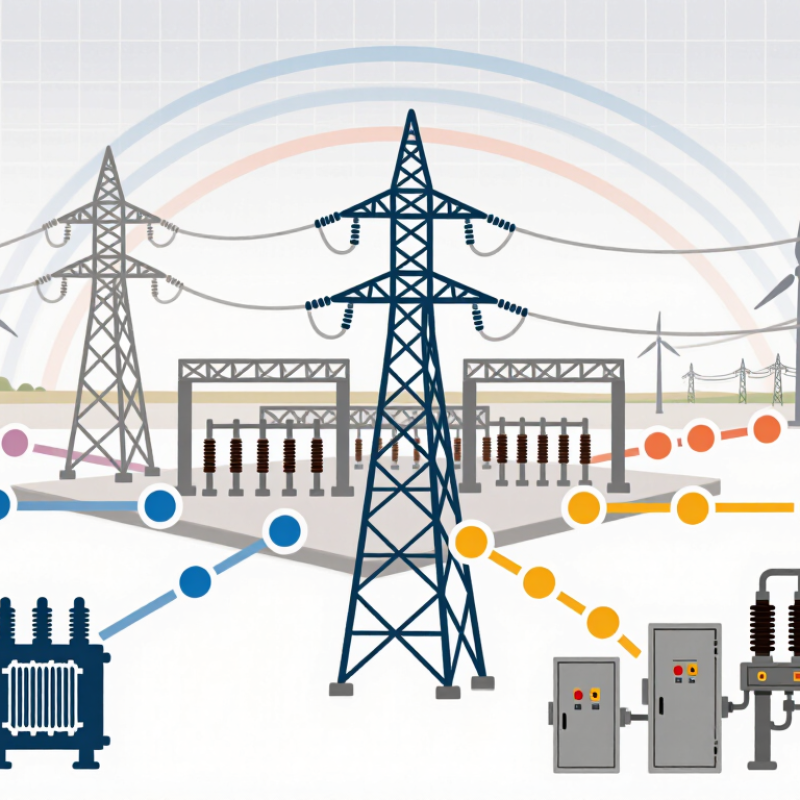
What Substation Voltage Levels Mean in Power Systems
Substation voltage is the electrical level used to transfer power between transmission lines and distribution networks. A 220 kV line, for example, may enter a station where transformers reduce voltage to 33 kV or 11 kV for regional delivery. A practical distinction. Higher voltage can move the same amount of power with less current, helping limit transmission losses. Yet voltage alone does not define a station’s capacity. Transformer ratings, circuit design, protection equipment, and operating conditions matter too. A voltage label can be misleading without that context.
Voltage levels differ by country and network, so a “top ten” list is not a universal ranking. The International Energy Agency’s 2023 report, Electricity Grids and Secure Energy Transitions, says more than 80 million kilometres of grids must be added or refurbished by 2040—roughly the length of today’s global grid. That scale makes voltage planning important when connecting distant generation to growing cities. The same report says annual grid investment must more than double by 2030, exceeding $600 billion. For buyers, the useful question is not simply which voltage is highest. It is whether the chosen level fits the connection point, expected load, and local network. Some project details remain easy to overlook.
Top 10 Substation Voltage Levels for Global Buyers — What Substation Voltage Levels Mean in Power Systems
| Typical Nominal Voltage | Common System Role | Typical Substation Application | Regional Context | Buyer Considerations |
|---|---|---|---|---|
| 765 kV AC | Extra-high-voltage bulk transmission | Long-distance transfer between major generation areas and large load centers | Used in selected large-scale transmission networks, including parts of North America, India, and Brazil | Specialized insulation, clearances, switching equipment, and protection studies are required; this level is not common in every market |
| 500 kV AC | High-capacity transmission backbone | Interconnection of major grid regions, power plants, and transmission corridors | Found in several countries, including the United States, Canada, China, Japan, and Brazil | Confirm the local nominal voltage, system frequency, short-circuit duty, and applicable grid standards |
| 400 kV AC | Extra-high-voltage transmission | National or regional transmission networks and major grid interconnections | Common in parts of Europe, India, the Middle East, and other regions | Equipment ratings and insulation coordination must match the network’s specified highest voltage for equipment |
| 345 kV AC | High-voltage transmission | Regional transmission and connection of large power stations or substations | Used in parts of North America; not a universal international standard voltage | Check whether the project specifies 345 kV nominal voltage and verify all interface and utility requirements |
| 230 kV AC | Subtransmission or transmission, depending on the grid | Regional supply, grid interconnection, and delivery to major substations | Used in countries including the United States, Canada, Australia, and parts of Latin America | “230 kV” is a nominal system voltage; the equipment voltage class and insulation level are specified separately |
| 220 kV AC | High-voltage transmission | Regional and national transmission, including links to primary distribution substations | Widely used in parts of Asia, Africa, Europe, and the Middle East | Do not assume 220 kV and 230 kV are interchangeable; use the exact network and procurement specifications |
| 132 kV AC | Transmission or subtransmission | Regional grid supply and connection of large industrial or urban substations | Used in several countries, including the United Kingdom, India, Australia, and parts of Africa | Its function varies by country and utility; confirm the site’s operating voltage and required equipment ratings |
| 110 kV AC | Subtransmission or lower-tier transmission | Supply to distribution substations and medium-to-large industrial customers | Common in parts of Europe, Asia, and other regions | Verify local practice, because networks may use nearby nominal levels such as 110 kV or 115 kV |
| 66 kV AC | Subtransmission | Regional distribution, industrial supply, and connections from larger transmission substations | Used in selected networks, including parts of Asia, Africa, and Australia | Check whether this voltage is standard for the local utility and whether the project requires a dedicated customer substation |
| 33 kV AC | Primary distribution or subtransmission | Distribution feeder supply, industrial sites, and step-down substations | Common in many distribution systems, particularly in parts of Asia, Africa, and the Middle East | Confirm the distribution utility’s nominal voltage, grounding method, fault level, and protection coordination requirements |
Note: These are representative three-phase AC nominal line-to-line voltage levels, not a universal ranking by prevalence. Actual network voltages and standard equipment classes vary by country and utility. Procurement specifications should distinguish nominal system voltage from the equipment’s rated voltage and insulation level.
