
China Top Stainless Steel Powder Manufacturers?
China has become an important source of metal powders, but choosing among its suppliers takes more than comparing prices. This guide to China’s top Stainless Steel Powder manufacturers explains what buyers should check before requesting a quote. Stainless Steel Powder is used in processes such as metal injection molding, additive manufacturing, and powder metallurgy. Each application can require different particle sizes, shapes, flow behavior, and chemical composition.
A manufacturer’s product sheet is only a starting point. Ask for recent test data covering particle-size distribution, oxygen content, apparent density, and batch consistency. Check whether the company produces the powder itself or sources it from another supplier. That distinction matters. Review quality-control procedures, available grades, sample options, production capacity, and export experience. A prompt, detailed answer can reveal as much as a polished catalog. Still, one sample cannot prove long-term consistency.
This overview is intended to help buyers compare suppliers using practical, verifiable criteria rather than broad claims. It also considers communication, documentation, and the ability to match powder specifications to real production needs. No single manufacturer is right for every application. Even a careful shortlist may overlook differences in equipment or quality systems. That limitation is worth admitting. Buyers should confirm current specifications directly, test samples under their own process conditions, and clarify packaging and delivery expectations before placing a large order.
What Is Stainless Steel Powder and How Is It Produced?
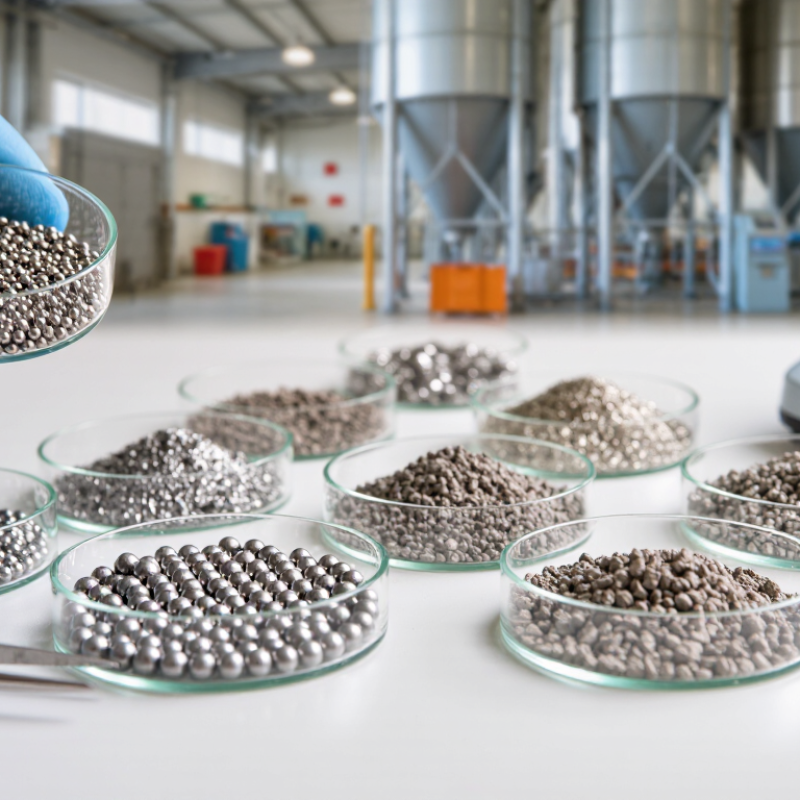
Stainless steel powder is made of fine particles containing iron, chromium, and usually nickel. Its corrosion resistance comes from the alloy, while particle size and shape affect how the powder flows and packs. Tiny details matter. Spherical particles often flow more evenly; irregular particles can interlock and pack differently. According to worldstainless’ 2023 production report, global stainless steel melt-shop output reached 58.4 million tonnes that year. That figure measures bulk steel, not powder production. The distinction is easy to blur.
Production commonly begins by melting a carefully specified stainless alloy. In gas atomization, a high-pressure gas stream breaks molten metal into droplets, which cool into powder. Water atomization uses water jets and often produces less spherical particles. The route influences flow, packing, and surface condition. It is not a cosmetic choice. Manufacturers then screen and classify the powder by particle size, while checking its chemistry and oxygen content. ASTM B214 provides a sieve-analysis method for metal powders. In practice, test results can vary with sampling and handling, so a single size number rarely tells the whole story. For powder intended for metal additive manufacturing, consistency between batches is just as important as a neat particle-size specification.
