
Who Are the Top Seamless Pipe Manufacturers in China?
Choosing a reliable Seamless Pipe manufacturer in China requires more than comparing price lists. Buyers should examine production capability, material traceability, inspection practices, and delivery performance. A polished catalog is not proof of consistent quality. Ask whether the supplier operates its own mills or sources from other producers, and request clear documentation for the specific order.
This overview considers manufacturers through practical factors: available steel grades, outside diameters, wall thicknesses, heat-treatment options, and export experience. It also highlights quality checks that matter in real projects, including dimensional inspection, hydrostatic testing, and ultrasonic examination where applicable. Details such as heat numbers and mill test certificates can help buyers connect delivered pipes with production records. Small details matter.
“Top” depends on the application. A supplier suited to construction work may not fit a demanding energy project, while a large production capacity alone does not guarantee a good match. Buyers should confirm current certifications, sample documents, production schedules, and inspection arrangements directly with each company. Specifications and capabilities can change, so this article is a starting point, not a substitute for supplier verification. There is room for doubt: published claims may not show how consistently a factory performs across different orders. The strongest choice is the manufacturer whose documented capabilities match the project’s requirements.
What Are Seamless Pipes and How Are They Manufactured?
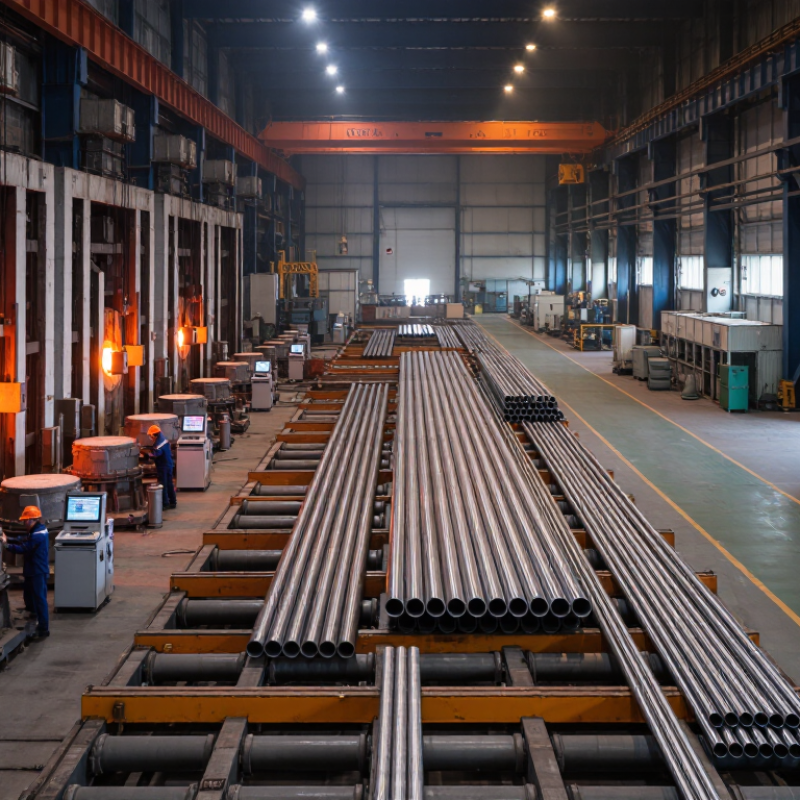
Seamless pipe is made from a solid steel billet, not a rolled strip joined by a weld. The billet is heated until workable, then pierced by rotating skew rolls and a plug to create a hollow shell. The shell is elongated, rolled to its target diameter and wall thickness, and sized. That distinction matters.
World Steel Association’s World Steel in Figures 2024 reports that China produced 1,019.1 million tonnes of crude steel in 2023; global production was 1,892.2 million tonnes. These figures describe crude steel, not seamless pipe output, so they show the scale of the upstream supply base rather than pipe capacity.
After rolling, manufacturers may cool, heat-treat, straighten, and cut the pipe to length. Inspection can include ultrasonic testing, eddy-current testing, and hydrostatic testing, depending on the product specification. A smooth outside is not proof of a sound inner wall.
Inspectors check dimensions and test results against the applicable standard and order requirements. Small process differences matter: heating time, piercing alignment, and cooling rate can affect wall uniformity and mechanical properties. Even a well-controlled line needs careful checks; the process is not flawless by default.
