
147 Mill Ridge Rd Suite 232
Lynchburg, Virginia 24502
Phone 757-982-3665

Top Material Handling Robots for Warehouses?

Warehouse teams move pallets, cartons, totes, and returns through spaces that rarely behave like diagrams. A narrow aisle, uneven floor joint, or crowded packing station can change which robot performs well. Material Handling Robots now include autonomous mobile robots, automated guided vehicles, robotic pallet movers, and systems that support picking or sorting. Each solves a different movement problem. Small details matter.

This guide compares leading warehouse robot types by their practical fit, not by headline speed alone. It considers payload, travel distance, aisle width, traffic patterns, battery needs, and how easily a system connects with existing warehouse software. A robot that moves quickly in a clean test area may struggle when people, carts, and replenishment work share the same route. That difference deserves attention.

The right choice depends on the task and the building. A tote-moving robot may suit frequent short trips, while pallet handling calls for greater load capacity and careful route planning. Buyers should also review installation demands, staff training, service access, and how work continues during downtime. These points can be missed in a polished product comparison.

There is no universal winner. Even a strong recommendation rests on assumptions about inventory, shifts, and floor conditions. Those assumptions should be checked against real workflows before a purchase. The following overview helps warehouse operators compare options, ask more useful questions, and spot trade-offs before a pilot begins. It is a starting point, not a substitute for an on-site assessment.
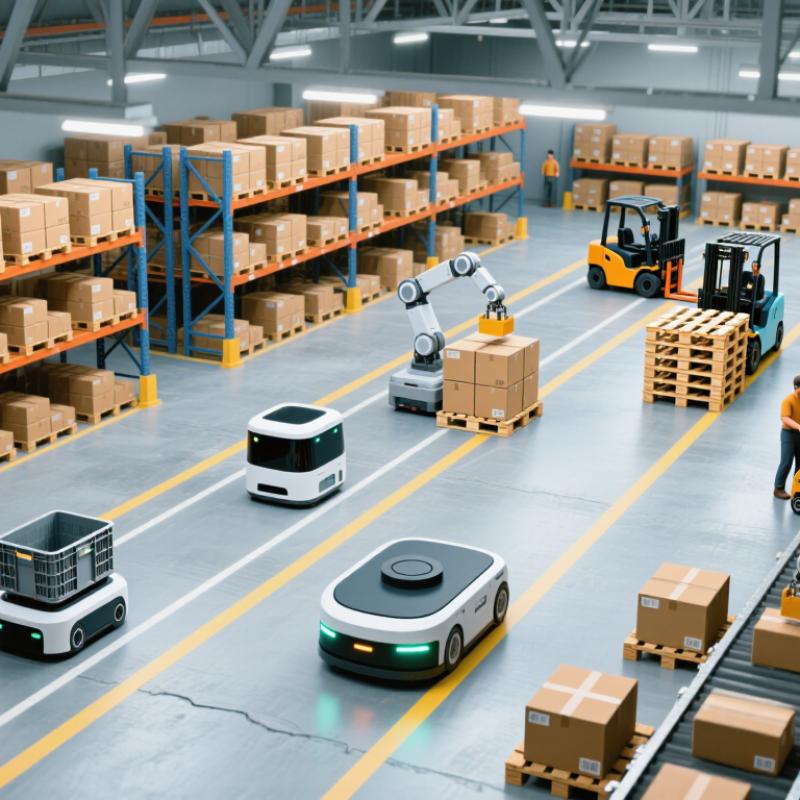
Top Material Handling Robots for Warehouses?

What Material-Handling Robots Do in Modern Warehouses

In modern warehouses, material-handling robots move goods between storage, packing, and shipping areas. Some carry shelves or sealed totes to workstations. Others transport pallets along marked routes or help robotic arms load and unload cases. Their job is not simply to travel. They connect separate steps in the flow of inventory. Short trips add up.

A mobile robot may collect a tote after an order is released, then deliver it to a picker. A pallet-moving unit can bring replenishment stock closer to a busy picking aisle. These movements reduce repeated walking and forklift travel, while warehouse software helps assign tasks and track locations. At packing stations, steady deliveries can help workers avoid waiting for the next item. Small gains matter.

The value depends on the layout, order mix, and quality of inventory data. A narrow aisle, misplaced tote, or blocked route can interrupt a seemingly simple task. Operators still monitor exceptions, maintain equipment, and adjust workflows as demand changes. Robots do not remove every delay; sometimes they expose a process that was already poorly organized. That is worth examining.

Which Robot Types Handle Transport, Picking, and Palletizing?

Transport robots move totes, cartons, or pallets between receiving, storage, and packing areas. Autonomous mobile robots can navigate changing routes, while guided vehicles usually follow fixed paths. Both need clear traffic rules and reliable handoff points. A robot that waits beside a blocked aisle is still a bottleneck.

Picking systems vary with order size and product mix. Goods-to-person robots bring storage bins to a stationary worker, reducing long walks across the warehouse. Robotic arms can pick individual items when cameras identify their position and shape. They may struggle with soft bags, reflective packaging, or tightly packed products. Real stock is rarely as tidy as a test setup.

Palletizing robots stack cases in planned patterns at the end of a packing line. Their payload, reach, and gripper must match the heaviest case and the pallet dimensions. Mixed case sizes may require frequent recipe changes, and unstable loads need careful testing. Small pilots help. Still, a smooth demonstration does not prove a system will handle peak-season congestion; teams should measure cycle time, missed picks, and recovery delays under real operating conditions.

Top Material Handling Robots for Warehouses

Mobile robots and autonomous forklifts primarily transport goods; picking robots handle item selection; palletizing robots build and break down pallet loads. Bars indicate a robot type’s typical primary task, not exclusive capability or a performance rating.

How IFR Reported Nearly 86,000 Logistics Robots Sold in 2022

Warehouse handling is changing quickly, but the sales figures need context. The International Federation of Robotics reported nearly 86,000 logistics robots sold worldwide in 2022, an increase of about 44 percent from the previous year. These units covered professional robots used for transport and logistics, not just machines inside warehouses. Still, the scale is striking. It signals growing demand for automated movement of goods.

In a busy distribution center, mobile robots can carry totes between storage aisles and packing stations. A worker may scan an order, place items in a container, and send it onward without pushing a cart across the floor. That can reduce repetitive travel and help keep work flowing during peak shifts. Yet a robot still depends on clear routes, dependable charging, and accurate inventory data. A blocked aisle can disrupt more than one task.

The reported total shows adoption, not guaranteed savings or perfect performance. Some facilities may need layout changes, staff training, or new safety procedures before robots fit smoothly into daily work. And sales figures alone cannot tell us how many systems were used intensively. That distinction matters. Warehouses differ in floor space, order volume, and staffing, so the right handling system is rarely obvious at first glance. A careful site assessment can reveal where automation helps—and where a simple process change may work better.

How to Compare Robot Payload, Speed, Navigation, and Integration

Comparing material handling robots starts with the load they must carry every day. Check payload against the combined weight of the goods, tote, and any lifting attachment. Also consider load shape, center of gravity, and uneven floors. A robot rated for a heavy load may move it poorly if the load sits off-center. Measure the tightest aisle and turning space, not just the warehouse’s average dimensions.

Speed figures need context. Ask whether they describe an empty robot, a loaded run, or a full pickup-and-drop cycle. A fast vehicle can still cause delays if it waits at a lift or slows near people. Test it loaded. Navigation should be evaluated around real obstacles, including parked carts, reflective packaging, and blind corners. A clean test route can be misleading.

Integration often decides whether a robot helps or creates extra work. Check how it receives tasks from warehouse software, reports faults, and handles blocked routes or unavailable destinations. Confirm what happens at charging points, doors, and lift interfaces. A useful pilot tracks completed moves, waiting time, and manual interventions across several shifts. The handoffs may look simple on paper; in practice, they can be awkward. That assumption deserves a second look.

Top Material Handling Robots for Warehouses? — How to Compare Robot Payload, Speed, Navigation, and Integration
Robot Type Typical Payload Typical Travel Speed Navigation and Localization Common Warehouse Tasks Integration Considerations
Cart- or shelf-carrying AMR About 300–1,000 kg, depending on the platform and load configuration About 1.0–2.0 m/s; operating speed is commonly reduced near people and obstacles Typically uses laser scanners or LiDAR with mapped routes; some systems add cameras or other sensors Moving carts, racks, totes, and work-in-process between warehouse zones May connect to a fleet manager, warehouse management system (WMS), or warehouse execution system (WES) through APIs or standard messaging interfaces
Pallet-moving AMR About 500–1,500 kg About 1.0–1.8 m/s, subject to load, floor conditions, and safety limits Often combines LiDAR-based localization with sensors for pallet detection and obstacle avoidance Transporting pallets between receiving, storage, production, and shipping areas Confirm pallet dimensions, pickup clearances, traffic rules, charging strategy, and task handoff with WMS or WES
Autonomous forklift Commonly about 1,000–2,000 kg; lift height and load center affect rated capacity About 1.0–1.8 m/s in travel; lifting and docking operations are slower May use LiDAR, cameras, reflectors, or a combination; navigation method depends on the model and site layout Moving pallets, loading or unloading staging lanes, and replenishing rack or production locations Requires accurate location and load data, aisle and rack checks, safety-zone planning, and coordination with warehouse control software
Goods-to-person mobile robot Typically carries a shelf or pod of about 300–1,000 kg; the usable load depends on the system design About 1.0–2.0 m/s during travel, with slower movement at workstations Commonly uses LiDAR or camera-based localization and mapped operating zones Delivering shelves, bins, or inventory to picking and replenishment stations Integration commonly includes inventory location, task prioritization, workstation signaling, and order-management data exchange
Autonomous tugger Often rated by towing capacity rather than carried payload; roughly 1,000–5,000 kg of trailer load is common across different designs About 1.0–1.8 m/s, depending on trailer configuration and route conditions Typically uses LiDAR or laser-scanner localization; trailer tracking and turning clearance need to be assessed Pulling carts or multiple trailers along repeatable material-flow routes Check hitch compatibility, trailer count, route width, dispatch logic, and integration with production or warehouse task systems
Autonomous counterbalanced or reach truck Often about 1,000–2,000 kg, depending on lift height, load center, and configuration About 1.0–1.8 m/s while traveling; precise rack approach and lifting occur at lower speeds May combine LiDAR, cameras, and rack or pallet detection; high-bay operations require suitable localization and placement sensing Storing and retrieving pallet loads from rack locations Validate rack geometry, floor quality, pallet condition, lift-height requirements, and warehouse location-management interfaces
Comparison note: These are broad, representative ranges for warehouse robot categories, not specifications for a particular model. Actual payload, speed, navigation performance, and software compatibility vary by configuration and site conditions. Verify rated capacity, safety requirements, and interface support with the equipment supplier.

What Safety Standards and Performance Metrics Guide Deployment?

Warehouse robots need to fit the site’s safety plan, not just its floor map. Start with a documented risk assessment covering people, forklifts, blind corners, loading points, and emergency access. ISO 12100 provides a framework for identifying and reducing machinery risks. ISO 3691-4 addresses safety requirements for driverless industrial trucks and their systems. Check current editions and applicable local requirements with qualified safety professionals.

Walk the actual routes with operators. Measure stopping distance at realistic speeds and loads, including on polished floors and near tight turns. Track completed missions per hour, delivery punctuality, blocked-route recovery, and human interventions. Record near misses and safety-stop events, too. Small details matter. A sensor can work well in an open aisle but struggle when pallets hide its view.

Test during busy shifts, not only in controlled demonstrations. Log downtime, battery use, load damage, and manual overrides alongside throughput. Compare results across shifts and traffic conditions; averages can conceal risky bottlenecks. A pilot may still miss rare conflicts, so review incident reports and update the risk assessment after layout changes. The metrics are useful, but they do not replace workers’ observations.