
Top MAG Welding Machine Brands for Global Buyers
Choosing a Mag Welding Machine for international purchasing involves more than comparing amperage ratings and familiar logos. A machine that performs well in a demonstration may struggle with your production schedule, available power, or local service options. Details matter. For buyers welding structural steel, vehicle components, or sheet metal assemblies, consistent wire feeding directly affects weld quality and rework. MAG welding uses active shielding gases, commonly carbon dioxide or argon-based mixtures, making gas compatibility an essential purchasing consideration.
Brands such as Lincoln Electric, Miller, ESAB, Fronius, and Kemppi provide useful starting points for comparison across different industrial requirements. Their product ranges differ, so brand reputation alone cannot establish which model suits a particular workshop. Check the rated duty cycle at your intended welding current, alongside input voltage, wire diameter range, and feeder configuration. Ask suppliers to demonstrate arc stability on material matching your actual thickness and joint design. For a fabrication shop running long shifts, accessible contact tips and replacement feed rollers can matter more than extra programs. Service matters too.
This guide examines leading MAG welding machine brands through practical purchasing criteria, including application fit, technical documentation, support availability, and ownership costs. There is no universal winner, and even a detailed specification comparison leaves questions that only a representative welding trial can resolve. A lower purchase price may be attractive, but overseas freight and delayed repairs can change the calculation. We may also give familiar brands too much credit. Buyers should verify regional warranty terms, applicable certification documents, and distributor capabilities before committing to an order.
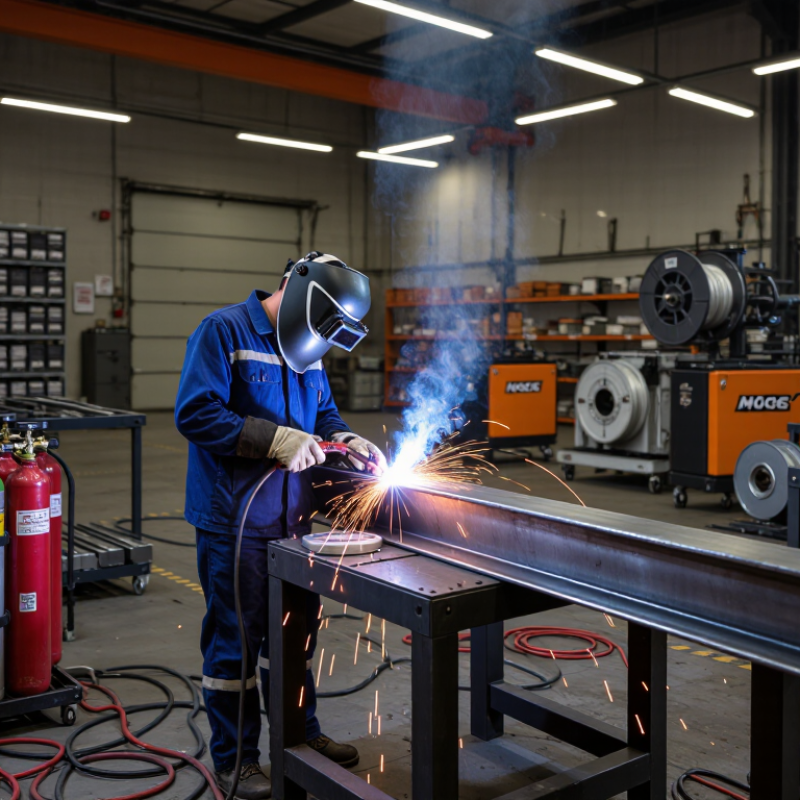
MAG Welding Fundamentals: ISO 4063 Processes 135, 136 and 138
MAG welding covers three distinct ISO 4063 processes, not one interchangeable setting. Process 135 uses a solid wire electrode with active shielding gas. Process 136 uses a flux-cored wire and active gas; its slag and arc behavior differ from solid-wire welding. Process 138 uses metal-cored wire with active gas, combining a tubular electrode with a metal-rich core. ISO 4063:2023 provides the process numbering, while the actual procedure still depends on material, joint design, position, and inspection requirements.
The scale of steel fabrication is considerable: World Steel Association’s World Steel in Figures 2024 reports 1,892.2 million tonnes of crude steel produced worldwide in 2023. That figure describes steel output, not MAG process use, but it helps explain why reliable, repeatable joining matters across fabrication shops. In practice, compare wire-feed stability, gas coverage, fume extraction, and access to the joint. A draft across a shop floor can disturb shielding gas. Small details matter.
Higher deposition rates can improve productivity, but they do not guarantee better welds. Process 136 may suit applications where slag formation is acceptable; 135 often offers a clean bead with less post-weld cleanup. Process 138 can provide useful deposition characteristics, yet consumable choice and parameter control remain critical. A polished bead is not proof of sound fusion. Process labels alone are not enough; qualified procedures and inspection should guide the final choice.
