
Top Industrial RFID Tablets for Global Buyers
Global warehouses are becoming more connected, mobile, and data-driven. RFID supports faster identification across receiving docks, production lines, and dispatch zones. Grand View Research valued the global RFID market at approximately USD 14.6 billion in 2023. Its report also forecasts strong growth through 2030. This expansion increases demand for durable INDUSTRIAL RFID TABLETS that combine UHF reading, barcode scanning, wireless communication, and real-time software access.
A good tablet must survive more than a product demonstration. It may face concrete floors, glove-covered hands, dust, vibration, and repeated drops. Buyers should examine IP ratings, operating temperature, battery-swapping options, screen brightness, and Android security support. VDC Research’s enterprise mobility studies consistently emphasize lifecycle management and device reliability as major purchasing factors. That matters when a failed tablet can slow pallet verification or interrupt inventory visibility. Small details matter.
Mark Roberti, founder of RFID Journal and a recognized RFID industry expert, stated, “RFID is not a technology problem; it’s a business problem.” His observation remains useful for global procurement teams. The strongest device is not always the most expensive one. It is the model that fits workflow, software, users, and service coverage. Sometimes, a cheaper tablet creates higher costs through downtime. That is easy to miss. This guide compares leading INDUSTRIAL RFID TABLETS for demanding industrial environments, considering performance, ergonomics, durability, connectivity, and long-term support. The evaluation is practical, but not flawless. Field conditions differ, and published specifications never tell the whole story.
What Industrial RFID Tablets Are and Why Global Buyers Need Them
Top Industrial RFID Tablets for Global Buyers
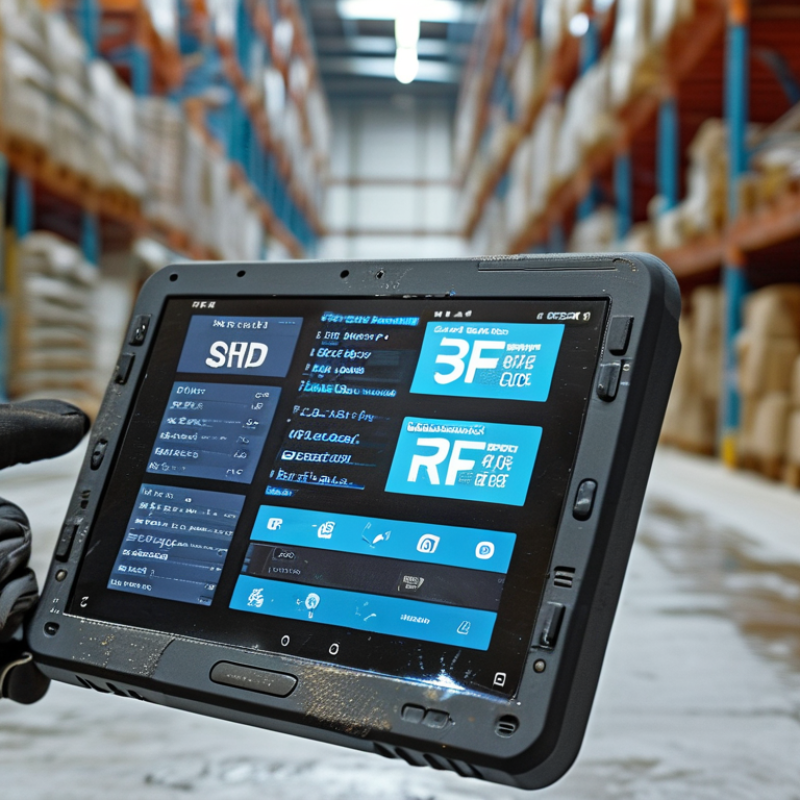
Industrial RFID tablets combine rugged mobile computing with radio-frequency identification. They let workers read tagged items without opening cartons or entering serial numbers manually. A warehouse operator can scan a pallet from several meters away, even while wearing protective gloves. Most models include a sunlight-readable screen, physical controls, long battery life, and protection against dust, water, and drops.
Global buyers need these devices because work conditions differ sharply across regions. A tablet used in a cold storage room may face condensation, while one used near metal racks may experience weaker RFID reads. Wi-Fi, cellular, Bluetooth, and satellite positioning also affect daily performance. RFID is not magic. Tag material, antenna placement, and reader power can change results. Testing with real products matters more than relying on a catalogue specification.
Reliable purchasing requires more than checking IP ratings. Buyers should request regional compliance documents, security information, battery details, repair options, and software support terms. Field trials should include gloves, poor lighting, moving equipment, and unstable network coverage. In practice, a rugged tablet can still fail when its scanner is awkward to hold. That uncomfortable detail is easy to miss. Select equipment that fits the workflow, not only the warehouse.
Top Industrial RFID Tablets for Global Buyers - What Industrial RFID Tablets Are and Why Global Buyers Need Them
| Industrial Tablet Category | Typical RFID Technology | Common Operating Frequency | Typical Read Range | Recommended Work Environment | Typical Protection Level | Key Buyer Benefit |
|---|---|---|---|---|---|---|
| Compact UHF RFID Tablet | Integrated UHF reader with EPC Class 1 Gen 2 / ISO 18000-63 support | Regional UHF bands, commonly around 860–960 MHz | Approximately 3–10 m, depending on tag, antenna, and surroundings | Retail backrooms, warehouses, service operations, and inventory counting | Usually IP65 or higher; rugged models may offer drop resistance | Balances portability, data capture, and medium-distance tag reading |
| Long-Range UHF RFID Tablet | High-output UHF reader with directional or extended-range antenna options | Regional UHF bands, commonly around 860–960 MHz | Approximately 8–15 m under suitable line-of-sight conditions | Pallet identification, dock doors, yards, large warehouses, and logistics hubs | Typically IP65–IP67 with reinforced housing | Reduces the need to approach every pallet, carton, or tagged asset |
| Multi-Protocol RFID Tablet | UHF plus HF/NFC for flexible tag and credential reading | UHF: approximately 860–960 MHz; HF/NFC: 13.56 MHz | UHF: several metres; HF/NFC: generally within a few centimetres | Manufacturing, healthcare, field service, access control, and mixed-tag operations | Commonly IP65 or higher | Supports different RFID use cases without carrying separate readers |
| Cold-Chain RFID Tablet | UHF RFID with barcode scanning and temperature-monitoring workflow support | Commonly regional UHF bands around 860–960 MHz | Approximately 3–10 m, depending on packaging and liquid content | Food distribution, pharmaceuticals, laboratories, and refrigerated logistics | Preferably IP66 or IP67 for washdown and moisture exposure | Combines identification, barcode verification, and electronic recordkeeping |
| Heavy-Duty Field RFID Tablet | UHF RFID with integrated barcode scanner, camera, GNSS, and cellular connectivity | UHF bands selected according to the destination market | Approximately 3–10 m for routine mobile asset identification | Utilities, construction, transportation, mining, and outdoor maintenance | Often IP65–IP68; many designs target MIL-STD-810H test methods | Improves asset visibility where dust, vibration, rain, and drops are common |
| Vehicle-Mount RFID Tablet | UHF RFID with external antenna and wired or wireless industrial connectivity | Regional UHF bands around 860–960 MHz | Approximately 5–15 m, subject to antenna placement and tag orientation | Forklifts, delivery vehicles, loading areas, and distribution centres | Usually IP65 or higher with vibration-resistant mounting | Enables hands-free or reduced-touch identification during material movement |
| Hazardous-Area RFID Tablet | RFID and barcode functions designed for use with applicable hazardous-area approvals | Depends on the certified reader configuration and local regulations | Typically a short-to-medium operational range validated by the certified design | Oil and gas, chemical processing, energy, and industrial inspection | Ingress protection and hazardous-area certification must be verified separately | Supports digital inspections while helping meet site safety requirements |
| Global-Buyer Selection Baseline | EPC Gen2 / ISO 18000-63, HF/NFC options, barcode compatibility, and software integration | Confirm regional UHF frequency regulations before purchase | Validate range using the actual tag material, antenna, mounting position, and environment | Choose based on workflow, climate, connectivity, and operator mobility | Check IEC 60529 IP rating, drop testing, operating temperature, and required certifications | Reduces deployment risk and improves compatibility across international operations |
Read ranges are practical reference values rather than guaranteed performance. Actual results vary with RFID tag design, reader power, antenna orientation, materials, regulations, and radio interference.
