Top Hydraulic Regulation Joystick Manufacturers Worldwide
A Hydraulic Regulation Joystick may look simple: a compact handle, a spring return, and a precise signal path. In service, it helps operators meter hydraulic functions smoothly, often through long shifts and changing loads. Small differences matter. A stiff return, inconsistent sensor output, or poorly sealed housing can affect feel and uptime.
This guide examines leading Hydraulic Regulation Joystick manufacturers worldwide through practical selection criteria. These include control type, output options, operating force, durability, customization, documentation, and support. Application matters, too. A joystick intended for an excavator may face different vibration, contamination, and duty-cycle demands than one used in agricultural or material-handling equipment. Buyers should verify compatibility with the machine’s hydraulic and electronic architecture rather than rely on appearance or a broad product label.
Hydraulic engineer Herbert E. Merritt’s work on control systems offers a useful principle, paraphrased here: “Control quality depends on the whole circuit, not the joystick alone.” That distinction is easy to overlook. A premium component cannot correct a mismatched controller or unsuitable valve interface. Manufacturer claims deserve careful checking against technical data and real operating needs. This comparison aims to make that checking easier, while recognizing that no single supplier fits every machine or market. Some specifications still leave questions. Good engineering starts by asking them.
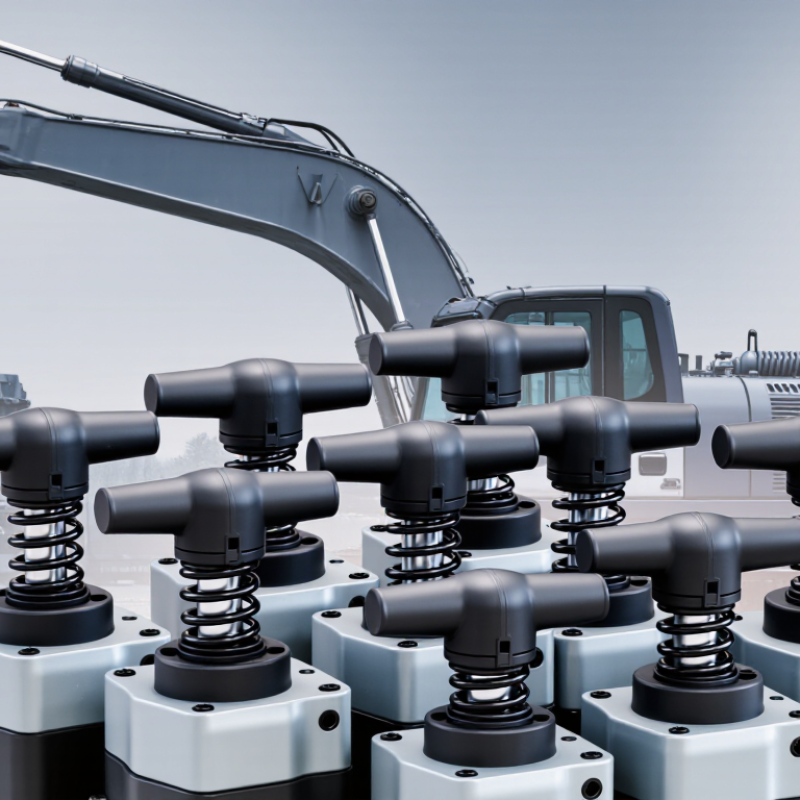
Hydraulic Regulation Joysticks: Definition and Core Functions
A hydraulic regulation joystick is a hand-operated control that meters pilot pressure to command a machine’s main hydraulic valve. Lever movement changes the pressure or flow sent to the valve, shifting its spool and directing oil to a cylinder or motor. Some systems use electronic sensors instead, so the term does not always describe one exact design. Names can be messy. Checking the hydraulic schematic helps clarify what the joystick actually controls.
Its core function is proportional command: a small lever movement can produce a small machine response, while greater movement requests more flow. The joystick may control direction, speed, or both. A spring-centered neutral position commonly returns the lever when released, helping stop the commanded motion. Detents or adjustable resistance may support specific operating tasks, but they are not universal features.
Good control depends on more than the lever. Valve response, oil temperature, linkage condition, and operator technique all affect how smoothly a machine moves. On a cold morning, stiff oil can make a familiar input feel less predictable. That deserves attention. Inspection should include loose mounts, worn joints, leaks, and inconsistent return to neutral. Even a well-designed joystick cannot compensate for a poorly maintained hydraulic circuit.
How Hydraulic Regulation Joysticks Control Equipment
A hydraulic regulation joystick turns an operator’s hand movement into controlled machine motion. Depending on the system, it may send hydraulic pilot pressure or an electrical signal to a proportional valve. The valve adjusts oil flow and direction, moving a cylinder or hydraulic motor. Push the lever forward, and a boom may lower; move it sideways, and the machine may swing. Small movements matter.
The response depends on the joystick design, valve settings, oil condition, and equipment load. A gradual lever input usually supports smoother motion, while a quick input can cause abrupt movement. Operators should learn the machine’s control pattern before working near people or obstacles. A control map may look clear on paper, yet feel awkward from the seat. That deserves attention, not guesswork.
Tips: Make slow, deliberate inputs and watch the attachment, not just the lever. Check for delayed or uneven movement; it can signal a control or hydraulic issue. Keep the operating area clear, and follow the equipment manual. Don’t assume every joystick works alike.
How to Assess Leading Manufacturers Worldwide
Assessing hydraulic regulation joystick manufacturers worldwide requires more than comparing catalog prices. Start with the operating details: system pressure, required flow response, mounting space, and expected duty cycle. A capable supplier should explain how its joystick’s valve design and control range fit those conditions. Ask for technical drawings, material specifications, and test procedures. Clear answers matter.
Look for evidence of repeatable quality, such as documented inspection steps and consistent performance checks. Request sample units when practical, then assess lever feel, return-to-center behavior, and leakage under representative conditions. Small details count. A smooth handle can still conceal poor support or unclear specifications. Ask how the manufacturer handles custom configurations, spare parts, and technical questions across time zones. Compare response quality, not just speed. Customer references from similar equipment applications can add useful context, though they may not reveal every limitation. I would also check whether stated operating ranges are backed by test data. A polished brochure is not proof. Manufacturers may describe reliability confidently, while real service conditions vary; that gap deserves careful questioning.
Profiles of Notable Hydraulic Joystick Manufacturers
Hydraulic joystick manufacturers differ less by appearance than by engineering depth. Established control-system suppliers typically offer proportional valves, configurable detents, sealed grips, and electrical outputs for machine controllers. Their products suit excavators and loaders, where operators need smooth movement through long shifts. Specialist control makers often focus on compact modules, custom handles, or low-volume applications. Regional manufacturers may offer shorter lead times and easier service access, though documentation and test evidence can vary.
Grand View Research estimated the global construction equipment market at USD 150.3 billion in 2023, with projected growth of 6.3% annually from 2024 to 2030. That figure measures equipment, not joystick sales; it indicates a broader market shaping control-system demand. When comparing manufacturers, engineers should check output linearity, ingress protection, cycle-life testing, and compatibility with the machine’s hydraulic circuit. A joystick can feel precise on a bench but behave differently under load. Small detail.
Not every supplier publishes comparable durability data, which makes direct rankings difficult. Ask for test conditions, not just a cycle count. Check whether the grip stays comfortable with gloves, and whether cables resist abrasion near the cab floor. Field feedback matters. A polished catalogue is useful, but it cannot replace service records from similar machines.
Applications and Trends in Hydraulic Joystick Design
Hydraulic regulation joysticks convert hand movement into controlled hydraulic flow. On excavators, operators use them for precise boom, arm, and bucket movements. In tractors and forestry machines, sealed controls help withstand dust, vibration, and wet gloves. Small movements matter.
Design is moving toward proportional sensing, adjustable grip shapes, and electronic communication with machine controllers. Hall-effect sensors can reduce mechanical contact, while CAN-based systems support configurable functions. Yet more electronics are not automatically better. Operators still need predictable feedback, and calibration can feel inconsistent across machines.
MarketsandMarkets’ Hydraulic Equipment Market report valued the broader hydraulic equipment market at USD 39.3 billion in 2023. It projected USD 48.6 billion by 2028, a 4.3% compound annual growth rate. These figures cover hydraulic equipment, not joysticks alone. They do, however, indicate a substantial market context for control components. In practice, designers must balance sensitivity with durability: a joystick that responds too sharply can make delicate positioning tiring. That trade-off deserves more attention in product testing.

