
Top Galvanized Steel Plate Suppliers for Global Buyers
Global buyers need more than a low quoted price when selecting a Galvanized Steel Plate Supplier. They need consistent coating quality, accurate dimensions, dependable documentation, and delivery plans that match project schedules. A plate may look bright and uniform, yet its zinc layer, surface treatment, or mechanical performance can vary significantly. Small differences matter.
This guide examines leading galvanized steel plate suppliers serving international markets. It considers production capacity, steel grades, coating thickness, plate sizes, tolerances, and inspection procedures. It also reviews practical evidence, including mill test certificates, third-party inspection options, sample approvals, and export experience. Reliable suppliers should explain their manufacturing process clearly. They should also answer technical questions without hiding behind vague promises.
Real purchasing decisions are rarely perfect. Freight costs change. Production dates move. A certificate may require closer review. Buyers should compare suppliers using the same specifications and request written confirmation before placing an order. Useful details include zinc coating weight, yield strength, tensile strength, surface finish, edge condition, packaging method, and port of shipment. Ask for recent project references where possible.
Some suppliers excel at large infrastructure orders. Others respond better to smaller, customized batches. Neither option fits every buyer. This comparison aims to support careful decisions through verifiable information, practical industry experience, and transparent evaluation criteria. The strongest supplier is not always the largest one. It is the partner that delivers suitable steel, accurate records, and consistent communication when conditions become difficult.
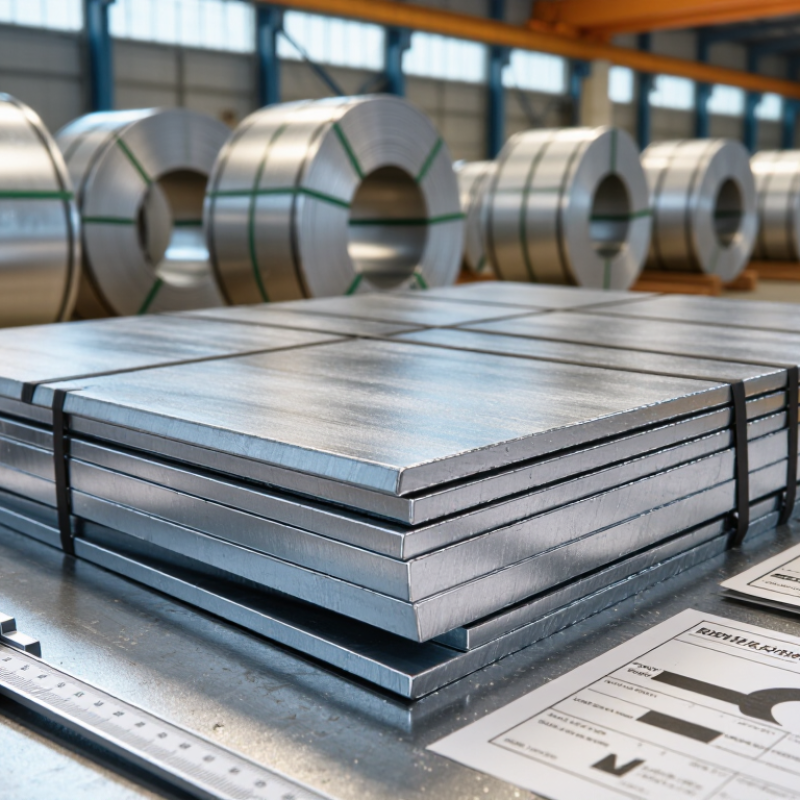
Global Galvanized Steel Plate Supply: 60–600 g/m² Zinc Coatings
Global Galvanized Steel Plate Supply: 60–600 g/m² Zinc Coatings
Global buyers often compare galvanized steel plates by zinc coating mass, not appearance alone. A range from 60 to 600 g/m² can change service life, forming behavior, and total cost. World Steel Association data reported approximately 1.89 billion tonnes of crude steel production in 2023, showing the scale behind this supply market. Yet, production volume does not guarantee coating consistency.
A 60 g/m² coating suits lighter indoor or low-corrosion applications. Heavier coatings near 275, 350, or 600 g/m² offer stronger protection for humid, industrial, or outdoor environments. Always confirm whether the value applies to both surfaces or one surface. This detail is often missed. ASTM A653 and ISO uniformity requirements can support technical checks, but buyers should request mill test certificates, coating measurements, and edge inspection records. In practice, surface scratches and cut edges may reduce real protection. This is where specifications need more thought.
Tips: Ask suppliers to state coating mass, steel grade, plate thickness, tolerance, testing method, and delivery condition. Compare salt-spray results carefully; they are useful, but they do not fully reproduce local weather. Request samples before large orders. A thicker zinc layer is not always better. It can affect bending, welding, and handling. For reliable sourcing, match the coating to exposure conditions, expected service life, and fabrication process.
| Zinc Coating Mass | Approx. ASTM A653 Designation | Typical EN 10346 Designation | Approx. Zinc Thickness* | Typical Base Steel Thickness | Common End Uses | Buyer Specification Priority |
|---|---|---|---|---|---|---|
| 60 g/m² | G20 | Z60 | ≈ 8.5 μm total | 0.30–1.20 mm | Indoor panels, light-duty profiles, low-corrosion environments | Surface finish and dimensional consistency |
| 100 g/m² | G30–G35 | Z100 | ≈ 14 μm total | 0.35–1.50 mm | General fabrication, ducting, indoor construction components | Coating uniformity and formability |
| 120 g/m² | G40 | Z120 | ≈ 17 μm total | 0.40–1.80 mm | Roofing accessories, wall panels, light structural parts | Bend performance and edge protection |
| 180 g/m² | G60 | Z180 | ≈ 25 μm total | 0.45–2.00 mm | Exterior cladding, roofing sheets, HVAC components | Outdoor corrosion resistance and cut-edge quality |
| 275 g/m² | G90 | Z275 | ≈ 38.5 μm total | 0.50–2.50 mm | Roofing and siding, framing members, agricultural buildings | Verified coating mass and structural grade |
| 350 g/m² | G115 | Z350 | ≈ 49 μm total | 0.60–2.50 mm | Coastal construction, utility components, demanding exterior applications | Salt exposure resistance and coating certification |
| 450 g/m² | G150 | Z450 | ≈ 63 μm total | 0.70–3.00 mm | Heavy-duty roofing, infrastructure components, industrial enclosures | Long service life and abrasion resistance |
| 600 g/m² | G200 | Z600 | ≈ 84 μm total | 0.80–3.00 mm | Severe atmospheric exposure, marine-adjacent and industrial applications | Maximum coating mass, traceability and testing |
| Technical note: Zinc coating mass is normally specified as the total coating on both surfaces. Approximate coating thickness is calculated using a zinc density of 7.14 g/cm³ and may vary by measurement method. ASTM A653 designations are expressed in oz/ft², while EN 10346 designations are expressed in g/m²; buyers should confirm the applicable standard, tolerance, steel grade, surface finish, dimensions and inspection requirements before ordering. | ||||||
