
Who Are the Top Combination Wrench Manufacturers in China?
A Combination Wrench looks simple: one open jaw, one ring, and a steel handle. Yet small differences matter. A jaw that sits squarely on a hex fastener can reduce slipping; a rough finish may signal uneven production control. For buyers comparing Chinese manufacturers, the challenge is separating reliable capability from polished catalog claims.
Quality expert W. Edwards Deming is often associated with the principle, “Quality is everyone’s responsibility.” Applied to wrench production, that means examining more than the final polish. Forging consistency, heat treatment, dimensional checks, and batch traceability all deserve attention. A bright chrome surface is easy to notice. Internal process discipline is harder to see.
This overview introduces leading Chinese Combination Wrench manufacturers and the evidence buyers should weigh. It considers product range, manufacturing experience, inspection practices, customization, and export support. These factors can help narrow a supplier shortlist, but they do not replace sample testing or direct verification. Rankings also have limits; public information may be incomplete, and factory capabilities can change. A careful buyer should ask for current specifications, inspection records, and clear answers about materials and tolerances. The details matter. One overlooked measurement can turn a promising quote into a poor fit on the workshop floor.
What Combination Wrenches Are and Where They Are Used
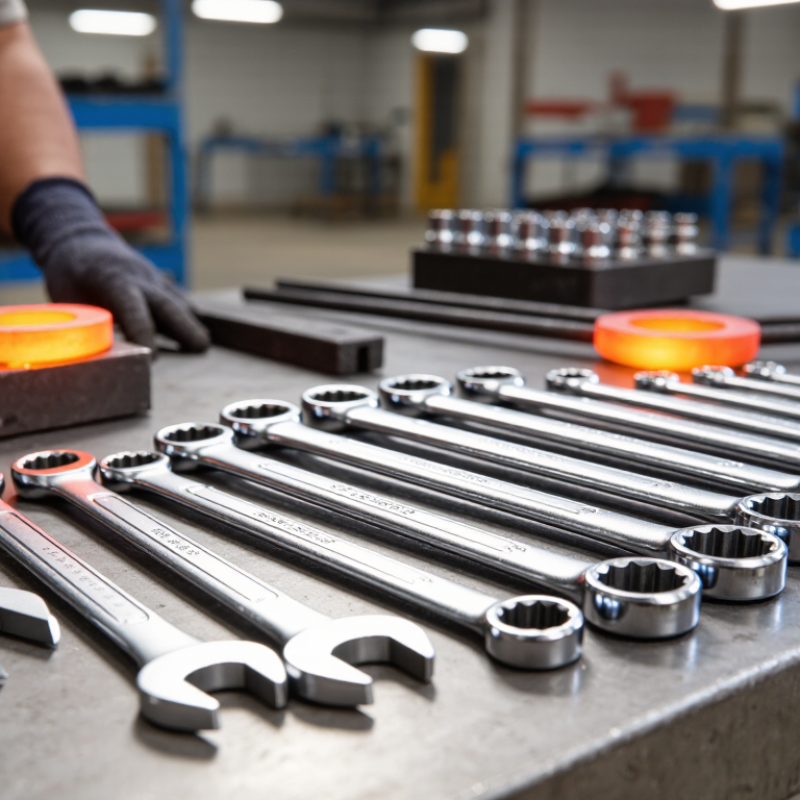
A combination wrench has an open jaw at one end and a closed box end at the other. Both ends usually fit the same size of nut or bolt. The open end slips on quickly, while the box end grips more sides of the fastener. This makes the tool useful for equipment assembly, vehicle maintenance, and household repairs. It is compact enough for a toolbox, yet sturdy models can handle many routine fastening jobs. Small details matter: a wrench that is slightly too large can round a nut’s corners.
Tips: Match the wrench size to the fastener before applying force. Keep the wrench square and fully seated. Pull steadily rather than jerking. If a bolt needs a precise tightening force, use a suitable torque wrench instead.
Combination wrenches work well where a socket and ratchet cannot fit easily, such as beside a bracket or inside a crowded engine compartment. The open end can help start a turn, then the box end can provide a firmer grip. Still, one wrench rarely solves every access problem. A nearby pipe or panel may block its swing, and forcing it can damage the fastener or your hand. Check the working space before choosing your tool.
