
China Top 10 Rubber Deflashing Machine Manufacturers
Choosing among China’s top 10 Rubber Deflashing Machine manufacturers is not just a price comparison. It is a process decision. A machine that works well for thick molded seals may struggle with thin, delicate components. Part geometry, rubber hardness, batch size, and acceptable surface finish all matter.
Rubber technologist John S. Dick’s published work offers a useful perspective. Editorial paraphrase, not a verified direct quotation: “Consistent results depend on controlling materials, process conditions, and inspection.” That distinction matters. No single machine suits every compound or part. Ask suppliers how they handle your actual components, not only standard samples. Request a trial using representative parts, then inspect edges under consistent lighting. Check cycle time, media or tooling requirements, operator workload, and maintenance access. Small details count. A hard-to-clean chamber can slow a busy shift. Unclear service arrangements can matter later.
This guide compares manufacturers through practical criteria: machine type, customization, production capacity, control features, quality documentation, and after-sales support. It also considers whether a supplier explains limitations plainly. That is not always easy to judge from a catalog. Treat rankings as a starting point, not a guarantee of fit. Before ordering, confirm specifications in writing and test the process against your own quality requirements. A careful comparison can reduce surprises, though it cannot replace a real production trial.
Understanding Rubber Deflashing Machines and Their Industrial Role
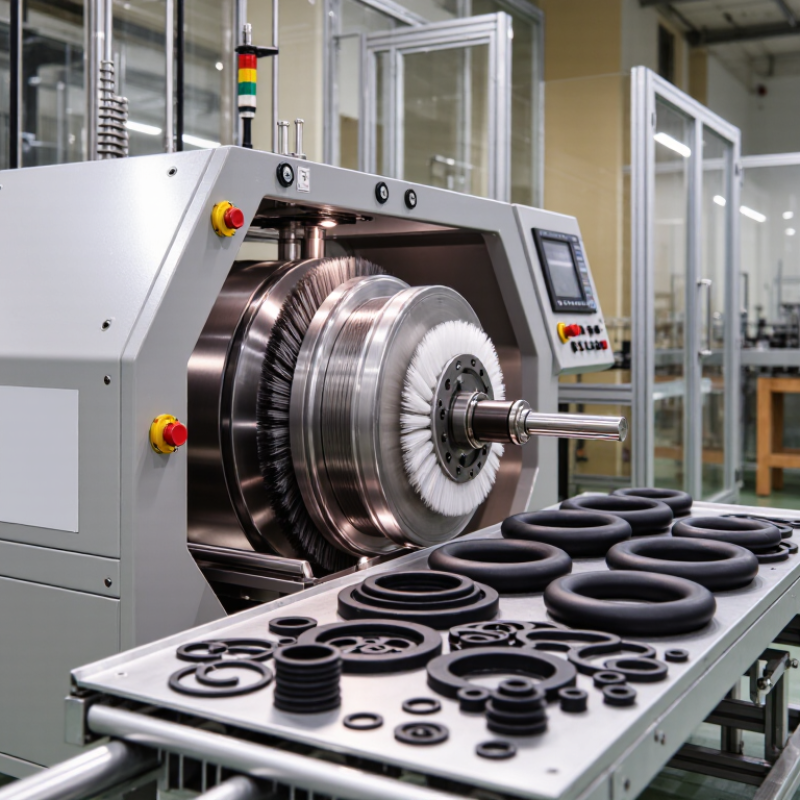
Rubber deflashing machines remove thin fins of excess material left along a molded part’s seam. These edges may look minor, but they can interfere with assembly, sealing, or a product’s fit. Depending on the rubber compound and part geometry, plants use methods such as mechanical trimming or cryogenic deflashing. The right choice depends on the part, not just the machine.
The industrial scale is substantial. The International Rubber Study Group’s World Rubber Industry Outlook 2024 estimated global rubber demand at roughly 30 million tonnes in 2023. Even small trimming inefficiencies can therefore matter across high-volume production. A well-set machine can reduce repetitive handwork and produce more consistent edges. Operators still need to check parts closely. Thin walls and tight corners can be damaged by excessive force or an unsuitable cycle.
A practical setup starts with a representative batch, not a catalogue promise. Technicians check flash thickness, part temperature, media, and cycle time, then inspect edges under good lighting. That detail matters. Deflashing is not magic; results vary with compound, mold condition, and part design. Some facilities also track rejected parts and rework, though the figures can be imperfect when teams record defects differently.
China Top 10 Rubber Deflashing Machine Manufacturers - Understanding Rubber Deflashing Machines and Their Industrial Role
The entries below describe ten common equipment specializations relevant to rubber deflashing. They are capability categories, not a ranked list of named manufacturers; actual machine specifications vary by supplier and application.
| No. | Equipment Specialization | Deflashing Method | Typical Parts and Materials | Industrial Role | Key Selection Consideration |
|---|---|---|---|---|---|
| 1 | Cryogenic batch systems | Parts are cooled, commonly with liquid nitrogen, so thin flash becomes brittle; tumbling or blasting then removes it. | Small-to-medium molded rubber parts, including seals, gaskets, and grommets. | Processes multiple parts in a batch while limiting manual trimming. | Confirm material response to low temperature, batch size, and the required surface finish. |
| 2 | Cryogenic continuous systems | Conveyor-fed parts pass through a controlled cryogenic cooling and deflashing process. | Parts produced in regular, repeatable production runs. | Supports higher-throughput operations with reduced batch handling. | Check line speed, part orientation, loading method, and compatibility with upstream and downstream equipment. |
| 3 | Rotary tumbling machines | Parts move against one another or against approved media in a rotating chamber to wear away flash. | Durable parts with shapes that can tolerate controlled part-to-part contact. | Offers a relatively simple mechanical route for bulk processing. | Evaluate the risk of part-to-part damage, media contamination, and uneven treatment of complex shapes. |
| 4 | Centrifugal finishing systems | Rotating barrels or chambers generate higher-energy movement than conventional low-speed tumbling. | Small, robust components that need consistent finishing in a contained process. | Can shorten processing cycles for suitable parts compared with gentler tumbling methods. | Validate that the force and contact pattern will not deform or mark the parts. |
| 5 | Abrasive or media-blasting systems | A controlled stream of suitable media strikes exposed flash and removes it from the part. | Parts with accessible flash lines and surfaces that can withstand the selected media. | Provides targeted removal and can be configured for manual or automated operation. | Match media type, impact energy, nozzle access, and dust collection to the compound and part geometry. |
| 6 | Automated trimming and robotic cells | Robots, fixtures, or programmed tools guide cutting or trimming along defined parting lines. | Parts requiring repeatable treatment of specific gates, edges, or flash locations. | Reduces repetitive manual work and supports consistent processing when parts can be located reliably. | Assess fixture design, tool access, cycle time, and the ability to accommodate part variation. |
| 7 | Seal and gasket processing systems | Deflashing is selected according to seal geometry, compound, and allowable edge condition; cryogenic and mechanical approaches are both used. | O-rings, molded seals, gaskets, and related elastomer components. | Removes excess flash that may affect assembly, appearance, or sealing performance. | Define acceptable edge quality and inspect critical sealing surfaces after processing. |
| 8 | Injection-molded rubber part systems | Batch or automated processes remove flash formed around mold parting lines and other exposed edges. | Injection-molded elastomer components with repeatable geometry. | Complements molding operations by preparing parts for inspection, assembly, or packing. | Consider mold condition, flash thickness, part geometry, and the production rate required. |
| 9 | Precision small-part systems | Controlled low-impact processing or carefully fixtured trimming targets fine flash on small components. | Small molded parts where dimensional consistency and surface condition are important. | Helps process components that may be difficult or slow to finish manually. | Test samples for dimensional change, residual flash, cleanliness, and part loss during handling. |
| 10 | Integrated custom production lines | Deflashing equipment is combined with part feeding, separation, inspection, or material handling. | Applications with defined process requirements and a stable production workflow. | Links finishing with adjacent operations to reduce manual transfer and improve process traceability. | Review controls, safety systems, changeover needs, maintenance access, and integration requirements. |
