
China Top 10 Industrial Ventilation Fan Manufacturers?
China’s industrial base supports a wide range of ventilation equipment manufacturers, from specialized workshops to large engineering groups. This article examines China’s Top 10 Industrial Ventilation Fan Manufacturers through practical and technical criteria. These include airflow performance, static pressure, motor efficiency, noise control, corrosion resistance, customization, testing capability, and after-sales support.
The need is substantial. The International Energy Agency reports that industry consumes approximately 37% of global final energy. Efficient fans can reduce avoidable electricity demand in factories, warehouses, tunnels, and process plants. Market studies from Grand View Research and Fortune Business Insights also indicate steady growth in industrial fan demand, supported by manufacturing expansion, energy-efficiency projects, and stricter indoor-air requirements. However, market estimates differ by product definition and research method. That matters.
A reliable supplier should provide performance curves, material specifications, motor data, and traceable quality records. On a factory floor, the difference may appear in simple details: stable airflow across a long duct, less vibration near a workstation, or a motor that withstands continuous operation. Relevant standards, including ISO quality systems and applicable IEC or GB requirements, should also be verified for each project.
This ranking is not absolute. Public information is uneven, and some manufacturers disclose more technical data than others. Therefore, the list combines documented capabilities, industry experience, product coverage, export presence, and customer-service evidence. Buyers should still request site-specific calculations and independent technical verification before placing an order. A powerful fan is not automatically an efficient fan.
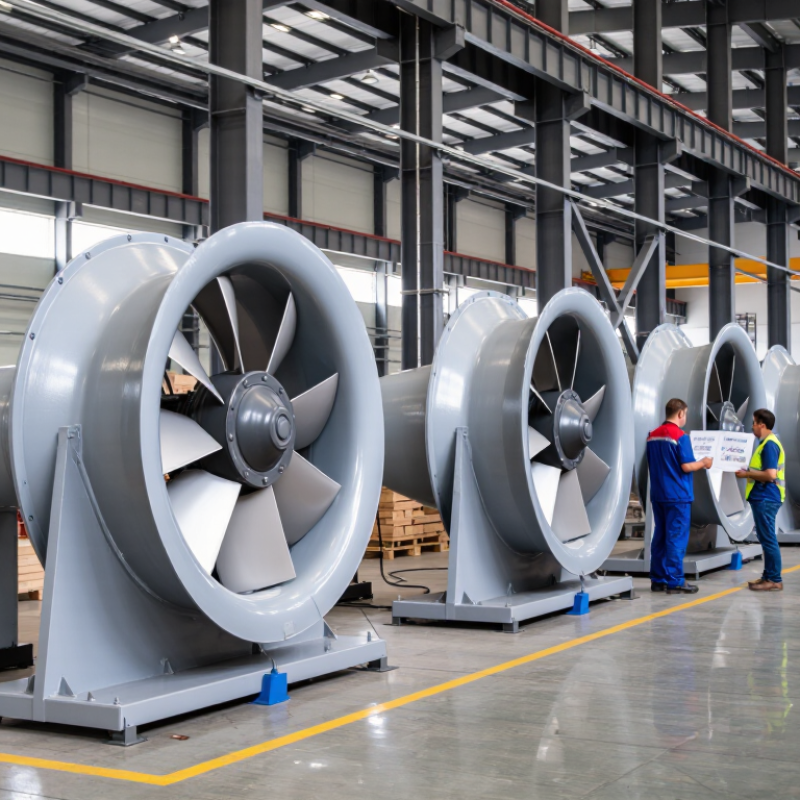
China’s Industrial Ventilation Fan Manufacturing Landscape
China’s industrial ventilation fan manufacturing landscape is broad, export-oriented, and technically diverse. The leading ten manufacturers are not always the largest factories. A reliable comparison should examine airflow performance, noise control, motor efficiency, corrosion resistance, and after-sales support.
Many Chinese producers operate through specialized manufacturing clusters. Their facilities commonly include sheet-metal workshops, impeller balancing equipment, motor assembly lines, and airflow testing rooms. Axial, centrifugal, roof, and explosion-resistant ventilation fans serve factories, warehouses, tunnels, and agricultural buildings. OEM and project-based production are also common. However, a polished catalog does not prove stable quality. I would check test records, material thickness, bearing sources, warranty terms, and delivery history before selecting a supplier.
Tips: Request performance curves at your required pressure and airflow. Confirm whether testing follows recognized standards. Ask for photos of balancing machines and finished inspections. Visit the factory when the project is important. A sample may perform well, while mass production varies. That uncomfortable possibility deserves attention. Talk with previous industrial customers, not only sales representatives. Compare lifecycle energy costs, spare-part availability, installation guidance, and response times. These practical details often separate dependable manufacturers from temporary market visibility.
China Top 10 Industrial Ventilation Fan Manufacturers? - China’s Industrial Ventilation Fan Manufacturing Landscape
This overview compares ten common industrial fan product segments found in the manufacturing landscape. It is a category guide, not a company ranking; no company or brand data is included.
| Product Segment | Typical Configuration | Common Applications | Key Design and Manufacturing Considerations | Typical Selection Checks |
|---|---|---|---|---|
| Axial-flow fans | Propeller-type impeller moves air mainly parallel to the shaft. | General ventilation, equipment cooling, and air movement through low-resistance systems. | Blade profile, diameter, rotational speed, casing, and motor arrangement. | Required airflow, available pressure, noise, installation space, and operating point. |
| Centrifugal fans | Impeller draws air near its center and discharges it radially through a casing. | Ventilation and process systems that require ducted airflow or higher resistance handling. | Impeller geometry, casing design, inlet arrangement, balancing, and drive configuration. | Airflow and pressure requirements, system resistance, efficiency, and service access. |
| Backward-curved centrifugal fans | Centrifugal impeller with blades curved opposite to the direction of rotation. | Air-handling systems, industrial exhaust, and applications requiring efficient airflow. | Blade angle, wheel strength, clearances, balance quality, and operating speed. | Duty point, efficiency across the operating range, motor load, and noise. |
| Forward-curved centrifugal fans | Centrifugal impeller with blades curved in the direction of rotation. | Compact ventilation units and systems designed for relatively high airflow at lower pressure. | Blade spacing, wheel construction, cleanliness of the air stream, and drive protection. | Airflow, static pressure, dust or contaminant levels, and maintenance needs. |
| Mixed-flow fans | Combines features of axial and centrifugal airflow paths. | Ducted ventilation where space is limited and more pressure is needed than a typical axial arrangement provides. | Impeller and guide-vane geometry, casing transitions, vibration, and motor cooling. | Duct resistance, airflow, available space, sound level, and installation orientation. |
| Roof exhaust fans | Roof-mounted units, commonly using axial or centrifugal fan arrangements. | Exhaust ventilation for factories, warehouses, and other large buildings. | Weather-resistant construction, roof curb compatibility, discharge design, and access for maintenance. | Required exhaust rate, roof opening, weather exposure, backdraft control, and noise. |
| Explosion-protected fans | Fan assemblies designed for specified hazardous-area conditions and protection requirements. | Ventilation in locations where flammable gases, vapours, or combustible dust may be present. | Applicable protection certification, motor and electrical components, materials, and installation controls. | Hazard classification, required certification, gas or dust group, temperature class, and local regulations. |
| High-temperature fans | Fans configured with temperature-suitable materials, components, and, where needed, cooling arrangements. | Hot-air exhaust, ovens, kilns, and other elevated-temperature processes. | Temperature limits for the complete assembly, thermal expansion, bearings, seals, and motor location. | Continuous and peak temperature, exposure duration, gas composition, and cooling requirements. |
| Corrosion-resistant fans | Fans made with corrosion-resistant materials or protective surface systems selected for the process. | Exhaust or supply air containing corrosive moisture, fumes, or chemical vapours. | Material compatibility, coating selection, joints, fasteners, drainage, and inspection access. | Chemical composition, concentration, temperature, moisture, and expected service conditions. |
| Dust-handling fans | Fans configured to handle air containing particulate matter; suitable designs depend on dust properties. | Dust extraction, material handling, and industrial process exhaust. | Particle size and abrasiveness, impeller wear, buildup prevention, cleanout access, and dust hazards. | Dust loading, particle characteristics, required conveying or extraction duty, and safety requirements. |
