
10 Tips for Choosing the Right Industrial Panel Hinge
Choosing the right Industrial Panel Hinge is a small decision with serious consequences. A poorly matched hinge can sag, bind, rattle, or expose a cabinet during maintenance. The problem often appears months after installation.
Industry demand is moving toward smarter, denser equipment. MarketsandMarkets’ Industrial Automation Market report, published in 2024, identifies expanding automation investment across factories, logistics, and process industries. More equipment means more enclosures, access panels, and repeated service cycles. Fortune Business Insights’ 2024 Industrial Enclosure Market analysis also highlights durability, protection, and modular access as continuing purchasing priorities.
“An enclosure hinge is a load-bearing part, not merely an accessory,” says Michael R. Wilson, an industrial enclosure hardware engineer. “Its geometry, material, and cycle rating must match the panel and its environment.” That principle deserves attention, although one quotation cannot replace testing.
This guide presents ten practical tips for choosing an Industrial Panel Hinge. It considers load capacity, opening angle, corrosion resistance, vibration, security, installation space, and maintenance access. It also examines concealed and lift-off designs, because appearance is not the only concern.
A stainless-steel hinge may suit a washdown area, while a zinc-plated model may perform better in a dry indoor cabinet. A heavy door needs more than confidence; it needs calculated support. Check the real panel weight, including locks, cables, and attached instruments.
Standards such as IEC 60529 and UL 50E can help frame enclosure protection decisions. Still, catalog ratings may not reflect every installation. Temperature, misalignment, and repeated impact can change performance. That is the uncomfortable part.
Field testing remains essential. Five minutes with a prototype may reveal what a specification sheet misses.
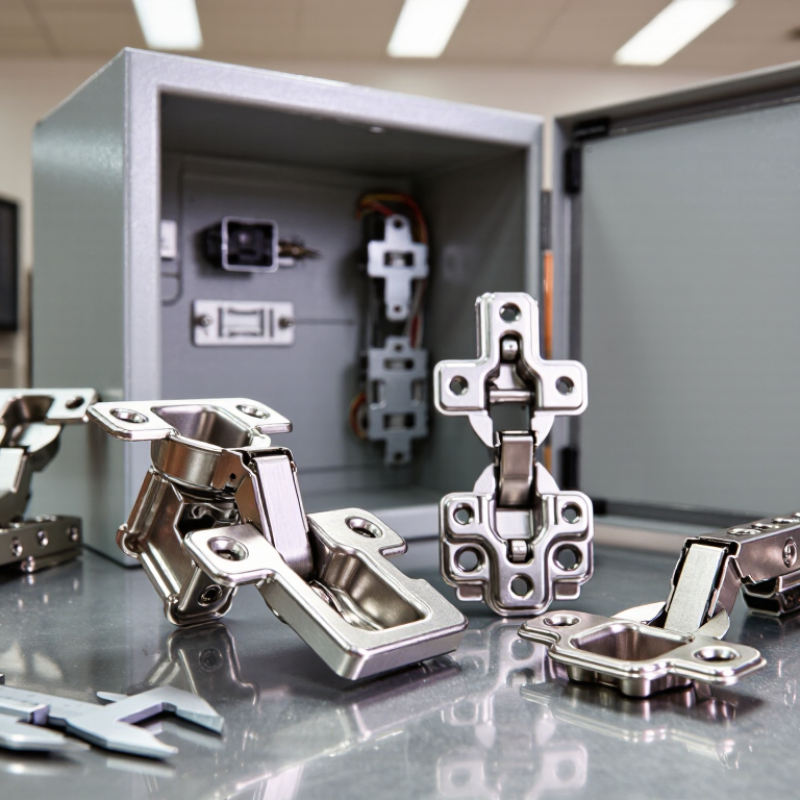
Understanding Industrial Panel Hinge Types and Applications
10 Tips for Choosing the Right Industrial Panel Hinge
Understanding hinge types matters more than copying a catalogue specification. Lift-off hinges suit panels removed during maintenance. Concealed hinges protect hardware inside compact electrical enclosures. Continuous piano hinges spread load along the panel edge. Friction hinges hold access doors at a chosen angle. Adjustable hinges help correct minor alignment changes after installation.
Each type serves a different application. Machine guards often need strong, exposed hinges and frequent opening cycles. Outdoor control cabinets need corrosion-resistant materials, sealed mounting areas, and careful gasket compression. For heavy doors, check load capacity, hinge spacing, opening angle, and fastener strength together. A hinge may carry the static weight but fail during vibration. That detail is easy to miss.
Grand View Research valued the global industrial automation market at about 233.3 billion dollars in 2023. Its forecast also indicates continued growth through 2030. This expansion increases demand for reliable cabinet access and machine protection hardware, although the report does not measure hinges directly. IEC 60529 remains a useful reference when enclosure ingress protection matters. In practice, a hinge can weaken the enclosure seal if its movement twists the gasket. I have seen that problem appear only after repeated testing. A perfect selection is rarely perfect in the first drawing. Clearance, cycle testing, and real installation feedback still deserve attention.
10 Tips for Choosing the Right Industrial Panel Hinge - Understanding Industrial Panel Hinge Types and Applications
| No. | Selection Tip | Hinge Type or Feature | Recommended Application | Important Specification | Typical Rating |
|---|---|---|---|---|---|
| 1 | Match the load capacity | Heavy-duty lift-off or continuous hinge | Large electrical cabinets, machine guards, and access doors with substantial panel weight | Calculate total door mass and account for its center of gravity. Use more than one hinge when required by the load. | Load-specific; verify manufacturer data |
| 2 | Check the available space | Concealed or compact hinge | Compact control boxes, flush-mounted panels, and enclosures installed close to walls or machinery | Review hinge envelope, mounting depth, knuckle clearance, and required door offset. | Application-dependent |
| 3 | Define the opening angle | Standard butt hinge or 180-degree hinge | Cabinet doors requiring normal access or full swing-away clearance | Confirm the actual opening angle, stop position, door interference, and adjacent equipment clearance. | Approximately 90°–180° |
| 4 | Consider maintenance needs | Lift-off hinge | Panels that must be removed frequently for inspection, servicing, or component replacement | Check whether the door can be lifted vertically without disturbing wiring, seals, or nearby components. | Removable door design |
| 5 | Choose suitable materials | Steel, stainless steel, aluminum, or zinc-alloy hinge | Industrial cabinets, outdoor enclosures, food-processing areas, and lightweight equipment panels | Match material strength and corrosion resistance to moisture, chemicals, temperature, and panel construction. | Environment-specific |
| 6 | Evaluate environmental exposure | Corrosion-resistant or sealed hinge | Outdoor control cabinets, washdown zones, coastal installations, and humid production areas | Review corrosion resistance, surface finish, operating temperature, and enclosure protection requirements. | Use the required IP/NEMA enclosure rating |
| 7 | Protect the enclosure seal | Offset, concealed, or gasket-compatible hinge | Dust-resistant, water-resistant, and electrically protected enclosures | Ensure hinge placement does not compress, cut, or obstruct the continuous door gasket. | Based on enclosure design |
| 8 | Review cycle life | High-cycle friction or bearing hinge | Operator access doors, production machinery, test equipment, and frequently opened service panels | Select a hinge tested for the expected number of opening cycles and operating load. | Specify tested cycle count |
| 9 | Confirm installation method | Weld-on, screw-mounted, rivet-mounted, or clip-in hinge | New enclosure fabrication, retrofit projects, removable covers, and sheet-metal assemblies | Check panel thickness, hole pattern, fastener access, welding requirements, and alignment tolerance. | Defined by panel construction |
| 10 | Address safety and security | Tamper-resistant or captive-pin hinge | Electrical control panels, guarded machinery, public-access equipment, and restricted service areas | Use compatible locks, captive hardware, guards, and safety interlocks where access control is required. | Risk-assessment dependent |
Note: Hinge load, cycle life, corrosion resistance, and enclosure protection ratings should be verified against the specific panel design, installation environment, and applicable safety requirements.
