
What Is a Super Intalox Saddle and How Does It Work?
Packed towers are used to bring gas and liquid into close contact during absorption, stripping, and scrubbing. Inside, the packing creates a wetted surface while leaving open paths for gas flow. The Super Intalox Saddle is a random packing shaped to support that contact. Its curved, open geometry helps distribute liquid and limit resistance to rising gas. Small details matter: liquid should spread across the pieces, not run through one narrow channel.
Koch-Glitsch’s technical literature describes Super Intalox Saddle as a high-performance tower packing. For broader context, the U.S. EPA’s Air Pollution Control Cost Manual discusses packed-bed scrubbers and the role of packing in gas-treatment equipment. The GPSA Engineering Data Book also provides established guidance on packed-tower design and operation. These sources help frame the engineering principles, but they do not guarantee a specific result for every tower.
Performance depends on more than packing shape. Gas and liquid rates, fluid properties, tower diameter, bed depth, and liquid distribution all affect capacity and pressure drop. Poor distribution can leave parts of the bed underused. That matters. This is why engineers check operating conditions and compare pressure-drop and mass-transfer requirements before selecting a packing. Supplier data are useful, but they are not a substitute for process-specific design. A closer look at how the Super Intalox Saddle works reveals both its practical advantages and its limits.
What a Super Intalox Saddle Is
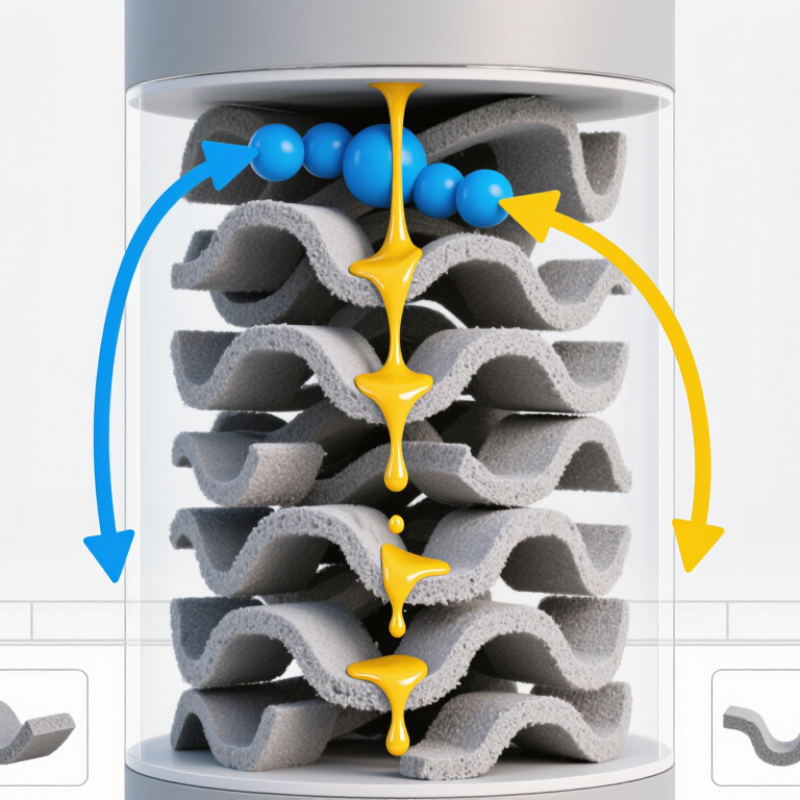
A Super Intalox saddle is a piece of random packing used inside a packed tower. Its curved, open shape creates surfaces where liquid can spread while vapor moves through the bed. Unlike a simple ring, the saddle has a contoured profile that helps reduce close stacking and leaves pathways for flow. The exact shape and performance vary by material and size.
In operation, liquid trickles over the packing and forms thin films on its surfaces. Rising vapor contacts those films, allowing heat or components to transfer between the two phases. It is not a filter, and it does not work alone: tower design, liquid distribution, and operating conditions all matter. A poorly distributed feed can leave parts of the bed nearly dry.
Tips: Check the material’s chemical and temperature compatibility before choosing a packing. Also inspect how evenly liquid reaches the bed. Small gaps or dry patches can affect performance. Even a well-designed saddle cannot fix every installation issue. Some field results are less tidy than the diagrams suggest.
