
How to Choose a Glass Machine Manufacturer in 2026?
Choosing a Glass Machine Manufacturer in 2026 is not just a matter of comparing prices or attractive catalog images. A glass tempering line, cutting table, or insulating-glass system must fit your product mix, floor space, staffing, and production targets. Small mismatches can become costly: a loading area may be too narrow, a control interface may slow new operators, or spare parts may take weeks to arrive. Details matter.
A credible supplier should explain machine capacity, tolerances, energy use, safety features, installation needs, and maintenance intervals in clear terms. Ask to see performance data from comparable installations, not only a demonstration video. References from plants with similar glass thicknesses and daily output can reveal how equipment performs after the first months. Check how training, commissioning, remote support, and warranty claims are handled. Promises are easy.
The strongest evaluation also looks beyond the machine itself. Review component brands, software updates, documentation, service response times, and wear-part availability. If possible, watch a live production run and inspect finished edges, cycle consistency, and operator access. Compare total ownership costs over several years, including power, consumables, downtime, and planned upgrades. A lower purchase price may not mean lower operating costs.
Still, no checklist removes every uncertainty. Your factory may change, and support quality can vary by region. Record assumptions, request written answers, and involve operators and maintenance staff before signing. The goal is not to find a perfect machine. It is to choose a manufacturer whose engineering and after-sales support fit your production conditions—and whose limitations are discussed openly.
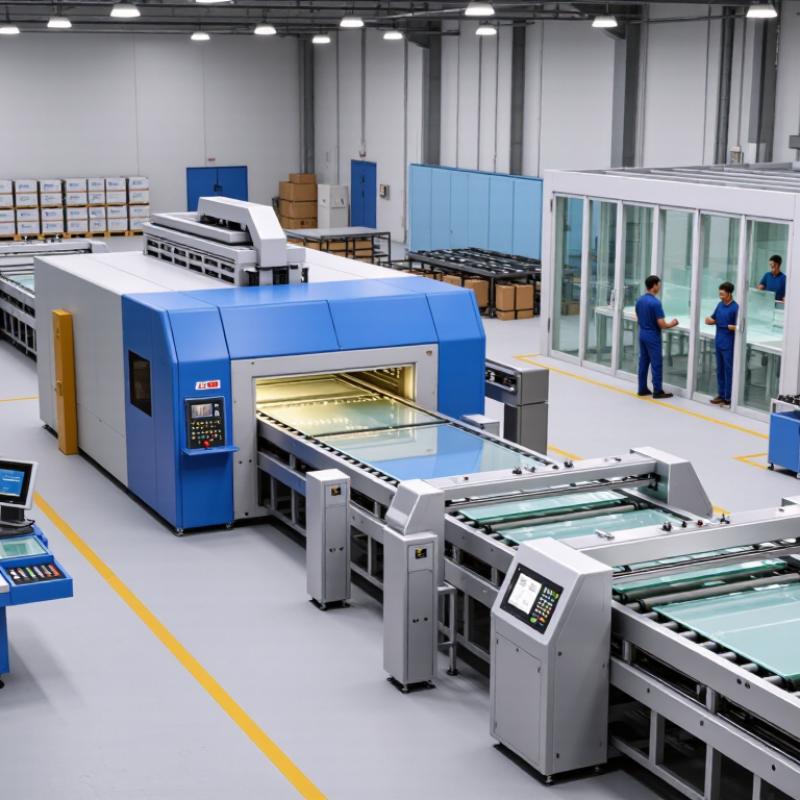
Define Your Glass Processing Needs and Production Requirements
Before comparing glass machine manufacturers, define the products and the work each line must perform. Will you cut architectural panels, drill appliance glass, or finish small custom batches? Record glass type, thickness range, maximum sheet size, edge profile, hole positions, and required tolerances. Include daily output and how often product sizes change. Small details matter. A 2-millimeter thickness variation can affect handling, tooling, and downstream fit.
Industry data can help frame the scale. Glass Alliance Europe’s 2022 industry figures report approximately 36 million tonnes of glass production in Europe in 2021, across several product segments. That diversity is a reminder: “glass processing” is not one standard duty. Ask manufacturers to demonstrate your actual product mix, not just a single fast cycle. Specify acceptable breakage rates, changeover time, operator skill, floor space, and available power and compressed air. The European Commission’s 2013 Glass BREF describes melting temperatures around 1,500°C; while that concerns furnaces, it underlines why upstream glass condition and thermal history matter to later processing. One assumption deserves checking: peak speed may look impressive, yet be less useful than stable output across a mixed shift. Keep some requirements provisional until sample runs expose what the specification missed.
How to Choose a Glass Machine Manufacturer in 2026? - Define Your Glass Processing Needs and Production Requirements
| Processing Need | Typical Products | Key Machine Requirements | Typical Material Range | Production Requirements to Define | Questions to Ask the Manufacturer |
|---|---|---|---|---|---|
| Glass cutting and optimization | Architectural panels, furniture glass, appliance components | Automatic cutting table, loading system, cutting bridge, break-out support, and optional shape cutting | Commonly 3–19 mm flat glass; confirm the machine’s supported sheet size and glass type | Sheets per shift, average part size, cutting pattern complexity, loading method, and required yield | What sheet sizes and thicknesses can it process? Can the software optimize cutting patterns and export production data? |
| Edge grinding and polishing | Shower enclosures, shelves, doors, furniture panels | Straight-line or shape edging machine matched to the required edge finish and workpiece geometry | Thickness capability varies by machine; many production models handle approximately 3–25 mm | Edge type, panel dimensions, number of edges, finish quality, cycle time, and operator handling | Which edge profiles can be produced? What are the minimum workpiece dimensions and achievable finish? |
| Glass drilling and machining | Hardware-ready doors, partitions, balustrades, and fittings | Single- or double-sided drilling system, with optional milling, notching, or CNC machining | Confirm supported thickness, hole diameter, glass size, and minimum distance between holes and edges | Hole count per panel, hole-position tolerances, tool-change frequency, and mix of product designs | Can the machine process the required hole patterns and shapes? How are positioning accuracy and breakage controlled? |
| Glass tempering | Safety glazing for buildings, doors, showers, and appliances | Horizontal tempering furnace sized for the largest panels and required heating, quenching, and cooling performance | Many lines process approximately 4–19 mm glass; minimum and maximum sizes depend on the furnace design | Daily output by thickness and size, product mix, allowable distortion, energy supply, and operating schedule | What output is achievable for our actual product mix? What are the utility requirements and applicable safety-glass standards? |
| Laminated glass production | Safety glazing, skylights, canopies, and acoustic glazing | Glass washing and assembly equipment, interlayer handling, pre-pressing, and an autoclave or other qualified processing system | Configurations may include common builds such as 3+3 mm or 6+6 mm; confirm total thickness and interlayer compatibility | Panel size, laminate build-up, interlayer type, batch size, cycle time, and traceability requirements | Which interlayers and laminate constructions are supported? What validated process controls and quality records are provided? |
| Insulating glass unit assembly | Double- or triple-glazed units for windows and façades | Glass washing, spacer application, assembly, pressing, and sealing equipment appropriate to the chosen unit design | Define pane dimensions, cavity width, total unit thickness, spacer type, and any special gas-filling requirements | Units per shift, maximum unit size, product mix, sealant process, and required inspection or data capture | Which unit constructions can the line handle? How are washing quality, spacer placement, sealing, and gas filling verified? |
| Integrated production line | Mixed architectural or commercial glass products processed across multiple stages | Linked machines, conveyors, buffers, controls, and production software designed around the factory layout | Set requirements for every process, including glass type, thickness, dimensions, and finished-product tolerances | Target throughput, bottleneck process, shifts per day, floor space, staffing, expansion plans, and material flow | Can the supplier provide a documented line layout, capacity assumptions, installation plan, operator training, and after-sales support? |
Note: Material ranges and production capacity are indicative planning references, not guaranteed specifications. Confirm performance against your actual glass type, dimensions, product mix, quality standards, and operating conditions before purchase.
