
How Does an EDI Water System Work?
An Edi Water System turns pretreated feedwater into high-purity water using electricity, ion-exchange resin, and selective membranes. The EDI Water System Working Principle is straightforward: dissolved ions migrate through membranes under a direct-current field, while resin helps transport them. The result is a continuous polishing process, usually installed after reverse osmosis. No chemical regeneration is normally needed. The details matter.
Why does this technology attract attention? The Semiconductor Industry Association reported that global semiconductor sales reached $627.6 billion in 2024. Semiconductor manufacturing depends on tightly controlled ultrapure water for rinsing wafers and protecting sensitive processes. ASTM D5127-13(2021), a guide for ultrapure water used in electronics and semiconductor industries, also reflects how demanding these applications can be. Pharmaceutical and power-generation facilities use high-purity water too, though their required specifications differ.
This article explains the main components, water flow, ion removal, and operating conditions behind EDI. It also examines how feedwater quality, recovery, and monitoring affect performance. A small conductivity change can signal a process problem. EDI is not magic, though. It cannot compensate for poor pretreatment, incorrect system design, or neglected maintenance. Understanding the operating principle helps readers assess where the technology fits—and where it may fall short.
What an EDI Water System Is and Where It Fits in Water Treatment
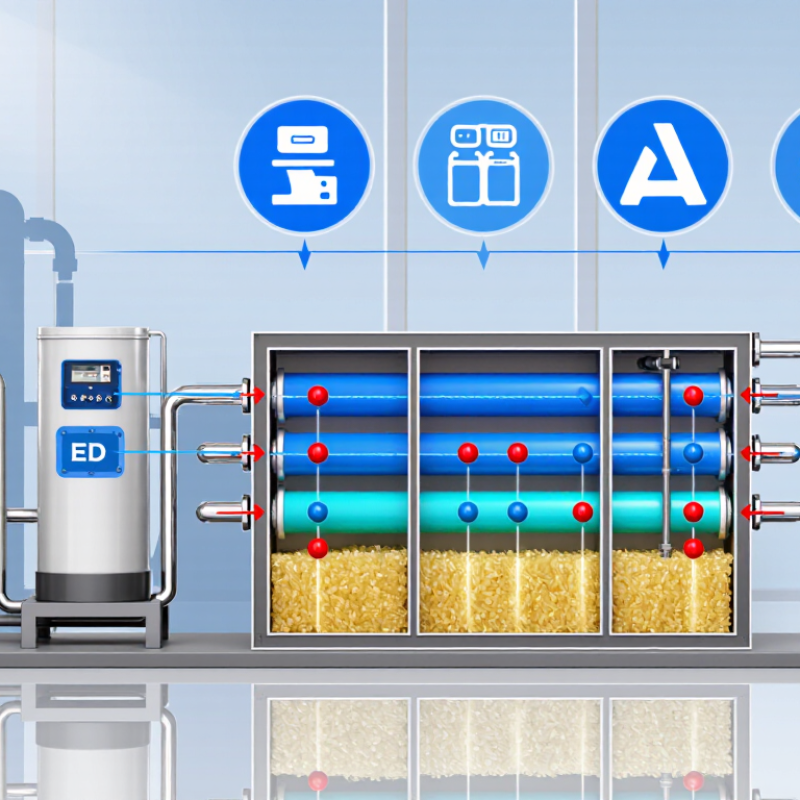
An EDI water system uses ion-exchange resin, selective membranes, and direct current to remove dissolved ions from water. In a typical high-purity treatment train, it sits after reverse osmosis (RO), not in place of it. RO removes most dissolved salts; EDI polishes the remaining ions and continuously regenerates its resin electrically. No acid or caustic is normally needed for resin regeneration within the EDI unit.
That is the polishing stage. Feed quality matters: changes in hardness, carbon dioxide, or silica can affect performance, so operators monitor conductivity and product-water resistivity. EDI does not remove every contaminant, and it is not a substitute for suitable pretreatment.
The U.S. Geological Survey estimated total U.S. water withdrawals at 322 billion gallons per day in 2015, including 14.8 billion gallons per day for industrial use (USGS Circular 1441, Estimated Use of Water in the United States in 2015). Those figures describe water use, not EDI output.
Still, they underline why industrial systems must track both water quality and losses. A practical design also checks the RO permeate, EDI concentrate, and storage loop; a tidy equipment diagram can hide real operating variation.
