
What Is Float Glass and What Is It Used For?
Float Glass is the flat, clear glass found in many windows, shopfronts, and building facades. Its name comes from a manufacturing method: molten glass flows onto a bath of molten tin, where it spreads into a smooth, even ribbon. The glass does not mix with the tin. As it cools and passes through a controlled annealing process, it becomes stable enough to cut and further process. The result is practical. Sheets can be made with consistent thickness and relatively smooth surfaces, qualities that matter when glazing must fit precise frames.
Float glass is used in homes, offices, commercial buildings, and many interior applications. It can remain clear, or receive coatings that help manage sunlight, heat, or privacy. Manufacturers also process it into products such as mirrors, laminated glass, and tempered glass. These are not interchangeable terms: ordinary float glass is not automatically safety glass, and its suitability depends on the application and any required testing. That distinction matters. A large pane beside a doorway, for example, may need different performance from a small decorative shelf. Float Glass offers a versatile starting point, but selection should account for thickness, coatings, edge finish, and intended use. Specifications can be easy to overlook. Even a visually flawless sheet may not meet a project’s needs unless its properties are checked carefully.
What Is Float Glass?
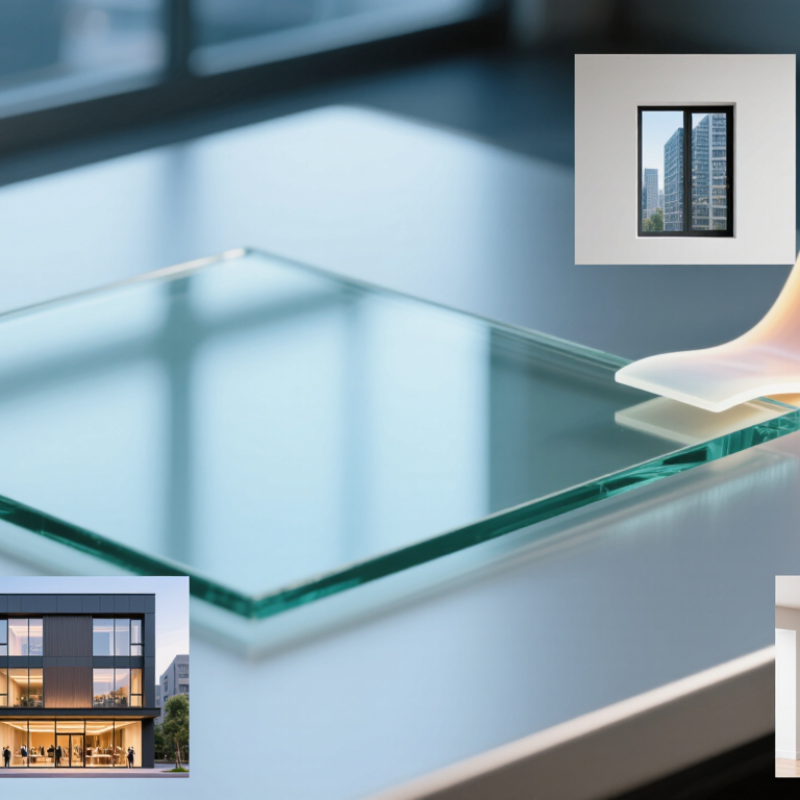
Float glass is flat glass made by letting molten glass flow onto a bath of molten tin. The glass spreads across the surface and forms a smooth, level ribbon. It then cools gradually in a controlled chamber, which helps reduce internal stress before the sheet is cut. The result is glass with nearly parallel faces and a fairly even thickness. That is the key. Compared with some older forming methods, it usually requires little surface grinding for ordinary sheet applications.
The term describes how the glass is made, not a special safety feature. Clear and tinted sheets can both be produced this way. Float glass is widely used as a starting material for building windows, shopfronts, furniture panels, and mirrors. It may look simple, but its surface quality and thickness consistency matter when sheets are cut or processed. Ordinary float glass is not automatically tempered or laminated; those treatments change how it behaves when damaged. A useful detail to keep in mind: “smooth” does not mean unbreakable. The name can sound more reassuring than it should.
What Is Float Glass and What Is It Used For? - What Is Float Glass?
| Aspect | Details | Common Uses or Notes |
|---|---|---|
| What float glass is | A flat glass made by floating molten glass on a bath of molten tin. The process produces a smooth, uniform sheet with parallel surfaces. | It is a widely used starting material for architectural and other flat-glass products. |
| Typical composition | Most Clear Float Glass is soda-lime-silica glass, made primarily from silica, soda ash, and limestone, with other ingredients used to control melting and finished properties. | Composition can vary by product, including for tinted or specialty glass. |
| Manufacturing process | Molten glass flows onto molten tin, spreads into a continuous ribbon, and is gradually cooled in a controlled annealing lehr before being cut to size. | The tin bath creates the glass’s flat faces; controlled cooling helps reduce internal stresses. |
| Common thicknesses | Float glass is produced in a range of thicknesses. Common building-glass options include approximately 3 mm, 4 mm, 6 mm, 8 mm, and 10 mm; availability depends on the producer and application. | Thickness is selected according to size, loading, safety requirements, and whether the glass will be processed or assembled into a unit. |
| Appearance and light | Clear float glass is transparent, although a slight green tint may be visible, especially at exposed edges. Light transmission depends on thickness, tint, and any coatings. | Low-iron and coated products are available when different appearance or light-control properties are needed. |
| Windows and façades | Float glass can be used as a pane or processed into products for windows, doors, and building façades. | For overhead, impact-prone, or other safety-critical locations, the specified glazing must meet applicable safety and building-code requirements. |
| Safety glass | Float glass can be heat-treated into fully tempered glass or incorporated into laminated glass. These products are not interchangeable and behave differently when broken. | Tempered glass breaks into small pieces; laminated glass is held together by an interlayer when cracked. |
| Insulating glass units | Two or more glass panes can be assembled with a sealed space between them to form an insulating glass unit. | Used in many building windows to reduce heat transfer compared with a single pane; performance depends on the complete unit’s design. |
| Mirrors and interiors | Flat float glass can be coated to make mirrors or cut and finished for interior applications. | Examples include furniture tops, shelves, partitions, and decorative panels, subject to suitable thickness and safety treatment. |
| Processing options | Depending on the glass type and intended use, float glass can be cut, edge-finished, drilled, coated, laminated, or heat-treated. | Some processes must be completed before tempering; the required sequence should be confirmed with the fabricator. |
| Important limitation | Ordinary annealed float glass is not automatically safety glass and can break into large, sharp pieces. | Select glazing based on its location, expected loads, human-impact risk, and applicable local codes. |
