
What Is Drone Jamming and Why Is It Regulated?
Drone Jamming describes the use of radio-frequency interference to disrupt communication between a drone and its controller, or to affect navigation signals. The term sounds simple. The consequences are not. A drone may lose a control link, behave unpredictably, or affect nearby communications. That is why jamming is treated as a safety and spectrum-management issue, not merely a security tool.
The FAA’s Aerospace Forecast FY 2024–2044 tracks the expanding role of uncrewed aircraft in U.S. airspace. The Government Accountability Office’s review of counter-drone technologies also examines agency authorities and coordination challenges. Together, these reports show why any response must account for aircraft, people, and radio users beyond the immediate scene. GNSS-security researcher Dr. Todd Humphreys has highlighted a related concern: radio interference can affect systems beyond its intended target. That risk is easy to underestimate.
Rules vary by country, but in the United States, transmitting devices and interference are subject to federal restrictions; private use of jammers is generally prohibited. Authorized agencies may have specific powers under applicable law. This introduction is not legal advice. The practical question is not only whether a drone can be stopped, but who is legally authorized to act and what else could be disrupted. The boundary is not always intuitive. That deserves careful attention.
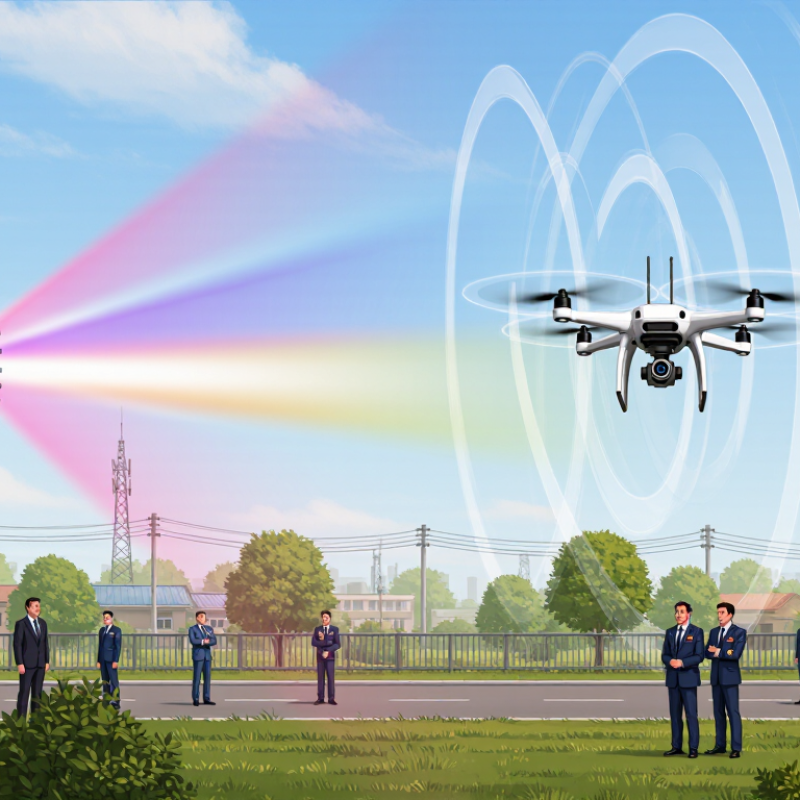
Drone Jamming Defined: How Radio-Frequency Interference Disrupts Drones
Drone jamming is radio-frequency interference intended to prevent a drone from receiving or exchanging essential signals. Those signals may carry control commands, location data, or status information between the aircraft and its operator. In practical terms, a drone may stop responding, lose a reliable navigation reference, or enter a programmed failsafe. Effects vary. No outcome is guaranteed. The result depends on the drone’s design, surroundings, and backup systems.
The word “jamming” can sound simple, but the behavior is not always predictable. A drone might hover, land, return, or drift, depending on its configuration and conditions. Buildings, terrain, and other radio traffic can also affect communications, so a sudden connection loss does not by itself prove deliberate interference. That distinction matters when assessing an incident. A careful account should separate observed symptoms from assumptions about their cause.
Radio links support more than convenience; they can help maintain safe separation from people, aircraft, and infrastructure. Interference may therefore create risks beyond the drone itself. For this reason, authorities regulate radio transmissions and restrict interference devices in many places. Rules differ by jurisdiction, and authorized testing generally requires appropriate oversight. Even a controlled experiment can affect nearby systems. A seemingly small signal can have a wider footprint than expected.
