
Why Choose an EV Charger Type 2 for Global Use?
Why Choose an EV Charger Type 2 for Global Use?
As electric vehicles cross borders, charging compatibility becomes more than a technical detail. It affects travel plans, installation costs, and everyday confidence. The Ev Charger Type 2 has become a familiar solution across Europe and many international markets. Its seven-pin design supports both single-phase and three-phase AC charging. A commuter may plug in at home overnight, while a hotel guest can recharge beside a busy highway.
Claas Bracklo, a long-time charging-industry specialist and CharIN board member, states, “Interoperability is the key to confidence.” This idea explains the growing appeal of the Ev Charger Type 2. Drivers need equipment that communicates reliably with different vehicles, buildings, and energy systems. Type 2 charging also supports practical features, including load management, scheduled charging, and solar integration. These functions can reduce pressure on a property’s electrical supply.
It is not perfect.
Connector availability still varies by region. Charging speed depends on the vehicle, cable, power supply, and local installation. A Type 2 socket alone cannot guarantee fast charging. That detail is easy to overlook. Buyers should check vehicle specifications, grid capacity, safety certification, and installer experience before choosing equipment. Real-world reliability comes from the complete charging system, not one connector.
For global use, the Ev Charger Type 2 offers a strong balance of compatibility, flexibility, and proven adoption. Its value is practical rather than flashy. It helps make charging feel ordinary. That may be its greatest strength.
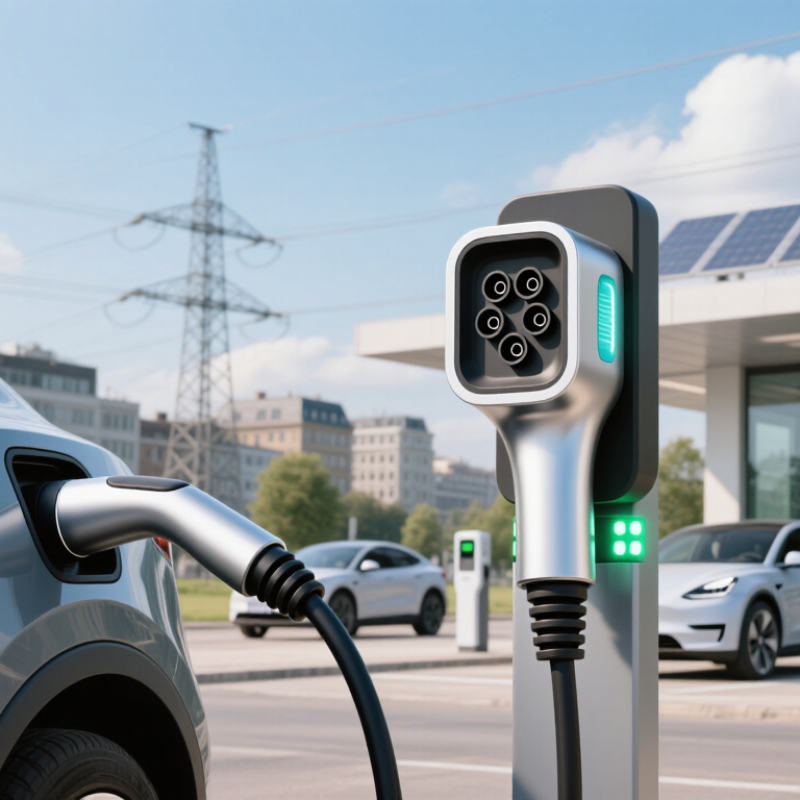
What Is an EV Charger Type 2?
An EV Charger Type 2 is an alternating-current connector defined by the IEC 62196-2 standard. It is common across Europe and several other charging markets. The connector usually has seven pins. These support power delivery, protective grounding, and communication between the vehicle and charger.
In practical use, Type 2 charging works with single-phase or three-phase electricity. A home installation may deliver around 3.7 to 7.4 kilowatts on single-phase power. Suitable three-phase equipment can provide higher output, depending on the vehicle and local supply. The vehicle controls the charging rate. It does not simply accept every available kilowatt.
That distinction matters.
During site checks, I have found that people often confuse the Type 2 connector with the complete charging system. The connector is only one part. A wall-mounted unit, portable cable, protective devices, and a compatible vehicle also affect charging performance. Type 2 commonly includes a locking mechanism and communication signals, which help prevent unsafe disconnection while power flows.
It is useful for global travel, but “global” needs careful interpretation. Electrical systems, plug ends, installation rules, and public charging networks differ by country. A Type 2 vehicle may need a certified cable or approved adapter elsewhere. Not every adapter is suitable for high current. Checking the vehicle manual, charger rating, socket condition, and local electrical requirements remains essential. I still think the term “universal” is too generous; compatibility is practical, not automatic.
Why Choose an EV Charger Type 2 for Global Use? - What Is an EV Charger Type 2?
| Data Dimension | Verified Information |
|---|---|
| Definition | An EV Charger Type 2 is an alternating-current (AC) charging interface defined primarily by the IEC 62196-2 standard. It is also commonly known as the Mennekes-style connector, although no brand reference is required for its technical definition. |
| Primary charging function | Type 2 supplies AC electricity to the vehicle. The vehicle's onboard charger converts AC power into DC power for the traction battery. |
| Connector design | The standard Type 2 AC connector has seven contacts: three phase contacts, one neutral contact, one protective earth contact, and two signal contacts for control and proximity functions. |
| Typical voltage | Common operating values are approximately 230 V for single-phase charging and approximately 400 V between phases for three-phase charging. Actual voltage depends on the local electrical grid. |
| Typical charging current | Residential AC charging commonly operates at 16 A or 32 A. Higher-current Type 2 installations are possible when the vehicle, cable, charger, and electrical supply are all rated accordingly. |
| Common charging power | Typical AC power levels include about 3.7 kW at 230 V and 16 A single-phase, 7.4 kW at 230 V and 32 A single-phase, 11 kW at 400 V and 16 A three-phase, and 22 kW at 400 V and 32 A three-phase. |
| Maximum practical power | Although some Type 2 systems can be rated for higher current, 22 kW is a widely used upper level for everyday public and commercial AC charging. The vehicle's onboard charger may accept less. |
| Communication method | Type 2 AC charging uses signaling between the vehicle and the charging equipment through the control pilot and proximity functions. These signals help manage charging readiness, current limits, and connector status. |
| Common charging mode | Mode 3 is the normal configuration for dedicated AC charging stations. It provides controlled charging through built-in protection and communication equipment. |
| Cable options | Type 2 charging may use a tethered cable permanently attached to the station or a detachable Mode 3 cable supplied by the user. Cable current capacity must match the charging system. |
| Regional adoption | Type 2 is widely used for AC charging across Europe and is also found in many international markets that align with IEC-based charging practices. It is not the universal AC connector in every country. |
| Global-use advantage | Its broad international adoption, single-phase and three-phase capability, standardized signaling, and availability in multiple power levels make Type 2 a practical choice for cross-border AC charging applications. |
| Safety features | A compliant installation normally includes protective earth monitoring, residual-current protection, overcurrent protection, temperature control where applicable, and charging-current negotiation before energy delivery. |
| Weather resistance | Outdoor suitability depends on the specific enclosure and installation rating. A Type 2 connector alone does not guarantee resistance to water, dust, impact, or extreme temperatures. |
| Charging-speed limitation | Charging speed is limited by the lowest-rated component among the vehicle's onboard charger, the charging station, the cable, the circuit, and the available grid capacity. |
| Type 2 versus DC charging | A standard Type 2 connection is intended for AC charging. High-power DC charging requires a separate DC charging interface or a combined connector system designed for that purpose. |
| Vehicle compatibility check | Before installation or travel, verify the vehicle inlet, permitted phase count, maximum AC current, maximum AC power, local voltage, connector configuration, and applicable national regulations. |
| Best-fit applications | Type 2 is well suited to home charging, workplaces, hotels, apartment buildings, destination charging, fleet depots, and public AC charging where vehicles remain parked for several hours. |
Note: Charging values are representative nominal figures. Final performance depends on the vehicle, electrical installation, local standards, cable rating, and charging-station configuration.
