
How to Choose a Tunnel Kiln in 2026
In 2026, choosing a Tunnel Kiln means balancing product quality, production targets, energy use, and maintenance demands. The International Energy Agency’s Energy Efficiency 2023 report estimates that industry used about 37% of global final energy in 2022. That figure is not a kiln benchmark, but it shows why firing efficiency deserves careful attention. The U.S. Department of Energy’s Industrial Decarbonization Roadmap also identifies process heat and energy efficiency as important industrial priorities. Buyers should therefore compare real operating data, not rely only on a supplier’s headline capacity or fuel-consumption claim.
Start with the product and production line. Record the ware dimensions, clay or ceramic body, required firing temperature, daily output, and acceptable reject rate. Then ask for the kiln’s temperature-uniformity data, firing-curve controls, fuel options, refractory specifications, and expected maintenance intervals. A fast line can still disappoint if the firing profile causes uneven color or weak pieces. Small details matter. Check how trays move through the kiln, where operators inspect burners, and how quickly routine repairs can be completed. Request references from plants making comparable products, plus measured consumption under similar operating conditions. A site visit helps. Still, no brochure can replace a careful review of your own fuel prices, utilities, layout, and staffing. Those assumptions are easy to overlook, and they can change the economics. The right Tunnel Kiln is not simply the largest or newest model; it is the one whose verified performance fits the plant’s products and operating realities.
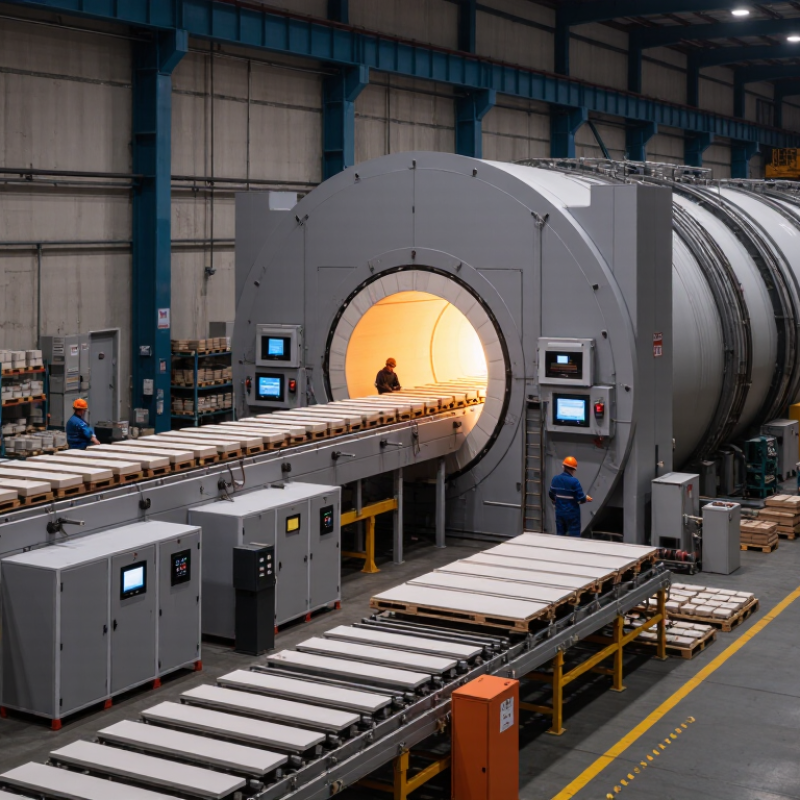
Define Production Requirements and Material Characteristics
A tunnel kiln should be sized around the product, not a catalogue capacity. Define daily output, operating hours, product dimensions, and acceptable variation before comparing designs. For ceramic products, the European Commission’s 2007 Ceramic Manufacturing BREF reports firing ranges that differ by product: roughly 800–1,200°C for bricks and 1,000–1,300°C for wall and floor tiles. These are broad reference ranges, not a firing recipe. Confirm the actual heatwork with test pieces.
Material behaviour matters just as much. Record moisture, shrinkage, thermal expansion, and sensitivity to rapid heating or cooling. A damp green body may crack; a tightly packed load may develop uneven temperatures. Include kiln furniture and spacing when calculating usable width and height. Small details matter. The U.S. Department of Energy’s process-heating guidance estimates that heating accounts for about half of manufacturing energy use, so compare fuel use at your expected load and schedule—not only at rated capacity. Ask for temperature-uniformity data across the loaded kiln. That part is easy to overlook. I would also test representative samples at the proposed cycle; laboratory results do not always predict a full production load.
