
Why Choose the Right Solar Cell Carrier for Your Business?
Solar manufacturing is scaling quickly, and small handling decisions now carry significant financial weight. IEA PVPS reported that global photovoltaic capacity exceeded 1.6 terawatts by the end of 2023. Behind that figure are production lines moving delicate cells through repeated loading, inspection, and transfer steps. A suitable Solar Cell Carrier helps protect cells from vibration, edge contact, and contamination while keeping the process consistent. It is not just a tray.
The right carrier can support higher throughput, fewer handling-related defects, and smoother integration with automated equipment. Fraunhofer ISE’s Photovoltaics Report documents silicon’s dominant role in today’s solar-cell market, making careful handling of thin silicon wafers especially relevant. Yet there is no universal carrier. Cell dimensions, line speed, cleaning methods, and equipment interfaces all affect the choice. A carrier that performs well in one factory may cause jams or extra changeovers in another. That detail is easy to overlook.
For business buyers, the decision should rest on measurable evidence: breakage rates, cycle time, particle control, service life, and compatibility trials using actual production conditions. Ask suppliers for test methods and operating data, not only a catalogue specification. Even then, results may vary between lines. That is worth admitting. Choosing well is less about buying the most advanced-looking carrier and more about finding one that protects product quality without slowing production.
What Is a Solar Cell Carrier and What Role Does It Serve?
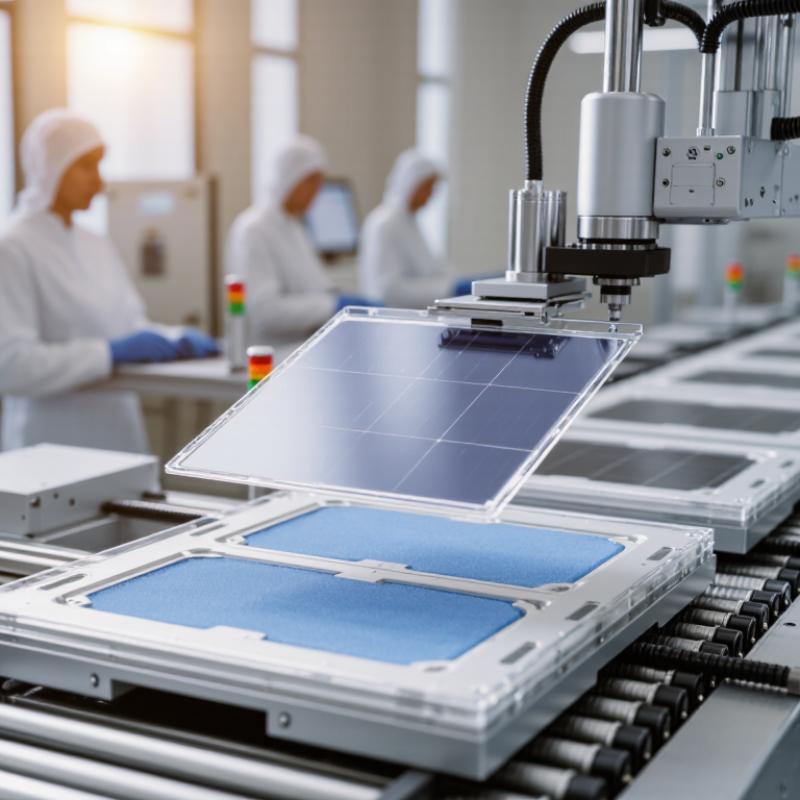
A solar cell carrier is a reusable tray, cassette, or magazine that holds cells as they move between manufacturing steps. It keeps fragile wafers separated, aligned, and easier for operators or automated equipment to handle. Think of thin cells resting in narrow slots, ready for inspection, cleaning, or processing. Small part. Big consequence. Poor fit or worn contact points can lead to scratches, chips, contamination, or machine stoppages. The carrier must suit the cell dimensions and the demands of each process, including exposure to heat or chemicals where relevant.
Its importance grows with production scale. IRENA’s Renewable Capacity Statistics 2024 reports that global solar capacity reached 1,419 GW in 2023, after 346 GW of additions that year. This figure describes deployment, not factory handling losses, but it shows why reliable, repeatable production matters. A suitable carrier helps maintain orderly transfers and supports consistent equipment loading; it cannot, by itself, guarantee higher yields. In practice, teams should check slot spacing, cell movement, cleaning needs, and compatibility with existing tools. One detail is easy to miss: a carrier that protects cells well may still slow loading if operators find it awkward. Testing it on the actual line is wiser than relying on specifications alone.
