
How to Choose a Motorcycle Assembly Line?
Choosing a Motorcycle Assembly Line is a production decision, not merely an equipment purchase. The right system must match product design, output targets, workforce skills, and available floor space. A line that looks efficient in a showroom may create delays beside your actual warehouse. That detail matters. This guide explains how to compare line layouts, station balance, tooling, testing, maintenance, and supplier support. It also considers worker safety, quality control, energy use, and applicable manufacturing standards.
Experienced production teams begin with demand forecasts and takt time, then verify every assumption. They measure frame movement, fastening points, inspection steps, and material travel before approving equipment. A practical assessment should include sample builds, operator trials, noise checks, and emergency-stop verification. Ask suppliers for documented accuracy, service response times, spare-parts plans, and installation references. Reliable vendors explain limitations clearly. Be cautious with impressive speed figures. They may exclude changeovers, inspections, training, or minor stoppages.
The best choice often balances automation with human judgment. Full automation can improve consistency, yet it may increase cost and maintenance complexity. Manual stations can offer flexibility, but they demand disciplined training and inspection. Your decision should reflect current production and realistic growth, not optimistic projections. I have seen evaluations weaken when teams ignore lighting, ergonomics, or rework space. Those omissions become expensive later. Use measurable criteria and invite engineering, quality, maintenance, and operators into the review. A thoughtful selection process reduces operational surprises and supports dependable motorcycle production.
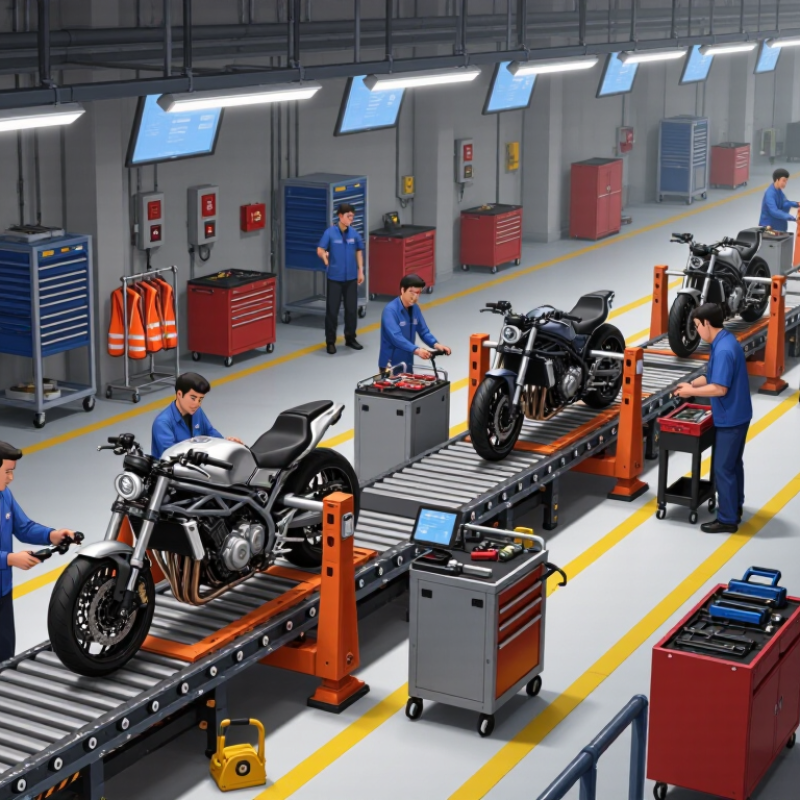
Define Production Requirements and Motorcycle Assembly Goals
How to Choose a Motorcycle Assembly Line: Define Production Requirements and Motorcycle Assembly Goals
A suitable assembly line begins with measurable production requirements. Define annual volume, shift patterns, motorcycle variants, quality targets, and available floor space.
For example, 480 motorcycles per eight-hour shift require a 60-second takt time before losses. At 90% line availability, the practical target falls near 54 seconds. That number affects conveyor speed, workstation balance, staffing, and buffer size. It also exposes weak assumptions early.
Market direction matters. The International Energy Agency reported that global electric two- and three-wheeler sales exceeded 10 million units in 2023, with most sales in China. Grand View Research estimated the global motorcycle market at USD 106.8 billion in 2022. These figures suggest growing variety, not simply higher volume. A line designed for one engine layout may struggle with battery packs, wiring checks, or different frame dimensions.
Set assembly goals beyond output. Specify first-pass yield, torque traceability, rework limits, changeover time, and operator safety. A practical target might include 98% first-pass yield and digital records for every critical fastener.
Yet perfect plans rarely survive the factory floor. I have seen efficient lines lose time because parts arrived in mixed bins. Leave room for model changes, training, and unexpected stoppages. A smaller, flexible line may outperform a faster line that cannot adapt.
