How to Choose the Right MCCB Circuit Breaker?
Choosing the right MCCB Circuit Breaker starts with the circuit, not the catalog. A breaker that fits the panel may still be wrong for the load. Check the system voltage, continuous current, available fault current, and the equipment’s starting behavior. A motor that draws a sharp inrush current can trip a poorly matched breaker. So can a fault level beyond the breaker’s interrupting capacity.
“Match the breaker to the real fault conditions, not just the normal load,” says Alex Chen, an electrical-protection specialist. This practical selection principle captures an important point: current rating alone is not enough. Compare the breaker’s rated current and interrupting capacity with the installation’s requirements. Review its trip characteristics, pole configuration, and coordination with upstream and downstream protective devices. Check the manufacturer’s data, too. Small details matter.
There is no universal best MCCB Circuit Breaker. A factory feeder, a pump circuit, and a commercial distribution panel may need different settings and protection. Ambient temperature and enclosure conditions can also affect performance. Even careful calculations have limits; the final choice should be checked against the actual installation and applicable technical requirements. This guide explains the key ratings, selection steps, and common mistakes. One point deserves extra care: never assume a higher current rating means better protection.
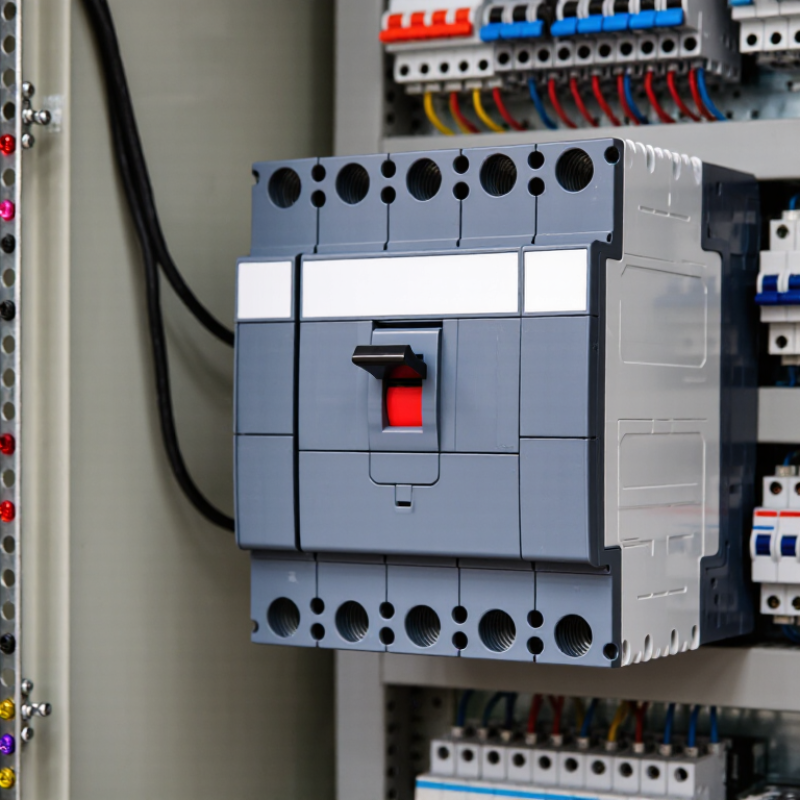
Check System Voltage: IEC 60947-2 Covers Up to 1,000 V AC / 1,500 V DC
Choosing an MCCB starts with the system voltage, not the largest number on a product label. IEC 60947-2 covers circuit breakers rated up to 1,000 V AC or 1,500 V DC. These are scope limits, not proof that any breaker will suit every circuit within them. Check the breaker’s rated operational voltage against the voltage it will actually interrupt.
For AC, confirm whether the stated system voltage is line-to-line or line-to-neutral. For DC, read the manufacturer’s rating carefully: interrupting capacity can depend on pole connections and the voltage across each pole. DC arcs do not benefit from the natural current zero found in AC circuits. Details matter. A rating at 250 V DC, for example, cannot be assumed to apply at 500 V DC.
Voltage is only one part of the selection. Compare the breaker’s short-circuit rating with the prospective fault current at the installation point, and check frequency, insulation rating, and environmental conditions. A useful habit is to match the nameplate and technical data sheet to the site’s single-line diagram. This check can feel tedious, and diagrams are not always current. Verify uncertain values with a qualified electrical professional before specifying the MCCB.
How to Choose the Right MCCB Circuit Breaker?
Check that the breaker’s rated voltage is suitable for your system. IEC 60947-2 covers circuit breakers rated up to 1,000 V AC or 1,500 V DC.
These values indicate the standard’s voltage coverage limits, not a recommended operating voltage. Always check the breaker’s rated voltage and suitability for the specific installation.
Size Rated Current: NEC 210.20(A) Uses 125% of Continuous Load
For an MCCB circuit breaker, size the rated current around the actual load—not just the equipment’s nameplate maximum. NEC 210.20(A) requires branch-circuit overcurrent protection rated for at least 125% of the continuous load, plus 100% of any noncontinuous load. A continuous load is generally one expected to run for three hours or more.
For example, a 32 A continuous load requires 40 A of overcurrent protection before other loads are included. Add a 12 A noncontinuous load, and the calculated minimum becomes 52 A. Choose an available breaker rating at or above that figure, where permitted, and verify conductor ampacity and equipment limits. A breaker that looks adequate on paper can still be mismatched to its wiring or operating conditions. Check the applicable NEC edition and local requirements, too.
Tips: Record which loads run for three hours or longer. Recheck the calculation against the breaker terminals, conductor size, and enclosure temperature. Small details matter. I’ve seen a tidy load estimate overlook a heater that stays on through an entire shift; that is an easy assumption to miss.
How to Choose the Right MCCB Circuit Breaker? — Size Rated Current: NEC 210.20(A) Uses 125% of Continuous Load | Example Load | Continuous Load | Noncontinuous Load | Minimum OCPD Calculation | Illustrative Standard MCCB Rating |
| Lighting circuit | 16 A | 8 A | (16 A × 125%) + 8 A = 28 A | 30 A, if permitted by the applicable code and conductor ampacity |
| Continuous process load | 24 A | 0 A | 24 A × 125% = 30 A | 30 A |
| Mixed equipment load | 32 A | 8 A | (32 A × 125%) + 8 A = 48 A | 50 A, if permitted by the applicable code and conductor ampacity |
| Continuous equipment load | 40 A | 0 A | 40 A × 125% = 50 A | 50 A |
| Mixed building load | 48 A | 12 A | (48 A × 125%) + 12 A = 72 A | 70 A is below the calculated minimum; consider the next suitable standard rating, such as 80 A, only if permitted by the applicable code and conductor ampacity |
| Important: NEC 210.20(A) generally requires an overcurrent device rating of at least the noncontinuous load plus 125% of the continuous load. A 100%-rated assembly listed for operation at 100% of its rating may be subject to a different sizing allowance. These examples are illustrative, not installation instructions. Confirm the adopted code edition, load classification, conductor ampacity, equipment listing, voltage, poles, interrupting rating, and applicable equipment-specific requirements before selecting an MCCB. A larger breaker must not be used unless permitted by the applicable code and compatible with the conductors and equipment. |
Match Icu to Prospective Fault Current; Check Ics Under IEC 60947-2
An MCCB should be selected against the fault current it may actually face, not just its normal load. Estimate the prospective short-circuit current at the breaker’s installation point. Transformer impedance, cable length, and the upstream supply all affect that figure. Then check that the breaker’s Icu, or ultimate short-circuit breaking capacity, meets or exceeds it at the stated operating voltage. Small details matter.
Ics is different. Under IEC 60947-2, it indicates the service short-circuit breaking capacity: the current the breaker can interrupt under specified test conditions and remain suitable for continued service. Ics is commonly stated as a percentage of Icu, so compare the actual ratings, not only the headline Icu number. A higher Ics can matter where an interruption should not leave equipment needing immediate replacement. Check the manufacturer’s declared value for the exact voltage and configuration.
Do the calculation carefully. A fault-current estimate based only on a transformer label may miss cable effects or changes to the supply. That estimate can be wrong. When the result is close to the breaker’s Icu, have a qualified engineer verify the network data and calculation. Also confirm coordination with upstream protective devices; a suitable breaking capacity alone does not guarantee selective protection. Use the installation’s actual conditions, not a convenient assumption.
Select Trip Settings and Coordination: IEC 60947-2 Defines Categories A and B
Choosing an MCCB is not only about matching its current rating to the cable. Trip settings must also protect equipment while allowing downstream breakers to clear local faults first. IEC 60947-2 distinguishes Category A and Category B breakers for this coordination. Category A has no intentional short-circuit delay for selectivity. Category B supports a short-time delay and specifies short-time withstand capability, helping upstream protection wait while a downstream device trips. That matters.
Set long-time pickup and delay to suit the protected cable and expected load. Then check short-time and instantaneous settings against the downstream breaker’s time-current curve. For Category B, confirm the breaker’s rated short-time withstand current and permitted delay exceed the prospective fault conditions. A coordination study should use actual fault-current values at each panel, not just nominal ratings. A few millimetres of busbar and cable impedance can change the result.
Risk deserves attention. NFPA’s 2019 Home Electrical Fires report estimated that electrical distribution and lighting equipment were involved in about 10% of U.S. home fires from 2012 to 2016. That figure is not a direct measure of MCCB performance, but it reinforces the value of sound protection design. Check settings against manufacturer-independent test data where available, verify selectivity across the full fault range, and document the final values on the panel schedule. In practice, the neat curve is not the whole story; motor starts and ambient heat can complicate it.
Verify Poles, Enclosure Rating, and Manufacturer Derating Data
Choosing an MCCB starts with the circuit, not the product label. Match the pole count to the supply and switching requirements: a three-phase circuit may need three poles, while some systems require a switched neutral and four poles. Confirm this against the equipment design.
More poles do not automatically mean better protection. Check the voltage and available fault current, too. Then inspect the enclosure rating for the actual installation. A dry indoor panel and a dusty, damp utility room do not present the same conditions. Compare the stated IP or NEMA rating with the site exposure, and account for the enclosure’s effect on heat buildup. Small details matter. Read the manufacturer’s derating data for ambient temperature, altitude, and closely mounted devices. A breaker rated for a certain current may need a lower usable setting in a hot enclosure. Check the specific table or curve; do not rely on a generic rule of thumb. This part is easy to rush, and field conditions rarely match a neat catalog example. Record the selected rating and the assumptions behind it, so another reviewer can verify the choice.

