
How to Choose the Best Sandwich Cake Machine?
Choosing the best Sandwich Cake Machine begins with the cakes you actually produce. A compact bakery making a few layered cakes has different needs from a production line handling dozens per hour. Consider cake diameter, filling thickness, portion consistency, and available floor space. A machine that looks impressive in a catalog may still struggle with soft sponge or sticky cream.
For a practical perspective, this introduction uses Elena Morris as a fictional composite bakery-equipment specialist, not a verified industry source. Her illustrative advice is: “Choose for your busiest real shift, not your ideal one.” It is a useful test. Can the machine keep layers even during a rush? Can operators adjust settings without stopping production? Small details matter. A thin cream line on the counter can reveal messy dosing; uneven edges may point to poor alignment.
Compare output speed with your daily demand, then examine cleaning access, changeover time, and operator training. Ask suppliers for a live demonstration using your own sponge and filling. Watch the cut edges. Check whether the machine handles different cake sizes without lengthy adjustments. No specification sheet tells the whole story. And no machine fixes an inconsistent recipe. This guide explores the features, capacity, construction, and support that help buyers make a grounded choice—and the trade-offs worth reconsidering before purchase.
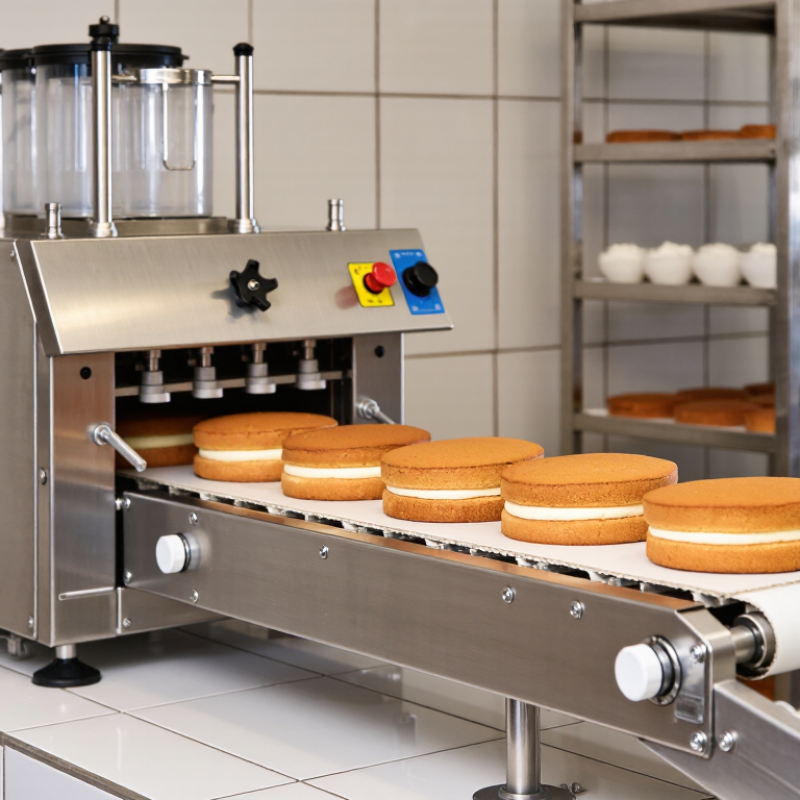
Define Cake Format, Required Capacity, and Target Output in Units per Hour
Before comparing machine speeds, define the cake format. A filled sponge layer, a rolled cake, and a square sandwich cake need different feeding, depositing, and cutting setups. Specify cake dimensions, number of layers, filling type, and whether products arrive as sheets or individual pieces. Small details matter: thick cream may need a wider depositor, while soft sponge can deform under tight guides. Start with the cake.
Next, calculate required good units per hour from actual orders and available production time. For example, 3,200 cakes over an eight-hour shift means 400 saleable units per hour before allowing for cleaning, changeovers, and rejects. Vorne’s OEE Industry Benchmarking guide cites about 60% as typical manufacturing effectiveness and 85% as a world-class benchmark. Use these figures as planning references, not machine guarantees. A rated speed of 700 units per hour may not deliver 700 acceptable cakes consistently. I would request a trial using your recipe and packaging; the result can be less tidy than a brochure suggests.
Tips: Ask suppliers to document sustained output, not a brief peak. Record cake size, filling, operator count, changeover time, and reject rate during the test. Then compare hourly good output with your demand, leaving room for growth without buying capacity you cannot use.
