
How to Choose the Best Carpet Cutter in 2026?
Choosing the right Carpet Cutter in 2026 is less about buying the biggest blade and more about matching the tool to the job. Grand View Research estimated the global carpet and rugs market at USD 51.71 billion in 2023, with continued growth projected through 2030. That market estimate does not measure cutter sales, but it reflects the scale of flooring work where accurate trimming matters. A poor cut can leave frayed backing, uneven edges, or wasted material.
The Carpet and Rug Institute’s professional installation guidance emphasizes careful fitting and finishing. On site, that can mean trimming dense pile along a straightedge, shaping carpet around a door jamb, or making repeated cuts without tiring your hand. Small details matter. Blade access, grip, visibility, and compatibility with replacement blades can affect both speed and control. A cutter that feels solid in a showroom may still be awkward after several hours on the floor.
This guide compares cutter types, blade designs, safety features, and value for different users, from occasional DIY installers to flooring professionals. It also considers practical trade-offs, not just specifications. I would not claim one model suits every carpet or every hand. That is easy to overlook. Use the comparisons to identify a tool that fits your materials, workload, and budget, then verify its instructions before cutting.
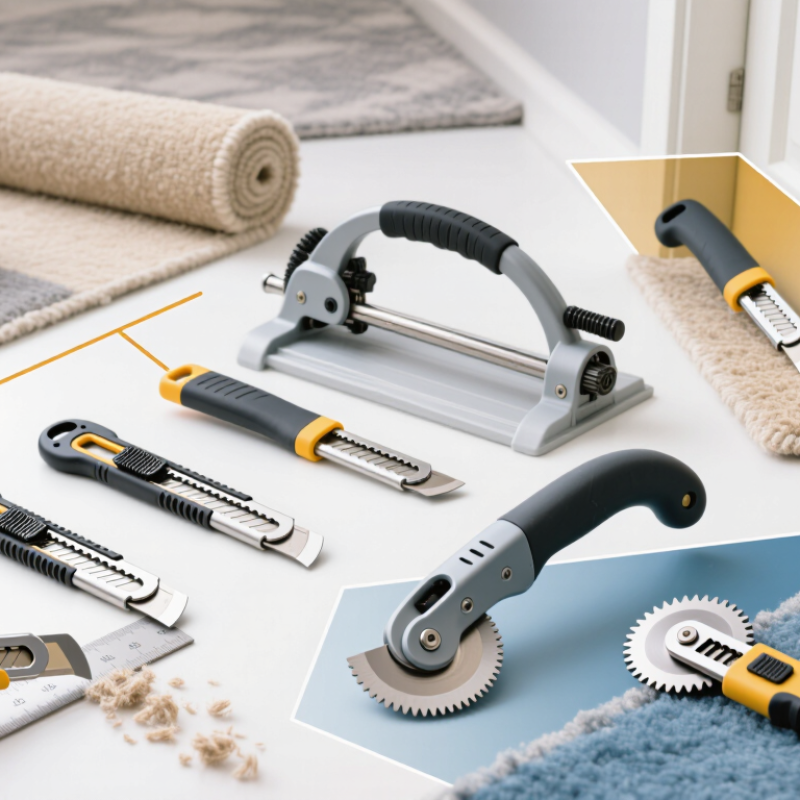
Identify Your Carpet Type and Cutting Requirements
Before choosing a carpet cutter, identify the carpet’s construction. Low-pile, tightly woven carpet usually needs a sharp utility knife and a firm straightedge. Thick plush carpet can compress under pressure, so make a shallow test cut before cutting through the backing. Loop-pile carpet needs extra care: a blade that catches a loop may pull or unravel the surface. Feel the backing. A stiff, dense backing may need several controlled passes rather than one hard push.
Also check what lies beneath the carpet. Cutting carpet and underlay together can dull a blade quickly and make the cut wander. If possible, lift an edge and separate the layers. Measure the cut length, mark the backing, and work from the back where the material allows it. Small details matter. On a stair tread, for example, a slightly uneven edge can remain visible at the corner.
Match the cutter to the job. Long, straight room cuts call for a comfortable handle and a blade that stays stable against a guide. Tight corners or curved cuts need a smaller, controllable tool. Replace a blade when it begins dragging or fraying the backing; forcing a dull edge is rarely more precise. I would not assume one cutter suits every carpet. A short test on an offcut can reveal how the pile and backing behave before the full cut.
