
How to Choose a Solar PV Hybrid Inverter in 2026?
Choosing a Solar Pv Hybrid Inverter in 2026 means matching real household needs to measurable equipment limits. The IEA’s Renewables 2024 report estimated that solar PV would account for nearly 550 GW of the almost 700 GW of renewable capacity added worldwide that year. That scale matters: buyers face more models, but specifications can still hide important differences.
“Solar is now the cheapest electricity in history,” IEA Executive Director Fatih Birol said in 2020. His statement concerned solar power economics, not inverter performance. Still, lower panel costs make the inverter’s role in storing and delivering energy more visible. Compare continuous and peak output, battery compatibility, MPPT inputs, backup transfer time, and efficiency under partial load. Check the actual datasheet, not just the brochure. A 10 kW label does not guarantee 10 kW of backup power.
Look closely. A hybrid inverter may not support every battery, or provide whole-home backup during an outage. The IEA’s Renewables 2024 analysis also highlights solar PV’s central role in future renewable growth, but global forecasts cannot predict your roof’s output. Shade from one chimney can change the numbers. Ask an experienced installer to model seasonal production, evening demand, and battery reserve settings. Compare warranty terms and local service access, too. One detail is easy to miss: compatible equipment on paper may still require specific firmware or configuration. The right choice is rarely the largest unit. It is the one that fits your loads, storage plans, and site conditions—with assumptions you can verify.
Understand How a Solar PV Hybrid Inverter Works
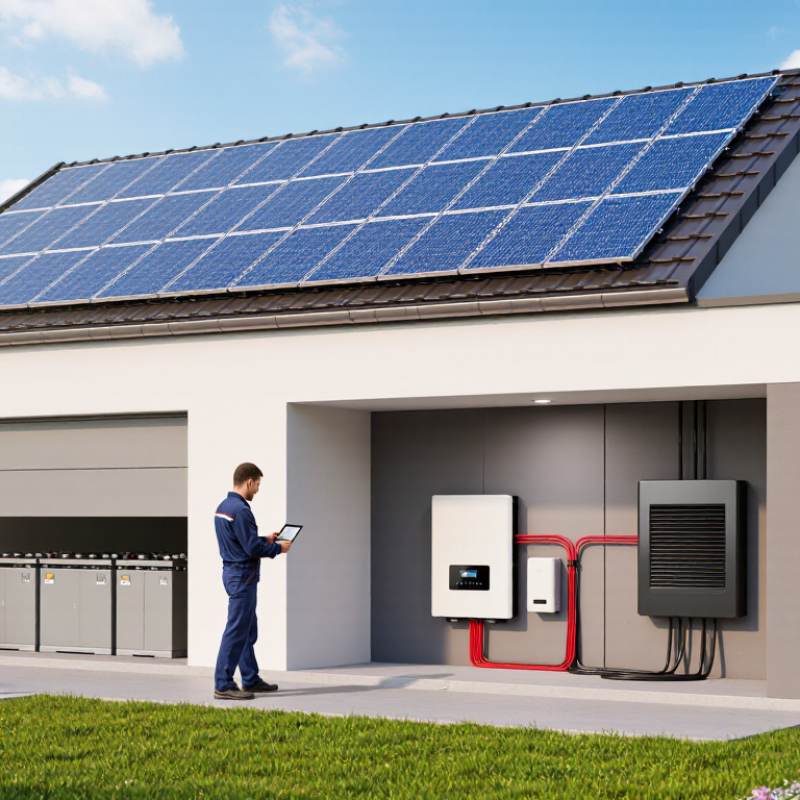
A solar PV hybrid inverter manages electricity from panels, a battery, the grid, and household loads. It converts the panels’ direct current into alternating current for appliances. When sunlight exceeds demand, the inverter can send surplus power to a battery or the grid, depending on system settings. After sunset, it can convert stored battery power for household use. The catch? A hybrid inverter does not automatically guarantee backup during an outage. Backup depends on compatible battery equipment, isolation controls, and the inverter’s rated output.
The scale of solar makes these operating details increasingly relevant. IEA PVPS’s Trends in Photovoltaic Applications 2024 reports that global solar capacity exceeded 1.6 terawatts by the end of 2023. When comparing units, check battery charging limits, conversion efficiency, and continuous and peak output.
For example, a refrigerator may draw modest power while running, yet need more briefly when its compressor starts. That short surge can matter. Also ask whether backup covers selected circuits or the entire home; those are different design choices. A clean specification sheet can still leave this unclear. In practice, matching the inverter to the battery, panel voltage range, and real household loads takes more than choosing the highest wattage.
