How to Choose an Electric Motor for Your Project in 2026?
Choosing an electric motor in 2026 starts with the machine’s real job, not a catalog headline. Will it drive a conveyor, pump, fan, or mobile mechanism? Each load behaves differently. A pump may need steady torque, while a conveyor can face sudden starts and changing weight. Small details matter.
A practical paraphrase of electric-motor author Austin Hughes’s selection guidance is: “Match the motor and drive to the load’s actual operating conditions, not just its rated power.” That distinction can prevent poor performance. It also keeps the Electric Motor Project grounded in measurable needs rather than assumptions. Record the required speed, starting torque, duty cycle, supply voltage, available space, and expected ambient temperature. Check whether the application needs speed control, frequent starts, or resistance to dust and moisture. Those details can change the motor type, control method, and total cost.
This guide examines how to compare motor technologies, read nameplate data, and assess efficiency alongside purchase price. It also considers controls, installation limits, maintenance access, and likely operating hours. A high-efficiency motor may not be the right choice if the load profile or drive system is misunderstood. That is easy to miss. I have seen project plans treat rated power as the whole answer; it is not. Use the sections ahead as a practical checklist, then confirm critical selections with current manufacturer data and a qualified engineer.
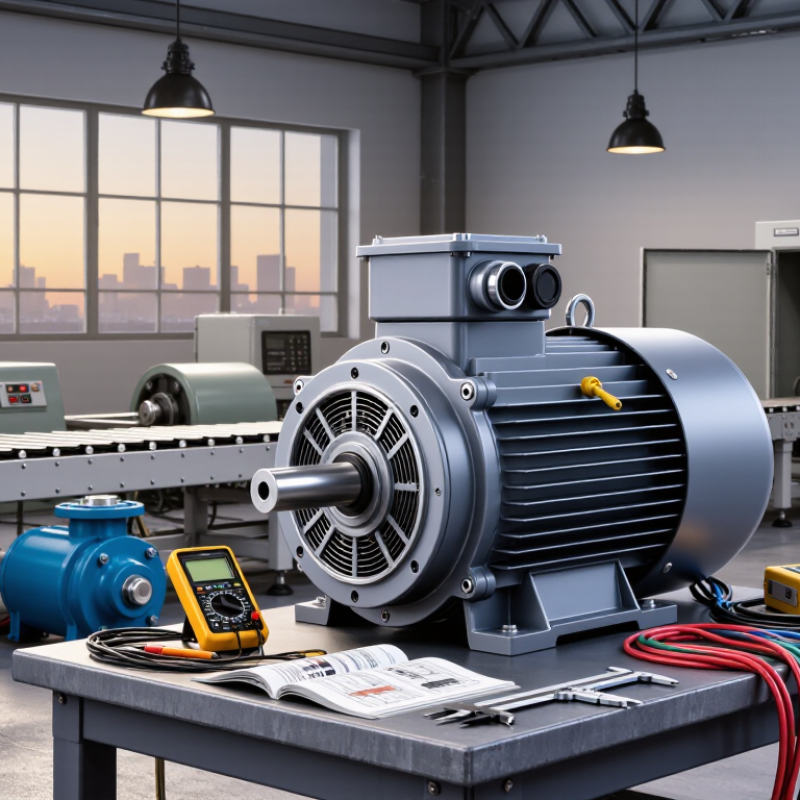
Define the Project’s Motion and Load Requirements
Define the motion before choosing a motor: does the load rotate continuously, index in short bursts, or move back and forth? Record required speed, travel, acceleration, and stopping time. Peak load matters. So does the time spent at each load.
Estimate shaft torque from the force and lever arm, then account for acceleration and friction. For a rotating load, acceleration torque depends on inertia and how quickly speed must change. Note starts per hour, reversals, and idle periods; a motor sized only for average power may overheat during repeated peaks.
The IEA’s 2011 report, Energy-Efficiency Policy Opportunities for Electric Motor-Driven Systems, estimated these systems consume 43–46% of global electricity. That scale makes matching motor output to the real duty cycle worthwhile.
Measure the actual load if possible. A conveyor carrying empty bins behaves differently from one loaded with wet material, and a pump’s demand changes with flow and pressure. Check the machine’s nameplate, log current during a full operating cycle, and compare readings with the design estimate. A spreadsheet can still miss a jam, a sticky bearing, or a sharp startup surge. Leave room for uncertainty, but avoid oversized motors that spend most of their time lightly loaded.
Choose a Motor Type for the Application
Start with the motion, not the motor catalogue. A pump or fan running for long shifts often suits an AC induction motor, especially when speed control is modest. A battery-powered tool may benefit from a brushless DC motor’s compact size and controllable speed. For a camera slider or pick-and-place mechanism, a servo handles changing position and speed; a stepper can suit simpler, repeatable moves. But steppers can lose position when overloaded. That matters.
Match the choice to the real load. Record start-up torque, operating hours, speed range, and how often the load changes. A conveyor carrying uneven boxes needs different torque behavior from a fan moving steady airflow. Check the drive, too: a variable-frequency drive can control many AC induction motors, while servos typically need compatible control electronics. Leave room for heat, dust, vibration, and the mounting space around the motor. A neat spreadsheet cannot capture every installation detail.
Efficiency deserves attention, not guesswork. The U.S. Department of Energy’s 2014 motor-systems sourcebook estimates motor-driven systems use about 68% of electricity in U.S. manufacturing. European Commission ecodesign materials also identify motors as major industrial electricity users. Those figures describe broad systems, not your project’s savings. I would compare rated efficiency and measured duty-cycle needs before choosing; the first estimate may be wrong. For a prototype, test the motor under the actual load and note temperature, noise, and response.
Match Torque, Speed, Voltage, and Mounting Requirements
Selecting an electric motor in 2026 starts with the load, not the catalog. Estimate continuous and peak torque, then check the required speed across the full operating cycle. A conveyor may need high starting torque, while a fan usually needs less. Measure under load. A no-load speed can mislead.
The U.S. Department of Energy’s Improving Motor and Drive System Performance: A Sourcebook for Industry reports that motor-driven systems use about 64% of U.S. industrial electricity. That figure makes correct sizing an energy decision, not just a mechanical one. Compare the motor’s torque-speed curve with the load, and check whether a variable-speed drive is needed. Leave room for startup and brief overloads, but avoid excessive oversizing.
Match the supply voltage, phase, and frequency to the site, and confirm drive compatibility. Then verify frame size, shaft diameter, flange pattern, and mounting orientation against the machine drawing. Check enclosure and cooling needs for dust, moisture, or restricted airflow. A small detail. I would still recheck the shaft and bolt pattern before ordering; drawings can be old, and assumptions sometimes survive too long.
How to Choose an Electric Motor for Your Project in 2026
Match the motor’s torque and speed to the load, then confirm that its voltage suits your power supply and its mounting dimensions fit your equipment.
How to read this chart: Torque is calculated from mechanical output power using T (N·m) = 9550 × P (kW) ÷ speed (rpm). These are theoretical operating-point calculations, not manufacturer motor curves; a real motor may not deliver constant power across this speed range. Check the motor datasheet for rated and starting torque, speed range, and voltage, and verify the frame, shaft, and mounting-hole dimensions before selection.
Evaluate Efficiency, Controls, and Operating Conditions
A motor’s efficiency rating is useful, but it does not tell the whole story. Compare efficiency at the load your project will actually use, not only at the rated point. A small conveyor that runs for hours may benefit more from strong part-load performance than from a high peak figure. Check the expected duty cycle, starting torque, and speed range. Heat matters. A motor that works efficiently on paper may waste energy if it is oversized or frequently starts and stops.
Controls shape both performance and complexity. A variable-speed drive can provide smooth acceleration and adjust speed as demand changes, but it must suit the motor and electrical supply. Check whether the application needs precise speed regulation, frequent reversing, or simple on-off operation. More control is not always better. Extra settings can add setup time, and poor tuning may cause vibration or excess heat. Leave room to test the system under its real load; I have seen calculations miss friction that was obvious once a mechanism moved.
Operating conditions deserve the same attention as the specification sheet. Dust, moisture, limited airflow, and high ambient temperatures can shorten service life. Measure the available mounting space and note how the motor will be cooled. If the load varies, record its normal and peak demands over a typical cycle. Those measurements may be imperfect, but they are better than guessing.
Compare Cost, Availability, and Maintenance Needs
Compare Cost, Availability, and Maintenance Needs
A motor’s purchase price is only one part of its cost. Check energy use, installation changes, spare parts, and the cost of unexpected downtime. The International Energy Agency’s 2011 report, Energy-Efficiency Policy Opportunities for Electric Motor-Driven Systems, estimates that these systems use about 45% of global electricity. That makes efficiency worth checking, especially for motors running long shifts. A cheaper unit can cost more over time. I still find it easy to underestimate the value of a clear duty-cycle estimate.
Availability matters when a project has a fixed deadline. Ask suppliers about stock, delivery dates, and compatible frame sizes—not just the quoted model. A common frame can simplify replacement, though it may not fit every design. For maintenance, compare bearing access, cooling requirements, and whether the motor will work with the planned drive. Dusty rooms and frequent starts can change service needs. Small details matter.
Tips: Before choosing, record voltage, load, operating hours, and start frequency. Request a written lead time and a parts list. Compare total operating costs, but verify the assumptions; estimates can miss real-world downtime.
How to Choose an Electric Motor for Your Project in 2026? — Compare Cost, Availability, and Maintenance Needs
| Motor Type | Typical Motor-Only Cost (USD) | Availability | Maintenance Needs | Best Suited For | Key Trade-Off |
| AC Induction | $100–$500 for a general-purpose motor around 0.75–1.5 kW | Very widely available in standard frame sizes and common industrial ratings. | Low. Typically needs periodic bearing checks and cleaning; no brushes to replace. | Pumps, fans, conveyors, and other applications needing robust, continuous operation. | Usually economical and durable, but variable-speed operation generally requires a compatible drive. |
| Brushed DC | $100–$500 for a general-purpose motor around 0.75–1.5 kW | Common in some industrial and mobile applications; selection may be narrower than for standard AC induction motors. | Moderate to high. Brushes and the commutator wear and need inspection or replacement. | Applications that need straightforward speed control or already use a DC supply. | Simple speed control, but brush wear and electrical noise can make it unsuitable for low-maintenance or clean environments. |
| Brushless DC (BLDC) | $150–$700 for a motor around 0.75–1.5 kW; drive usually costs extra. | Widely available, especially for compact machinery, mobility products, and electronically controlled equipment. | Low. No brushes to replace; bearings and cooling still require attention. | Compact, efficient systems requiring electronic speed control and good power-to-size performance. | Requires a compatible electronic controller; wiring, feedback, and control setup can add project effort. |
| PMSM Servo | $300–$1,500 for a motor around 0.75–1.5 kW; drive and feedback options may cost extra. | Common in automation, robotics, and precision motion systems, but configurations are less interchangeable than general-purpose motors. | Low to moderate. No brushes to replace; inspect bearings, connectors, feedback devices, and cooling as specified by the manufacturer. | Applications requiring accurate position, speed, or torque control, such as packaging and CNC machinery. | Offers precise dynamic control, but typically has the highest system cost and setup complexity. |
Planning notes: Cost ranges are indicative budget estimates for unbranded, general-purpose motors in the approximate 0.75–1.5 kW class, not live quotations. Prices vary by power, voltage, enclosure, efficiency rating, mounting, quantity, and region. Drives, controllers, cables, and installation are excluded unless noted. BLDC and PMSM motors are both permanent-magnet synchronous motor types; the labels often reflect differences in drive and control conventions.

