
China Top Stainless Steel Meat Hooks Suppliers?
Choosing a supplier for Stainless Steel Meat Hooks in China requires more than comparing unit prices. Buyers should examine steel grade, hook diameter, surface finish, weld quality, load capacity, and production consistency. A polished sample can look convincing under showroom lights. It still needs to perform under repeated use, cleaning, and handling.
Materials scientist Michael F. Ashby’s materials-selection work offers a useful principle, paraphrased here: choose a material for the conditions it must withstand. This is not a verified verbatim quotation about meat hooks. It is a practical lens for evaluating supplier claims. Ask for clear specifications, traceable material documentation, sample inspection, and evidence of quality checks. Small details matter. A rough weld or uneven hook tip can affect durability and handling.
This guide introduces China-based suppliers and explains what buyers should compare before requesting quotations. It considers product range, customization, communication, lead times, and quality-control practices. Supplier websites rarely tell the whole story, and a catalog photo proves little. That deserves scrutiny. The strongest choice may not be the lowest-cost offer; it is the supplier whose claims can be checked against samples and records. Use the comparisons as a starting point, then confirm every requirement directly with the manufacturer.
What Are Stainless Steel Meat Hooks and Where Are They Used?
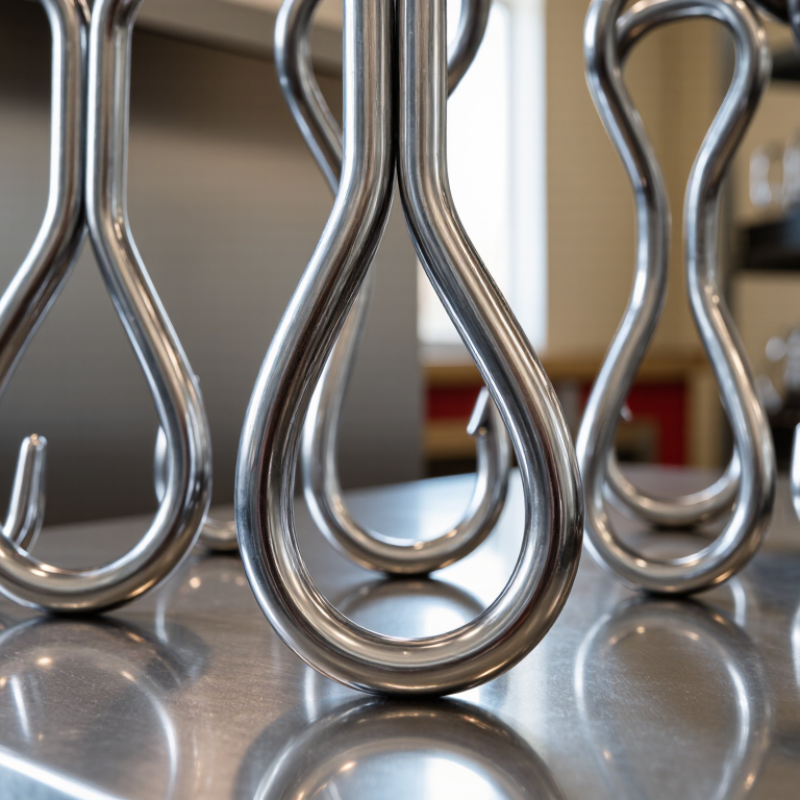
Stainless steel meat hooks are sturdy, reusable tools designed to suspend carcasses or meat cuts during processing, chilling, curing, and storage. Most have a pointed or curved end for gripping, plus a loop or handle that attaches to a rail or gambrel. Their polished metal surfaces are practical, but shape matters too: a narrow hook can tear soft tissue, while a poorly balanced load may swing on an overhead rail. Small tool. Heavy duty.
These hooks are used in slaughter and meat-processing facilities, butcher rooms, smokehouses, and commercial cold stores. The OECD-FAO Agricultural Outlook 2024–2033 projects global meat production to grow by 12% by 2033 compared with the 2021–23 base period. That wider production context helps explain why durable handling equipment matters, though the report does not measure hook demand. Buyers should check load ratings, wire thickness, weld quality, and whether the design can be cleaned thoroughly. I would not choose by shine alone. Crevices around joints can hold residue, and hook size must match the cut and handling setup. Stainless steel can resist corrosion, but it still needs proper cleaning, drying, and inspection.
China Top Stainless Steel Meat Hooks Suppliers? - What Are Stainless Steel Meat Hooks and Where Are They Used?
| Data Dimension | Hook Type or Option | Typical Use | Material and Design Notes | What Buyers Should Check |
|---|---|---|---|---|
| Basic function | Stainless steel meat hook | Hanging or moving carcasses, meat cuts, poultry, and food-processing loads in butcher shops, slaughterhouses, and processing facilities. | Hooks are made in different shapes and sizes for manual handling, rail systems, and specific products. | Match the hook shape and dimensions to the product, handling method, and equipment. |
| Hook shape | S-hook | Suspending items from a rail, bar, or another compatible support point. | Usually has two curved ends; the opening and wire or rod thickness vary by design. | Check both opening sizes, overall length, material thickness, and whether the hook can be safely retained on the support. |
| Hook shape | Single-point hook | Hanging individual cuts or products where a single contact point is suitable. | Available with different point shapes and shank designs; some versions are intended for use with a carrier or rail. | Confirm the point style, shank dimensions, intended product, and compatibility with the handling system. |
| Hook shape | Double-point or spreader-style hook | Supporting a product at two points, such as certain carcass-handling or processing applications. | Two contact points can help distribute support, but performance depends on the hook geometry and the load. | Check spacing between points, overall width, and the supplier’s rated working load for the specific design. |
| Hook shape | Gambrel-style hook | Suspending carcasses or large cuts with support at separated points. | Common designs use a crosspiece with hooks or points at either end; configurations vary by application. | Verify crosspiece length, point spacing, connection method, and compatibility with the intended load and rail. |
| Rail-system use | Trolley or rail-compatible hook | Moving hanging products along an overhead track in processing or storage areas. | The hook may connect to a trolley, carrier, or other track component; the connection is system-specific. | Confirm track and trolley compatibility, connection dimensions, load rating, and intended operating conditions. |
| Stainless steel grade | Type 304 stainless steel | General food-processing environments where a common corrosion-resistant stainless steel is suitable. | Type 304 is an austenitic stainless steel widely used for food equipment; suitability depends on cleaning chemicals and exposure conditions. | Request clear grade identification and consider the actual sanitation chemicals, moisture, and operating environment. |
| Stainless steel grade | Type 316 stainless steel | Applications with greater exposure to chlorides or more corrosive conditions, when specified for the service environment. | Type 316 contains molybdenum and generally offers better resistance to chloride-related corrosion than Type 304. | Confirm the exact grade and assess chemical concentration, contact time, temperature, and cleaning procedures. |
| Surface and cleanability | Smooth, accessible construction | Facilities that wash and sanitize hooks regularly. | Simple, smooth surfaces are generally easier to inspect and clean than surfaces with crevices or trapped-residue areas. | Inspect welds, joints, bends, and surface condition; follow the facility’s validated cleaning and sanitation procedures. |
| Load and safety | Rated working load | All manual and mechanical hanging applications. | Capacity depends on material, dimensions, shape, manufacturing, and loading direction; there is no single rating for all meat hooks. | Obtain the rated working load for the exact model. Do not estimate capacity from appearance or material grade alone. |
| Supplier documentation | Specification and traceability records | Purchasing, quality assurance, and equipment approval. | Relevant records may include material identification, dimensions, load information, and inspection or conformity documents where applicable. | Compare documented specifications with the purchase requirements and applicable site or regulatory requirements. |
Note: Hook dimensions, finishes, and load ratings are design-specific rather than universal. Confirm the exact product specification, intended use, cleaning requirements, and handling-system compatibility before purchasing.
