
147 Mill Ridge Rd Suite 232
Lynchburg, Virginia 24502
Phone 757-982-3665

China Top 10 Eddy Current Separator Manufacturers?

Choosing an Eddy Current Separator manufacturer in China requires more than comparing product photos or quoted prices. Buyers should examine rotor design, magnetic field strength, belt speed, feed capacity, and the material size range each system can handle. These details affect how effectively a separator can recover aluminum, copper, and other non-ferrous metals from mixed material streams. Small details matter.

This guide to China’s top 10 Eddy Current Separator manufacturers is intended as a practical starting point, not a definitive ranking. Company capabilities, product configurations, and service coverage can change, while published specifications may not reflect performance with your actual feed. Ask suppliers for clear technical data, installation requirements, testing options, and examples from applications similar to yours. A sample run can reveal problems that a brochure cannot, such as inconsistent particle size or poor material distribution across the belt. Not glamorous, but useful.

A sound comparison should also consider engineering support, customization, spare-part availability, and communication during commissioning. Request references where possible, and confirm that stated capacity matches your material and operating conditions. An impressive recovery figure means little without a defined test method. The manufacturers discussed here may suit different budgets and industries, so the right choice depends on your process, not a name on a list. Some information may still need direct verification; that is worth admitting.
China Top 10 Eddy Current Separator Manufacturers?

What Is an Eddy Current Separator and How Does It Work?

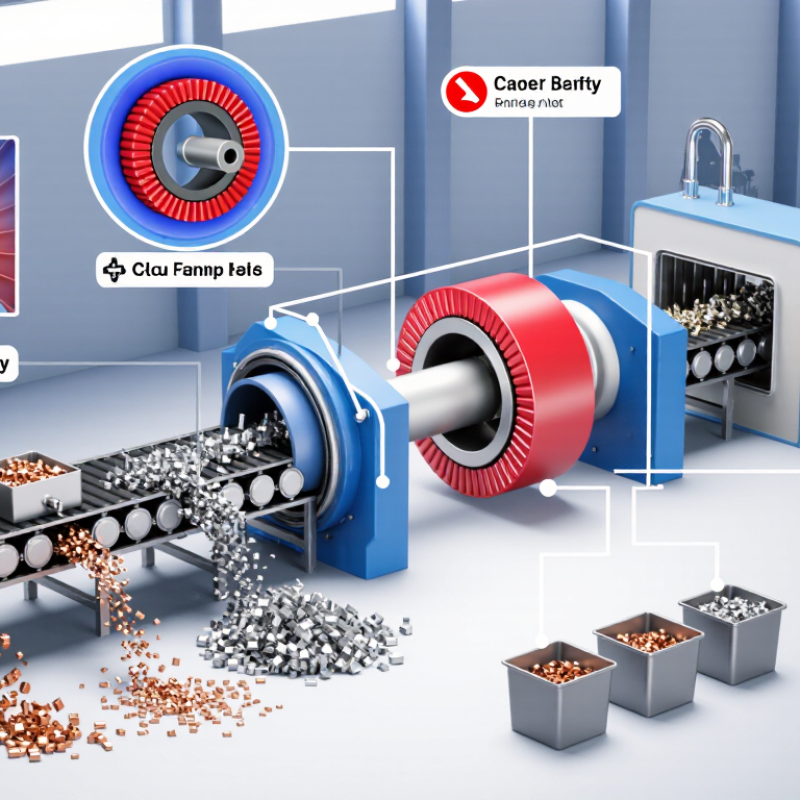
An eddy current separator sorts electrically conductive non-ferrous metals from mixed waste. It commonly recovers aluminum and copper from shredded material. Inside the machine, a fast-spinning magnetic rotor creates a changing magnetic field beneath the conveyor belt. When a conductive fragment passes over it, electrical currents form inside the metal. These currents generate a magnetic response that pushes the fragment away from the belt’s normal path. Plastic, glass, and other nonconductive pieces usually continue forward. That matters. Ferrous metals are typically removed before this stage, since they can interfere with separation.

The International Aluminium Institute reports that recycling aluminium uses about 5% of the energy needed to produce primary aluminium, a saving of roughly 95%. Effective sorting can help preserve that material’s value.

Yet performance depends on practical details: rotor speed, belt thickness, particle size, and how evenly fragments are spread. A small aluminum flake may follow a different path from a larger piece. Moisture and crowded feed can also reduce separation quality. It is not a perfect machine. Operators should test the actual material stream and check the recovered fractions regularly; settings that work on one line may disappoint on another.

Key Components and Separation Principles of Eddy Current Separators

An eddy current separator turns a fast-changing magnetic field into a sorting force. Its main parts are a feed belt, a magnetic rotor, a conveyor, and an adjustable splitter. The rotor sits inside the end pulley and carries alternating magnetic poles. When conductive pieces such as aluminium pass over it, changing magnetic flux induces eddy currents. These currents create their own magnetic field, pushing the pieces away from the belt. Nonconductive material follows a different path. A useful detail: rotor speed, pole arrangement, feed depth, and particle size all affect the separation. A crowded belt can weaken the result.

The International Aluminium Institute reports that recycling aluminium uses about 5% of the energy required for primary production. That figure helps explain why recovering clean metal matters, though an eddy current separator alone cannot guarantee purity. Ferrous metals are usually removed upstream, and operators adjust the splitter to suit the material stream. Watch the belt closely: a thin, even layer is easier to separate than a deep, mixed load. Small pieces can behave unpredictably. It is not magic. In practice, moisture, dust, and worn belt surfaces may reduce performance, so routine checks remain important.

Industrial Applications of Eddy Current Separation in China

Across China, eddy current separators help recycling plants recover non-ferrous metals from mixed material streams. In a typical line, shredded aluminum cans or copper-bearing scraps pass over a rapidly rotating magnetic rotor. The changing field induces currents in conductive pieces, pushing them away from less responsive material. It is a physical separation step, not a sorting miracle. Particle size matters.

Applications vary by region and feedstock. Municipal recycling facilities may use separators after screening and ferrous-metal removal, while factories can process clean production offcuts. Construction and vehicle recycling lines also use them to recover aluminum and copper for further processing. Operators adjust belt and rotor speeds to suit the material. A wet, overloaded belt can reduce separation quality, even when the equipment is correctly set. Small details count.

Plant experience is essential. A quick visual check of the discharge streams can reveal metal carryover, but periodic sampling gives a more reliable picture. Maintenance teams should inspect belts, bearings, and rotor protection, following equipment-specific procedures. In practice, feed mixtures are rarely consistent all day. That part is easy to underestimate. Separators can improve recovery, yet their results depend on upstream shredding, screening, and steady feeding. No single setting works for every line.

China Top 10 Eddy Current Separator Manufacturers? – Industrial Applications of Eddy Current Separation in China

Electrical conductivity of selected metals at approximately 20°C (MS/m)

Eddy current separators are used in recycling lines to recover non-ferrous metals from mixed materials, including scrap vehicles, waste electrical and electronic equipment, packaging waste, and municipal solid waste. Conductivity is one factor affecting separation; particle size, shape, belt speed, and separator settings also influence performance. Values are approximate and vary by alloy and material condition.

How to Evaluate Eddy Current Separator Manufacturers in China

China Top 10 Eddy Current Separator Manufacturers?
How to Evaluate Eddy Current Separator Manufacturers in China

Choosing an eddy current separator manufacturer requires more than comparing catalogue capacities. Ask suppliers to test your actual feed, including particle size, moisture, and ferrous contamination. A clean sample can flatter results. Request a witnessed trial with a representative, weighed batch, then assess non-ferrous recovery and product purity separately. The Global E-waste Monitor 2024 reports 62 million tonnes of e-waste generated worldwide in 2022; only 22.3% was formally collected and recycled. This scale underscores the need for reliable sorting, but it cannot verify any machine’s performance.

Inspect rotor design, belt-speed controls, magnet configuration, safety guards, and access for cleaning. Ask suppliers to document throughput, feed width, material mix, and measurement methods. Numbers need context. The International Aluminium Institute reports that recycling aluminium can use about 95% less energy than producing primary aluminium. Actual recovery still depends on separation quality and downstream handling. Compare energy use and recovery using your own material. Check spare-part availability, commissioning support, operator training, and regional response times. Request references from plants processing similar feed, not only factory videos. One trial may still miss seasonal changes in material.

China Top 10 Eddy Current Separator Manufacturers? - How to Evaluate Eddy Current Separator Manufacturers in China

Evaluation checklist — these are selection criteria, not a ranked list of manufacturers. Compare suppliers using the same feed material and test conditions.

No. Evaluation dimension What to verify Useful evidence or test data Why it matters
1 Feed-material suitability Confirm the separator is suitable for the target non-ferrous metals, particle sizes, moisture level, and material composition. A written feed specification covering particle-size distribution, bulk density, moisture, and the metals to be recovered. Eddy current separation performance depends on material properties and particle size; one setup will not suit every feed.
2 Feed preparation and presentation Check for a suitable screening, metering, and spreading arrangement so material reaches the belt as a reasonably even layer. A process layout showing upstream screening, feed control, belt width, and material-layer assumptions. Uneven or overloaded feed can reduce separation quality and make test results difficult to reproduce.
3 Eccentric magnetic rotor design Ask whether the rotor position and configuration are appropriate for the application and whether adjustment or maintenance procedures are documented. Rotor arrangement drawing, operating instructions, and applicable inspection or maintenance information. The rotating magnetic field induces currents in conductive non-ferrous particles, producing a repulsive force that helps separate them from other material.
4 Operating parameters and adjustment Verify that relevant settings, such as rotor speed, belt speed, splitter position, and feed rate, can be specified and adjusted as required. A parameter sheet recording the tested settings and the conditions under which each result was obtained. Separation results depend on operating conditions; comparing performance without recording settings can be misleading.
5 Throughput verification Evaluate capacity using the actual feed and required separation quality, rather than relying only on a general maximum-capacity claim. A witnessed or recorded trial stating feed composition, operating settings, test duration, and measured mass flow. Capacity figures are meaningful only when the material and test conditions are defined.
6 Recovery and product quality Request separate measurements for target-metal recovery and the amount of unwanted material in the recovered fraction. Mass-balance results from representative feed, with sampling method and product-fraction analysis stated. Recovery and concentrate quality are different measures and should not be represented by a single unsupported percentage.
7 Construction and wear protection Inspect the belt, drum or rotor housing, guards, bearings, and wear-prone areas for suitability for the intended material and duty. Equipment drawings, material specifications for critical parts, and a maintenance or replacement-parts schedule. Abrasive or irregular feed can increase wear and maintenance needs.
8 Controls and electrical documentation Check the control system, motor and drive information, electrical drawings, and compatibility with the site’s power supply and process controls. Electrical schematic, equipment data sheet, operating instructions, and a list of control and interface requirements. Complete documentation helps with installation, operation, troubleshooting, and integration into a processing line.
9 Safety and installation requirements Review guarding, access for cleaning and maintenance, lifting points, installation footprint, and applicable site safety requirements. General arrangement drawing, installation instructions, risk-related documentation, and site utility requirements. A suitable machine must be safe to install and operate within the buyer’s process and site conditions.
10 Service, warranty, and delivery scope Clarify commissioning, operator training, warranty coverage, spare-parts availability, response arrangements, and exclusions from the quotation. A written scope of supply, warranty terms, recommended spare-parts list, and service plan. Clear after-sales and delivery terms make supplier proposals easier to compare and help plan ongoing operation.

Profiles of 10 Eddy Current Separator Manufacturers in China

China’s eddy current separator market includes manufacturers with different strengths, rather than one standard solution. These ten profiles describe common supplier types, not a verified ranking. Buyers should confirm specifications, test data, and service coverage directly.

One profile focuses on compact units for small recycling lines.
Another builds wider machines for higher material throughput.
A third offers adjustable rotor speeds for mixed feed.
A fourth specializes in separating non-ferrous metals from dry, prepared material.
A fifth integrates separators with conveyors and screening equipment.
A sixth provides custom infeed widths.
A seventh emphasizes accessible wear parts.
An eighth supports process testing with customer samples.
A ninth serves export projects and supplies installation guidance.
A tenth concentrates on engineering modifications for existing lines.

Details matter.

When comparing suppliers, ask about rotor design, belt speed, feed depth, and recovery results for your actual material. Request a sample test report, including operating conditions; a percentage alone can mislead. Check whether quoted capacity assumes clean, evenly spread feed. It often does. Installation space, dust control, and maintenance access also affect performance, yet these details are easy to overlook. Supplier profiles are useful starting points, but site-specific validation remains necessary.