
China Best Nitrile O Rings Supplier for Global Buyers
Choosing the right China Nitrile O Rings supplier can directly affect equipment uptime, sealing safety, and purchasing confidence. Global buyers need more than attractive prices. They need stable materials, accurate dimensions, clear communication, and evidence of consistent production.
A dependable supplier should explain how nitrile compounds are selected for oils, fuels, hydraulic fluids, temperature changes, and everyday industrial pressure. Product details should include inner diameter, cross-section, hardness, color, tolerance, and packaging. A practical quality process may involve incoming material checks, mold inspection, visual sorting, dimensional testing, and batch traceability. Small details matter. One uneven edge can cause leakage.
Experience also helps with real purchasing challenges. Mixed sizes, urgent replacement orders, export packaging, and technical drawings require careful coordination. Reliable manufacturers should provide samples before mass production and communicate limitations honestly. Not every NBR formula suits every working environment. That point is sometimes overlooked.
Good suppliers also understand that international buyers require predictable documentation and repeatable performance. Test reports, inspection records, and responsive after-sales support can reduce uncertainty. However, certificates alone do not prove long-term reliability. They should match actual batch quality.
This guide examines how global buyers can evaluate a China-based Nitrile O Rings supplier through manufacturing capability, inspection practices, customization support, and delivery performance. The best choice may not be the cheapest. It should be the supplier that answers clearly, tests carefully, and keeps improving when something goes wrong. No process is perfect. Continuous review remains necessary.
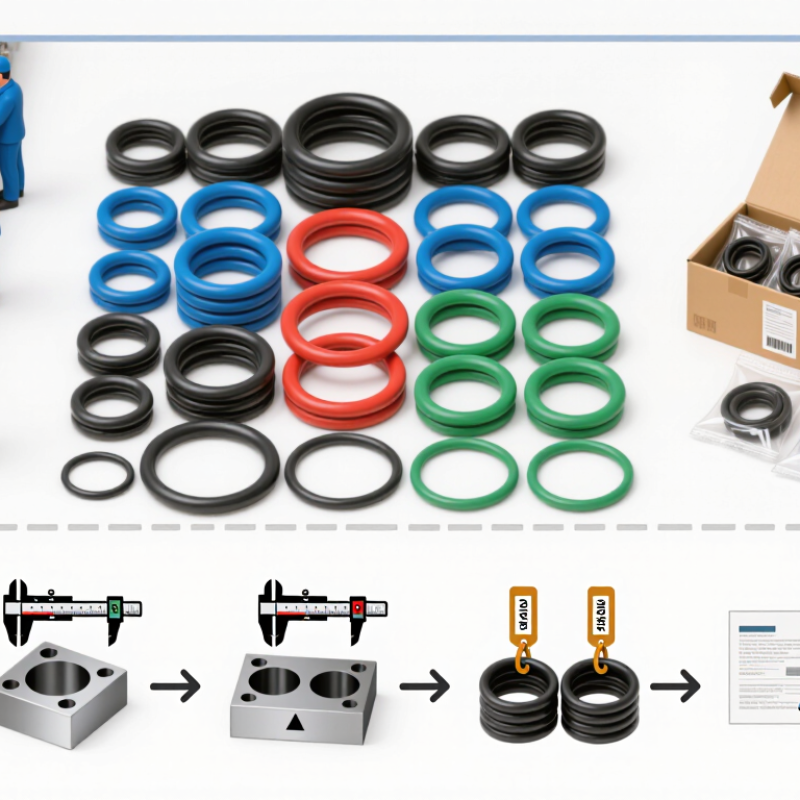
What Are Nitrile O-Rings and Why Are They Widely Used?
Nitrile O-rings, often called NBR O-rings, are circular sealing components made from acrylonitrile-butadiene rubber. Their main job is simple: prevent fluids or gases from passing through a joint. When compressed inside a machined groove, the ring fills tiny surface gaps and creates a dependable seal.
Nitrile performs well with mineral oils, hydraulic fluids, fuels, and lubricating greases. This makes it common in pumps, cylinders, valves, automotive systems, and industrial machinery. It also offers useful resistance to abrasion and compression set. In practical use, an O-ring may sit inside a dusty hydraulic fitting or face repeated pressure changes during each machine cycle.
Still, nitrile is not perfect. High temperatures, ozone, sunlight, and some chemicals can shorten its service life. A standard compound may work near 100°C, but the exact limit depends on formulation and operating conditions. Do not select material by appearance alone. Check hardness, size tolerance, pressure, temperature, fluid compatibility, and storage history.
Experienced global buyers often request sample rings before placing large orders. Measuring the groove is equally important. A ring that looks correct can leak if its cross-section is slightly wrong. Reliable suppliers in China should provide material data, inspection records, and traceable production information. Yet paperwork alone cannot replace testing. A pressure test with the actual fluid may reveal problems that a catalog never mentions.
