
China Best Buckle Tie Down Straps Supplier?
Choosing the China Best Buckle Tie Down Straps Supplier? requires more than comparing prices. Buyers must examine webbing strength, buckle performance, stitching quality, testing records, and factory consistency. A strap may look strong on a product page. Its real performance appears around sharp trailer edges, wet pallets, vibrating trucks, and repeated loading cycles.
Cargo-securing consultant John M. R. Turner states, “A tie-down strap is only as dependable as its weakest contact point.” This practical view matters when evaluating Buckle Tie Down Straps for logistics, warehousing, outdoor equipment, and commercial transport. The buckle should close smoothly and hold tension without slipping. The webbing should feel even, dense, and free from loose fibers. Reinforced stitching should remain flat around stress points. Small details matter.
A capable Chinese supplier should provide clear specifications, sample approval, production photos, inspection procedures, and traceable quality records. Ask about material options, buckle finishes, load ratings, packaging, and customization limits. Do not accept vague claims such as “heavy duty” without test evidence. That mistake is common.
Experience also brings uncertainty. Even a reputable factory can show variation between batches. Independent inspection may still be worthwhile. A supplier with responsive engineers can explain failures, not merely promise perfection. This guide will compare manufacturing capability, product reliability, communication, and value. The goal is not to find the cheapest source. It is to identify a dependable partner for Buckle Tie Down Straps that perform consistently when conditions are less than ideal.
What Are Buckle Tie-Down Straps and How Do They Work?
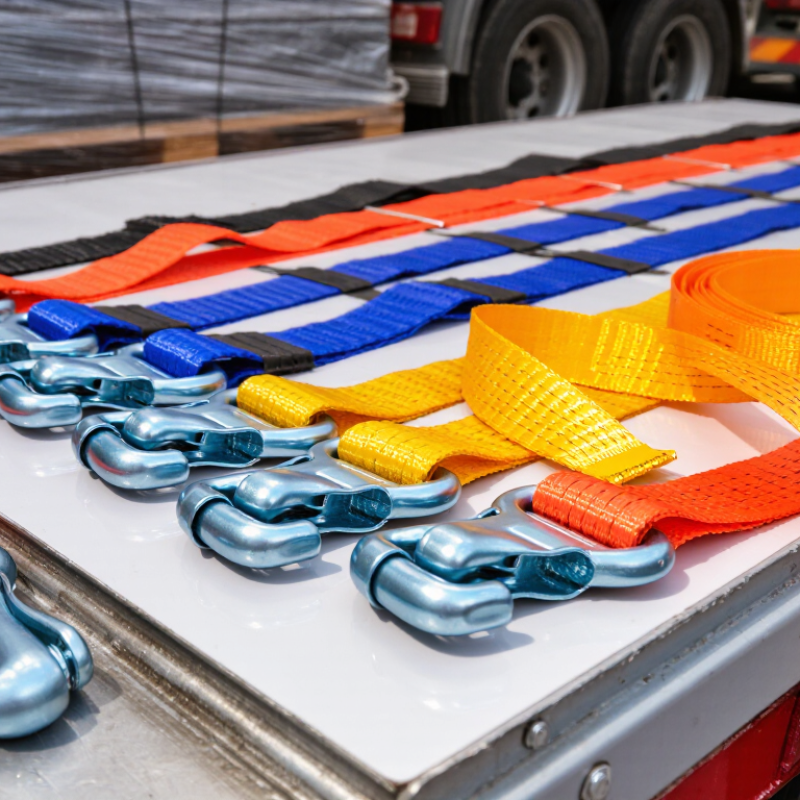
Buckle tie-down straps are webbing assemblies designed to hold equipment, cargo, or outdoor gear in place. A typical strap includes strong woven webbing, a metal or reinforced buckle, and an anchor loop. The strap passes through the buckle, then folds back on itself. Pulling the free end creates tension. Friction inside the buckle helps maintain that tension during transport. Cam buckles release quickly, while heavier buckles may offer a firmer grip. The correct supplier should provide clear material details, working load limits, and inspection guidance.
Using one is straightforward, but small mistakes matter. Place the strap over a stable section of the load, not a sharp corner. Thread it correctly through the buckle. Pull until the load feels secure, without crushing it. In practical checks, loose webbing often indicates poor positioning rather than weak material. A strap can look perfect and still be overloaded. That is easy to forget. Working load limits matter more than impressive breaking-strength figures.
Tips: Inspect stitching, cuts, frayed edges, buckle cracks, and faded webbing before every use. Keep the strap away from sharp edges, heat, and harsh chemicals. Choose a length that avoids excessive loose webbing. After securing the load, recheck the buckle after a short movement. I would not rely on appearance alone; clean webbing can hide internal damage.
China Best Buckle Tie Down Straps Supplier? - What Are Buckle Tie-Down Straps and How Do They Work?
| Data Dimension | Typical Information | Why It Matters |
|---|---|---|
| Product definition | A buckle tie-down strap is a webbing assembly that uses a manual buckle to create tension and secure cargo. | It provides controlled restraint without requiring a ratcheting mechanism. |
| Common webbing material | Polyester is widely used because it has low stretch, good abrasion resistance, and resistance to many common chemicals. | Low stretch helps maintain tension during transport and reduces load movement. |
| Typical webbing widths | 25 mm, 38 mm, and 50 mm are common sizes for light- and medium-duty tie-down applications. | Wider webbing generally distributes pressure over a larger area, but width alone does not determine capacity. |
| Buckle mechanism | The strap is threaded through a cam buckle, clamp buckle, or similar friction buckle. Teeth or clamping surfaces hold the webbing in place. | The buckle must match the strap width and the intended working load. |
| How tension is created | The free end is pulled by hand after the strap passes around or over the cargo. Friction in the buckle retains the tension. | Manual tightening is fast and convenient for loads that do not require very high pretension. |
| Typical length range | Approximately 1 m to 10 m, depending on the product configuration and cargo size. | The strap should be long enough to wrap or span the load without leaving excessive loose webbing. |
| Common end fittings | S-hooks, flat hooks, wire hooks, snap hooks, loop ends, and sewn anchor loops. | The fitting must connect securely to the vehicle anchor point or cargo attachment point. |
| Common applications | Motorcycles, bicycles, luggage, kayaks, small appliances, furniture, cartons, and general recreational equipment. | They are suitable for light- and medium-duty loads when the anchor points and strap capacity are adequate. |
| Typical working load limit | Often around 100 daN to 500 daN for consumer and general-purpose buckle straps, but the rated value must come from the product label or test documentation. | Working load limit is more useful for selection than breaking strength because it represents the recommended service load. |
| Breaking strength | The breaking strength of a complete assembly depends on webbing, stitching, buckle, hooks, and the connection method. | The weakest component determines the practical strength of the complete strap. |
| Cam buckle versus ratchet buckle | Cam buckles tighten by pulling the webbing manually; ratchet buckles use a handle and spool to generate greater mechanical tension. | Cam buckles are faster and lighter, while ratchet systems are better for heavier or more demanding loads. |
| Load protection features | Protective sleeves, soft loops, corner protectors, and abrasion-resistant webbing can reduce contact damage. | Protection is especially important when the strap passes over sharp, rough, or painted surfaces. |
| Weather resistance | Polyester generally performs well outdoors, but ultraviolet exposure, moisture, dirt, and temperature can gradually reduce service life. | Outdoor straps should be inspected regularly and stored clean, dry, and away from prolonged sunlight when not in use. |
| Inspection points | Check for cuts, fraying, melted fibers, chemical damage, distorted hooks, cracked buckles, damaged stitching, and unreadable labels. | A strap showing significant damage or deformation should be removed from service. |
| Supplier evaluation criteria | Review material specifications, complete-assembly test reports, stitching quality, buckle compatibility, labeling, sample consistency, and quality-control procedures. | A reliable supplier should provide traceable specifications for the complete strap assembly rather than webbing data alone. |
| Basic installation method | Position the strap evenly, connect both ends to suitable anchor points, thread the webbing correctly, pull it tight, and secure the excess. | Correct routing helps prevent slipping, twisting, abrasion, and accidental release. |
| Important limitation | Do not use a buckle tie-down strap for lifting people, overhead lifting, or any application beyond its stated rating and instructions. | Tie-down straps are designed to restrain cargo, not to replace certified lifting equipment. |
Note: Load ratings vary by webbing, buckle, stitching, hooks, test method, and configuration. Always follow the product label, manufacturer instructions, and applicable cargo-securement requirements.
