
What Is the Best Ready Concrete Mixer in 2026?
Choosing the best Ready Concrete Mixer in 2026 means looking beyond advertised capacity. A machine must deliver consistent batches, fit the worksite, and withstand daily loading, washing, and travel. A GCCA Concrete Future report estimates that roughly 14 billion cubic metres of concrete are used worldwide each year. That scale makes reliability more than a sales feature.
Small details matter. Check drum capacity, discharge speed, water control, maintenance access, and parts availability. On a busy site, a slow discharge can hold up a crew; dried concrete around the drum can turn routine cleaning into lost time. The right choice also depends on the job: a truck-mounted mixer, a stationary unit, and a small-site mixer solve different problems. They should not be ranked as if they were interchangeable.
Professor Karen Scrivener, a leading cement and concrete researcher, has described concrete as “the most widely used material in the world after water.” The IEA’s 2023 cement-sector tracking report puts global cement production at about 4.1 billion tonnes in 2022. Those figures offer context, not a buying verdict. There is no universal winner. Published capacity figures may also differ from useful output under real working conditions, so buyers should verify them with operating data. A careful comparison weighs build quality, service support, total ownership cost, and the actual mix being produced. Some specifications look impressive on paper. That is not enough.
What a Ready-Mixed Concrete Mixer Does Under ASTM C94/C94M
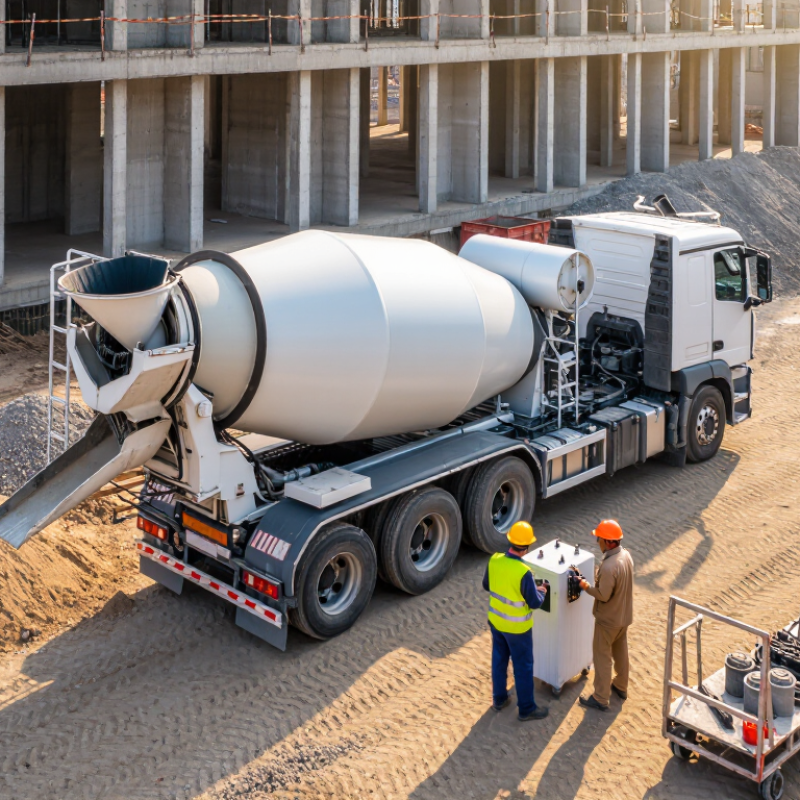
A ready-mixed concrete mixer does more than carry concrete to a jobsite. In a truck mixer, rotating blades blend the batch or keep it moving during delivery. The goal is concrete that remains workable and reasonably uniform from the plant to the chute. Look inside the drum: worn blades, hardened buildup, or uneven rotation can affect how well the load moves and discharges.
ASTM C94/C94M covers ready-mixed concrete production and delivery, including requirements for mixing, transportation, and discharge. It also clarifies what the purchaser and producer need to specify and verify. The standard does not make every mixer equally suitable, nor does the truck determine concrete strength. Mix proportions, materials, batching, and handling all matter. Details count.
On site, check the delivery ticket, note the arrival time, and observe whether the concrete flows consistently as it leaves the drum. If water or another adjustment is proposed, follow the applicable project requirements and document the change. A clean drum matters. So does maintenance. Still, a mixer can look sound and perform poorly under load; inspection alone is not proof of uniform mixing. The actual mixture and delivery conditions deserve attention.
