
147 Mill Ridge Rd Suite 232
Lynchburg, Virginia 24502
Phone 757-982-3665

7 Best Peel Tensile Testing Machines for Global Buyers

Global packaging buyers are under pressure to prove seal integrity, adhesive performance, and material consistency. Flexible packaging is expanding rapidly, but laboratory confidence often depends on small testing details. Grand View Research valued the global flexible packaging market at approximately USD 201.8 billion in 2023. Its report also forecasts continued growth through 2030. That growth increases the need for repeatable quality-control equipment.

This guide examines seven leading Peel Tensile Testing Machine options for international buyers. The comparison considers load capacity, test speed, grip design, software, calibration support, and operator safety. These factors matter when testing films, laminates, labels, medical packages, and adhesive assemblies. A machine may look advanced, yet produce unreliable results if the grips slip or the peel angle changes.

Standards matter.

ASTM International and ISO provide widely used methods for peel and tensile evaluation. ASTM F88/F88M addresses flexible package seal strength, while ISO 8510-2 covers peel resistance for adhesive bonds. Buyers should confirm whether the selected instrument supports the required method, specimen size, and reporting format. Smithers’ “The Future of Global Packaging to 2028” also highlights stronger demand for performance verification across modern packaging supply chains.

Real laboratories reveal another issue. Temperature, humidity, specimen preparation, and operator technique can change the final curve. Even excellent equipment cannot correct poor conditioning. This ranking is therefore practical, not absolute. The best choice for a film converter may not suit a medical-device manufacturer. Some specifications are difficult to compare fairly across brands. Readers should verify calibration certificates, local service coverage, software compatibility, and total ownership cost before purchasing. Reliability begins before the first test.
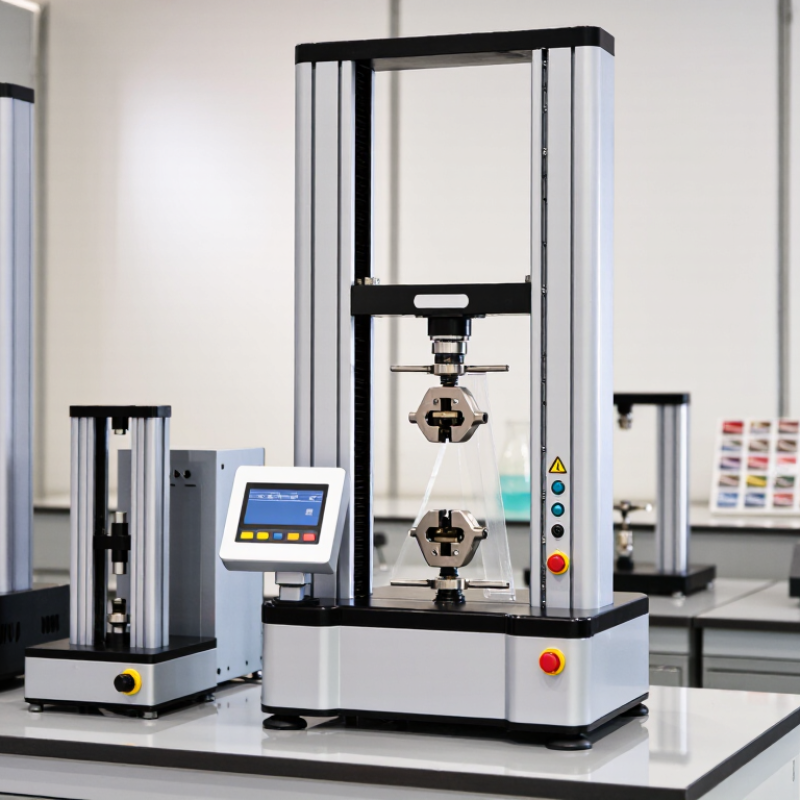
7 Best Peel Tensile Testing Machines for Global Buyers

What Peel Tensile Testing Machines Measure and How They Work

Peel tensile testing machines measure the force required to separate two bonded materials. This force is usually reported as newtons per millimetre of peel width. The result helps engineers assess adhesive strength, coating attachment, seal quality, and flexible packaging performance.

During a test, the machine clamps the backing material and pulls it at a controlled speed. A load cell records force while the bond opens at a defined angle, often 90 or 180 degrees. The software then displays peak force, average peel force, and force variation across the sample. Test speed, specimen width, temperature, and dwell time can strongly affect results.

Small changes matter.

Reliable testing starts with careful preparation. Cut specimens with parallel edges, avoid touching the adhesive area, and condition them under controlled humidity when required. Check alignment before loading. Even a slight twist can increase friction and distort the curve. Standards such as ASTM D3330 and ISO 8510-1 provide useful procedures, but they do not replace product-specific judgment.

In practical laboratory work, the smoothest graph is not always the most truthful one. Irregular peeling may reveal weak spots, surface contamination, or uneven coating. Calibrate the load cell regularly, record the failure mode, and keep the raw data.

A result without test conditions is difficult to trust. Sometimes, repeating the test exposes a preparation mistake rather than a material defect.

Key Features That Define a High-Quality Peel Testing Machine

A high-quality peel tensile testing machine should produce stable, repeatable results under demanding laboratory conditions.

In practical testing, the load cell is central. It must measure low peeling forces without losing sensitivity or creating noisy data. A suitable capacity range matters too. An oversized sensor may hide small differences between samples.

Precise speed control is another defining feature. The machine should maintain a steady crosshead speed, even when adhesive layers stretch or release suddenly. Adjustable peel angles, such as 90 and 180 degrees, support common packaging and materials tests.

Firm, aligned grips are essential. If a specimen slips by only a few millimeters, the force curve can become misleading. Good fixtures also reduce edge damage and uneven loading.

Clear software strengthens the testing process.

Operators should be able to record peak force, average force, displacement, and failure behavior. Live graphs can reveal sudden adhesive separation or material tearing. Exportable data helps laboratories review results and compare production batches.

Calibration records, emergency stops, and overload protection should be easy to access. They are practical safeguards, not decorative features.

No machine is perfect.

A polished interface cannot correct poor sample preparation. I have seen convincing curves produced from badly aligned strips. That result deserves review, not immediate acceptance.

Operators should inspect specimen width, backing thickness, peel angle, and conditioning time before trusting the numbers. Compatibility with recognized test methods also improves confidence, but regular verification remains necessary.

Seven Leading Peel Tensile Testing Machines for Global Buyers

Seven leading peel tensile testing machines serve different materials, test angles, and production needs. A motorized 90-degree peel tester suits labels and coated films. A 180-degree peel tester supports tape and adhesive comparison. A T-peel machine evaluates flexible laminates and bonded sheets. A universal tensile tester offers broader testing functions. A packaging peel tester handles pouches, seals, and lightweight films. An electronic force tester helps measure small adhesive forces accurately. A chamber-integrated tester examines peel performance under controlled heat and humidity.

In practical laboratories, repeatability depends on more than the machine. The grip must hold the specimen without crushing it. The peel rate must remain stable. Even a clean cutting blade can influence results. Operators should verify load-cell calibration, travel alignment, and data sampling before testing. Standards such as ASTM D3330, ASTM D1876, and ISO 8510 can guide method selection. However, laboratories must confirm the latest applicable version and customer requirements. That step is often overlooked.

Global buyers should compare force range, angle control, software access, fixture availability, and service support. A compact tester may fit a small laboratory, while a universal frame may better support future projects. Imported equipment also needs suitable voltage, documentation, and calibration traceability. No instrument is perfect. A highly automated system can still produce weak data when specimens vary in width or surface preparation. Users should record conditioning time, peel length, adhesive type, and failure mode. A simple photograph beside the test result can reveal details that a force curve misses.

7 Best Peel Tensile Testing Machines for Global Buyers - Seven Leading Peel Tensile Testing Machines for Global Buyers
Machine Type Primary Test Mode Typical Load Capacity Typical Speed Range Travel or Stroke Suitable Specimens Common Standards Key Strength Best Fit
Single-Column Universal Tester 90° and 180° peel, tensile, tear, and bond-strength testing 100 N to 5 kN 0.1 to 1,000 mm/min Approximately 600 to 1,000 mm Adhesive tapes, labels, films, laminates, flexible packaging, and lightweight bonded materials ASTM D3330, ASTM F88, FINAT FTM 1, ISO 8510-1, ISO 8510-2 Compact footprint with broad application flexibility Packaging laboratories, adhesive manufacturers, and quality-control departments
Dual-Column Universal Tester Peel, tensile, compression, puncture, and shear testing 1 kN to 100 kN 0.01 to 500 mm/min Approximately 800 to 1,200 mm Rigid laminates, metal-to-polymer bonds, construction materials, and higher-strength assemblies ASTM D903, ASTM D1000, ASTM F88, ISO 8510, ISO 527 Higher frame stiffness and improved stability at larger loads Industrial laboratories and facilities testing diverse material types
Motorized 90° Peel Tester Constant-angle 90° peel testing Up to approximately 500 N 50 to 300 mm/min Typically 300 to 500 mm Pressure-sensitive tapes, labels, release liners, films, and coated substrates ASTM D3330, FINAT FTM 2, PSTC test methods, ISO 8510-1 Maintains a controlled peel angle and repeatable test path Routine tape and label testing where consistent 90° geometry is required
Motorized 180° Peel Tester Constant-angle 180° peel testing Up to approximately 1 kN 50 to 500 mm/min Typically 300 to 600 mm Flexible packaging seals, adhesive bonds, tapes, films, and laminated structures ASTM D3330, ASTM D1876, ASTM F88, FINAT FTM 1, ISO 8510-2 Dedicated geometry simplifies repeatable 180° peel measurements Packaging and adhesive laboratories with frequent peel testing
High-Speed Peel and Seal Tester Peel, seal-strength, hot-tack, and dynamic opening tests Up to approximately 1 kN 1 to 1,500 mm/min, depending on configuration Typically 300 to 1,000 mm Heat-sealed pouches, lidding films, medical packaging, and flexible laminates ASTM F88, ASTM F2029, ASTM F1921, ISO 11607-related packaging evaluations Supports production-relevant testing speeds and sealing conditions Food, pharmaceutical, and medical-device packaging development
Temperature-Controlled Peel Tester Peel and tensile testing under controlled temperature conditions 100 N to 5 kN 0.1 to 500 mm/min Approximately 300 to 800 mm Hot-melt adhesives, tapes, films, labels, sealants, and temperature-sensitive laminates ASTM D3330, ASTM D903, ASTM F88, ISO 8510 Evaluates adhesive performance across selected temperature ranges Automotive, electronics, packaging, and specialty-adhesive applications
Advanced Multi-Station Peel Testing System Automated peel, tensile, shear, and repeat-cycle testing 100 N to 10 kN, depending on load frame 0.01 to 1,000 mm/min Approximately 500 to 1,200 mm High-volume tape, label, film, packaging, composite, and bonded-component testing ASTM D3330, ASTM D903, ASTM F88, ISO 8510, ISO 527 Improves throughput through programmable fixtures and automated data capture Global manufacturers requiring repeatability, traceability, and laboratory efficiency
Specifications shown are typical configuration ranges for laboratory peel and tensile testing equipment. Actual capacity, speed, travel, fixtures, environmental controls, and standards coverage depend on the selected load cell, grips, software, and test configuration.

How to Compare Accuracy, Capacity, Standards, and Usability

7 Best Peel Tensile Testing Machines for Global Buyers

Accuracy should begin with the load cell, not the software screen. Compare calibrated force range, resolution, repeatability, and recorded uncertainty. NIST Technical Note 1297 recommends reporting expanded uncertainty with a coverage factor of k=2. A machine showing more decimal places is not automatically more accurate. I have seen clean force curves expose poor fixture alignment. That detail matters.

Capacity must match the real test, including startup spikes and flexible specimens. Keep routine loads away from the sensor’s extreme limit, where resolution may weaken. Check travel length, crosshead speed, and fixture stiffness together.

ASTM D3330 covers pressure-sensitive tape peel adhesion, while ASTM F88 addresses flexible package seal strength. ISO 8510-2 is relevant for peel testing of bonded flexible substrates.

A suitable machine should store speed, angle, force, and specimen identification in one record.

Usability is easy to underestimate. Look for tool-free fixture changes, clear emergency controls, simple method templates, and raw-data export. Global buyers should verify ISO/IEC 17025 calibration traceability and local service access.

The ISO Survey 2023 reported 1,265,216 ISO 9001 certificates worldwide, showing how widely documented quality systems are used.

Still, documentation can become clutter. A practical interface may outperform a feature-heavy one when operators test dozens of samples daily.

The “best” machine is not always the most powerful; it is the one that produces repeatable evidence under your actual workload.

Choosing the Right Machine for Different Materials and Applications

7 Best Peel Tensile Testing Machines for Global Buyers

Choosing the Right Machine for Different Materials and Applications

Selecting a peel tensile testing machine starts with the material, not the catalog image. Flexible films often need smooth movement and low-force measurement. Adhesive tapes may require 90-degree or 180-degree peel fixtures. Laminated packaging can demand wider grips and stronger load capacity.

Thin films can wrinkle under uneven clamping. A pneumatic grip may control pressure better than a hand-tightened clamp. For coated paper, careful alignment prevents tearing outside the bonded area. Fabrics and flexible composites need fixtures that hold securely without crushing fibers. Small details matter.

Match the load cell to the expected force range. A larger cell is not automatically better. It can reduce sensitivity during low-force testing. Check speed control, travel distance, data sampling, and software flexibility. Temperature and humidity control may be essential for moisture-sensitive adhesives. Without conditioning, results can shift noticeably between laboratories.

A reliable machine should support repeatable setup and clear calibration records. I once saw inconsistent peel values caused by a slightly angled specimen, not a defective instrument. That experience changed how I review equipment. Ask whether the machine handles your specimen width, backing thickness, and test standard. Also inspect emergency stops, guarding, maintenance access, and operator training materials. The fastest machine may not be the most useful one. Test fixtures should be practical, replaceable, and easy to clean after adhesive residue builds up.