
10 Best Jewelry Equipment for Professional Jewelers?
A professional bench can look modest: a bright task lamp, a jeweler’s saw, pliers, files, and a loupe. Yet the right Jewelry Equipment affects accuracy, comfort, and the finish of every piece. A saw frame that flexes can wander through a fine cut. A poorly balanced torch can make delicate soldering harder. Small choices matter.
The U.S. Bureau of Labor Statistics reported a median annual wage of $47,450 for jewelers and precious-stone and metal workers in May 2023. Its Occupational Outlook Handbook also describes work involving hand tools, microscopes, and precision equipment. These figures do not measure tool quality, but they show why dependable equipment matters in skilled bench work. No tool replaces training.
Metalsmith and educator Charles Lewton-Brain is known for practical, technique-focused instruction. A useful summary of his bench philosophy is: “Choose tools that serve the work, not the other way around.” This is a paraphrase, not a verified verbatim quotation. That distinction matters. The guide ahead compares ten essentials, from bench pins and flex shafts to polishing systems and safety gear. It considers control, durability, maintenance, and workspace fit—not just price. Some recommendations will depend on the metal, design, and production volume. A perfect universal setup does not exist. Even experienced jewelers refine their choices as their work changes.
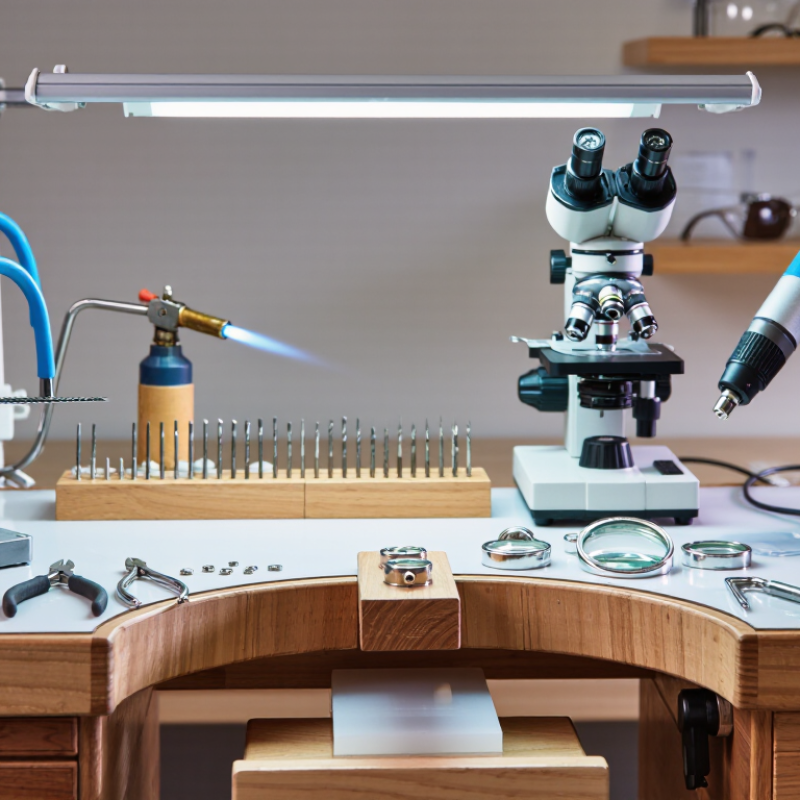
How Professional Jewelers Choose Essential Workshop Equipment
Professional jewelers choose workshop equipment by matching tools to the work they actually perform. A bench pin should feel stable under the hand, while a jeweler’s saw should hold blades firmly without excessive tension. Try tools before buying when possible. Comfort matters. A poorly positioned bench can cause more fatigue than a demanding task, especially during fine setting or repeated filing.
Lighting and magnification deserve careful attention. Look for a bright, adjustable lamp that reveals scratches without casting hard shadows across the work. A loupe should offer clear focus at a comfortable distance; stronger magnification is not automatically better. Keep ventilation and eye protection in mind when selecting equipment for soldering, polishing, or handling fine dust. These practical details are easy to overlook when comparing shiny tools.
Choose durable essentials before specialized machines. Pliers with smooth, aligned jaws help avoid unwanted marks, and a reliable mandrel supports consistent ring sizing. Check whether replacement parts and routine maintenance are manageable. Then test it. A tool that looks precise in a catalogue may feel awkward at the bench. Even experienced makers sometimes buy equipment for a technique they rarely use, so workshop needs are worth reviewing as projects change.
