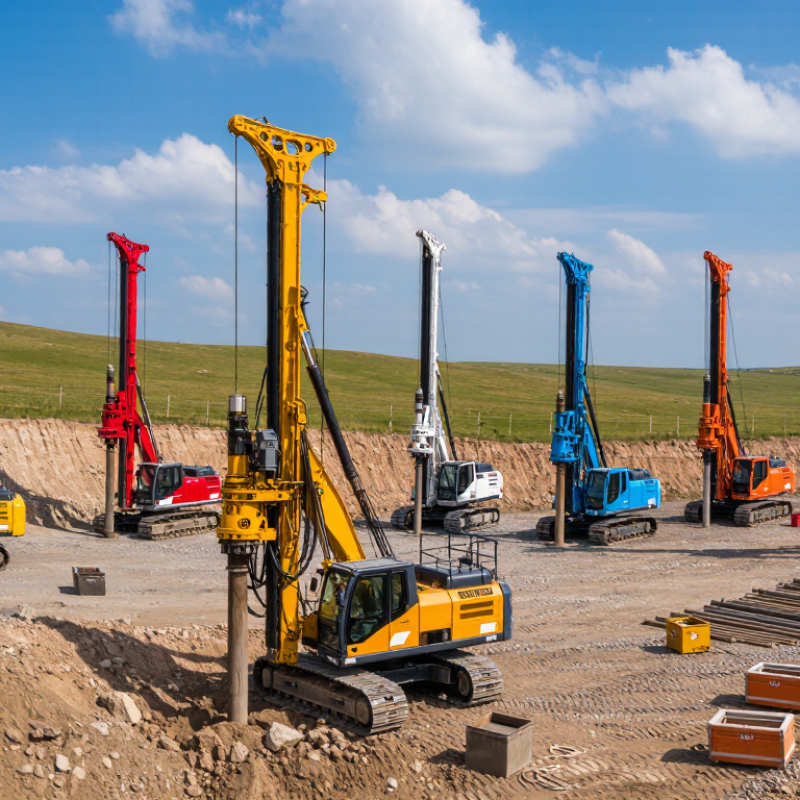
| 1. Crawler-Mounted Rotary Anchor Rig | Rotary drilling with a hydraulic rotary head; flushing may use air, water, or drilling fluid depending on the tooling and ground. | Soil, weathered rock, and some fractured formations where rotation and suitable flushing can maintain the bore. | Ground anchors, tiebacks, soil nails, and micropiles on slopes, retaining walls, and construction sites. | Tracked mobility and a stable working platform; adaptable to different drill bits, rods, and flushing arrangements. | Uncased holes may collapse in loose, saturated, or running ground. Large or difficult sites may require substantial access and setup space. | Check mast reach and inclination, available flushing systems, rod handling, access width, and whether temporary casing is needed. |
| 2. Top-Hammer Rotary-Percussive Rig | Rotation combined with impact delivered through a top hammer and drill string. | Competent rock and many fractured rock formations; performance depends on rock strength, jointing, tooling, and borehole design. | Rock anchors, slope stabilization, and anchor holes where penetration in rock is a priority. | Impact energy can help advance holes in hard rock; the method can be effective where a purely rotary bit progresses slowly. | Drill-string energy losses can become more significant as hole depth increases. Vibration and noise may affect nearby structures and sensitive sites. | Assess rock quality, required hole diameter and depth, proximity to structures, and the project’s vibration and noise limits. |
| 3. Down-the-Hole (DTH) Hammer Rig | A pneumatic hammer works near the bit at the bottom of the hole, with rotation and compressed air used to advance and clean the bore. | Hard, competent rock and some fractured rock, where compressed-air drilling and cuttings removal are suitable. | Rock anchors and other drilled ground-support holes in rock, including applications requiring relatively straight holes. | Hammer impact is applied close to the bit, which can be advantageous in deeper rock holes compared with top-hammer drilling. | Requires a suitable high-pressure air supply. Air and cuttings control can be challenging in water-sensitive, urban, or environmentally restricted areas. | Confirm compressor capacity, water conditions, cuttings management, allowable noise, and whether air drilling is permitted. |
| 4. Concentric Casing-Advance Rig | A casing system advances alongside the drill bit, supporting the bore as drilling progresses; tooling arrangements vary by system. | Loose overburden, mixed ground, and formations prone to collapse, especially where continuous temporary support is valuable. | Anchors and tiebacks through unstable overburden, fill, or mixed soil-and-rock profiles. | Supports the hole during advancement and can reduce the risk of collapse or loss of the bore in unstable ground. | Casing and specialized tooling add cost and handling requirements. Casing may be difficult to recover in some formations or layouts. | Check casing diameter and depth, extraction requirements, obstructions, groundwater, and compatibility with the anchor installation sequence. |
| 5. Eccentric Casing-Advance Rig | An offset or eccentric overburden system drills while advancing casing; the casing can commonly be withdrawn after the hole is completed. | Unconsolidated overburden, gravel, and heterogeneous ground where an unsupported bore may not remain open. | Anchors through unstable soil layers, including sites where the bore needs temporary casing during drilling. | Can advance casing through difficult overburden while drilling, helping maintain borehole stability. | Ground behavior, boulders, and obstructions can affect progress and casing recovery. Tooling selection is formation-dependent. | Review the expected ground profile, casing recovery plan, required bore diameter, and clearance around the rig. |
| 6. Compact Mast or Mini Anchor Rig | Usually rotary or rotary-percussive drilling in a compact, modular, or low-clearance configuration. | Sites with restricted headroom, narrow access, or limited working space; ground suitability depends on the fitted drilling system. | Retrofit anchors, basement and tunnel work, slope repairs, and drilling near existing structures. | Small footprint and flexible positioning can make access possible where a larger rig cannot operate. | May have lower available power, shorter mast reach, or more limited rod handling than larger rigs. Productivity can be affected by frequent repositioning. | Measure access and headroom, verify mast angle and reach, and confirm the rig can handle the required tooling and anchor depth. |
| 7. Truck-Mounted Multi-Purpose Anchor Rig | Rotary or rotary-percussive drilling, with configuration varying by mast, rotary head, hammer, and auxiliary equipment. | Road-accessible sites with variable soil or rock conditions; the appropriate method depends on the installed tooling and ground investigation. | Distributed anchor projects, retaining structures, slope stabilization, and jobs requiring frequent travel between locations. | Road transport can reduce mobilization effort between accessible sites; equipment packages may support more than one drilling method. | Requires suitable road access and a stable, level working area. A vehicle-mounted configuration may be unsuitable for confined or very steep locations. | Check transport dimensions and weight, site access, setup stability, mast reach, and the actual drilling package included. |