
2026 Best ASTMF2357 RCA Paper Tape Abrasion Tester?
Surface wear is easy to overlook until a coating turns dull, lettering fades, or a device’s finish shows a pale track. For product teams, repeatable abrasion testing can help identify these weaknesses before designs reach production. IDC reported 1.24 billion smartphone shipments worldwide in 2024, a 6.4% increase from 2023 (Worldwide Quarterly Mobile Phone Tracker, January 2025). That scale makes reliable, comparable surface testing valuable across consumer electronics supply chains.
The 2026 Best ASTMF2357 RCA Paper Tape Abrasion Tester should be judged by more than its advertised cycle count. Buyers need to examine load control, rotation consistency, tape handling, sample-fixture compatibility, and documented calibration. ASTM International’s published standards and revisions should be checked directly; a product label alone does not establish that a test setup follows the applicable method. For stronger confidence, laboratories can also consult ISO/IEC 17025 accreditation guidance when assessing calibration and testing competence.
Small details matter. A slightly misaligned specimen or inconsistent tape contact can change the result. A test can still mislead. Compare machines using the same tape specification, applied load, sample preparation, and endpoint criteria, then review repeatability across multiple runs. This guide introduces practical selection criteria and questions to ask suppliers, while recognizing an important limitation: no single tester can predict every real-world wear pattern. Use results alongside field observations and other material tests. That is less tidy, but more honest.
What Is an ASTM F2357 RCA Paper Tape Abrasion Tester?
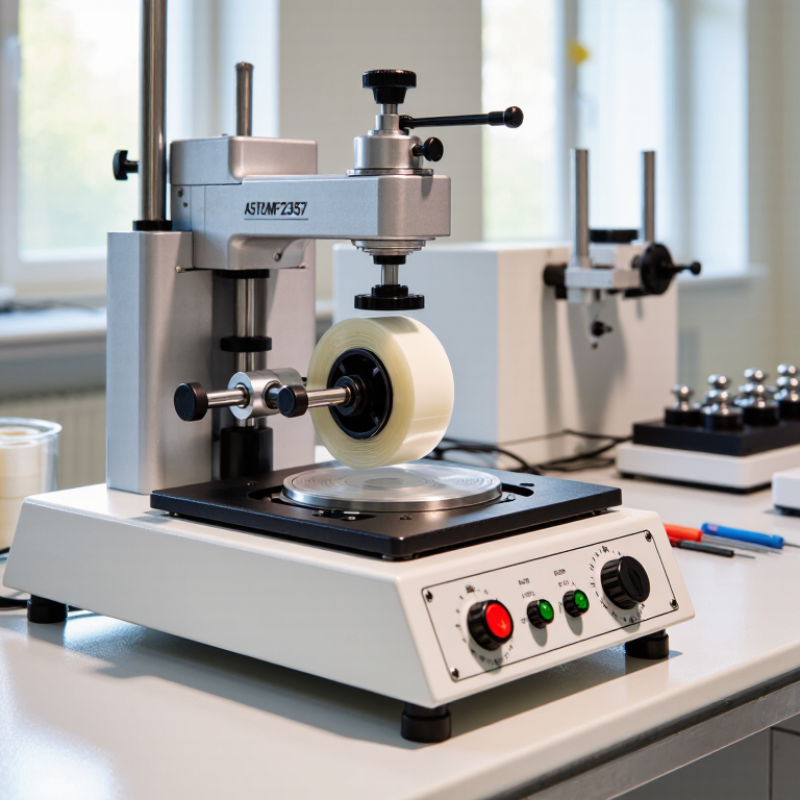
An ASTM F2357 RCA paper tape abrasion tester is a laboratory instrument used to evaluate coating durability on plastic surfaces. It applies controlled pressure while paper tape moves repeatedly across a defined test area. The test measures how many cycles a coating withstands before visible wear, color change, or substrate exposure appears.
A typical tester includes a rotating drum, a specimen holder, a load arm, and a cycle counter. The operator mounts a clean, flat sample and checks that the tape path is aligned. Load, tape condition, specimen preparation, and environmental conditioning can strongly affect the result. Small details matter. A dusty surface may produce misleadingly low resistance. Worn tape may also change the contact friction.
In practical testing, I would inspect the wear track under consistent lighting and record the endpoint with photographs. The result should include the load, tape specification, cycle count, sample location, and observed failure mode. This information makes comparisons more reliable between production lots or coating formulations. However, the method has limits. It does not reproduce every scratch, impact, or cleaning action found in daily use. The endpoint can also be partly subjective when wear develops gradually. For dependable data, laboratories should follow the current ASTM F2357 procedure, verify equipment calibration, and define acceptance criteria before testing. The instrument is useful, but it is not a complete picture of product life.
