
What Is an Aluminum LED Strip and How Does It Work?
An Aluminum Led Strip is more than a flexible circuit carrying small light-emitting diodes. It usually combines an LED tape with an aluminum profile, diffuser, end caps, and mounting hardware. The profile works as a heat sink. It draws heat away from the LEDs, stabilizes brightness, and can slow lumen depreciation. Without adequate heat control, a strip may become visibly dimmer near the center or fail sooner than expected.
The U.S. Department of Energy’s Solid-State Lighting research reports identify thermal management as a major factor in LED performance and lifetime. Its energy forecasts also show that wider LED adoption could reduce national lighting electricity use substantially. The exact result depends on installation quality. Length, power density, ambient temperature, and ventilation all matter. A five-meter strip inside a sealed channel behaves differently from one mounted beneath an open cabinet.
Lighting researcher Nadarajah Narendran has emphasized a simple principle: “Heat is the enemy of LEDs.” That statement remains practical, even if it sounds too simple. Aluminum cannot repair poor wiring, an undersized power supply, or excessive voltage drop. It only provides a better thermal path.
This guide examines how an Aluminum LED Strip works, why aluminum profiles improve reliability, and which specifications deserve attention. It also questions common marketing claims. “Long life” is not a guarantee. Check operating temperature, LED density, color consistency, IP rating, and tested lumen data before choosing a system. Small details matter.
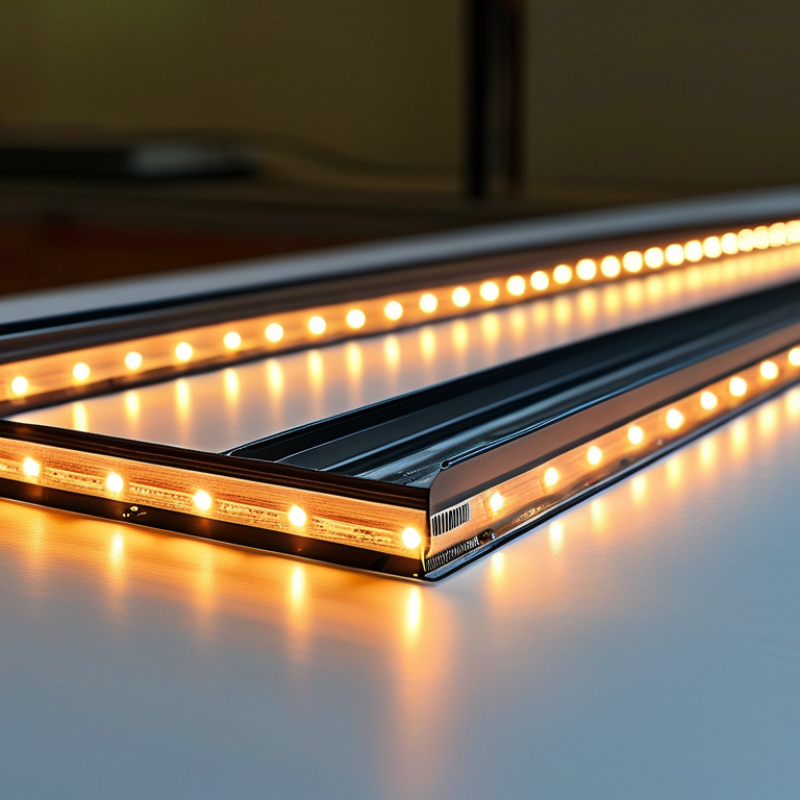
What Is an Aluminum LED Strip?
An aluminum LED strip is usually a flexible LED tape installed inside an aluminum channel. The channel is not merely decorative. It supports the tape, spreads heat, and holds a diffuser over the diodes. The aluminum body works as a passive heat sink. This matters because excessive heat can reduce light output and shorten component life.
The U.S. Department of Energy’s Solid-State Lighting R&D Opportunities report notes that laboratory LED efficacy can exceed 200 lumens per watt. Real installations perform lower because drivers, optics, wiring, and temperature add losses. An aluminum profile helps control one of those losses.
A practical installation should leave the tape fully attached to the channel surface. Dust, gaps, and weak adhesive reduce heat transfer.
It also creates cleaner light. A frosted diffuser hides bright dots and softens reflections on cabinets or walls. Wider profiles generally spread heat more effectively.
However, aluminum is not a cure for poor design. A long strip may still show voltage drop, uneven brightness, or excessive heat near the power feed. In field work, checking current, profile temperature, and connector quality is more reliable than trusting appearance alone.
The International Energy Agency reports that lighting consumes roughly 8% of global electricity, so efficiency deserves attention. Yet the figure can feel abstract at room level. A warm, flickering strip wastes comfort before it wastes much electricity.
