
2026 Top Shuttle Racking System Types for Warehouses
A modern warehouse rarely has one perfect storage pattern. Product mix changes. Order volumes shift. Aisle space stays stubbornly limited. A Shuttle Racking System can help, but the right design depends on the work behind each pallet: how often it moves, how quickly it must be reached, and whether stock rotates by date or batch.
This guide compares the main shuttle racking types expected to shape warehouse planning in 2026, including FIFO and LIFO layouts, single- and multi-level systems, and configurations designed for different throughput needs. It also considers practical trade-offs: lane depth, pallet consistency, shuttle availability, charging routines, and the space needed for service access. Small details matter. A deep lane may increase density, yet it can also make replenishment planning less forgiving.
For transparency, no source article or verified expert quotation was provided. The following is an illustrative line, not a real attribution: fictional warehouse systems engineer Alex Morgan says, “Choose the shuttle around the flow, not the floor plan alone.” That principle is useful, though incomplete; labor, maintenance, and future product changes deserve equal attention. A system that looks efficient on a drawing may behave differently during a busy shift. The sections ahead offer a clear framework for comparing options, asking vendors specific questions, and spotting assumptions that deserve another look.
How Shuttle Racking Systems Store and Move Pallets
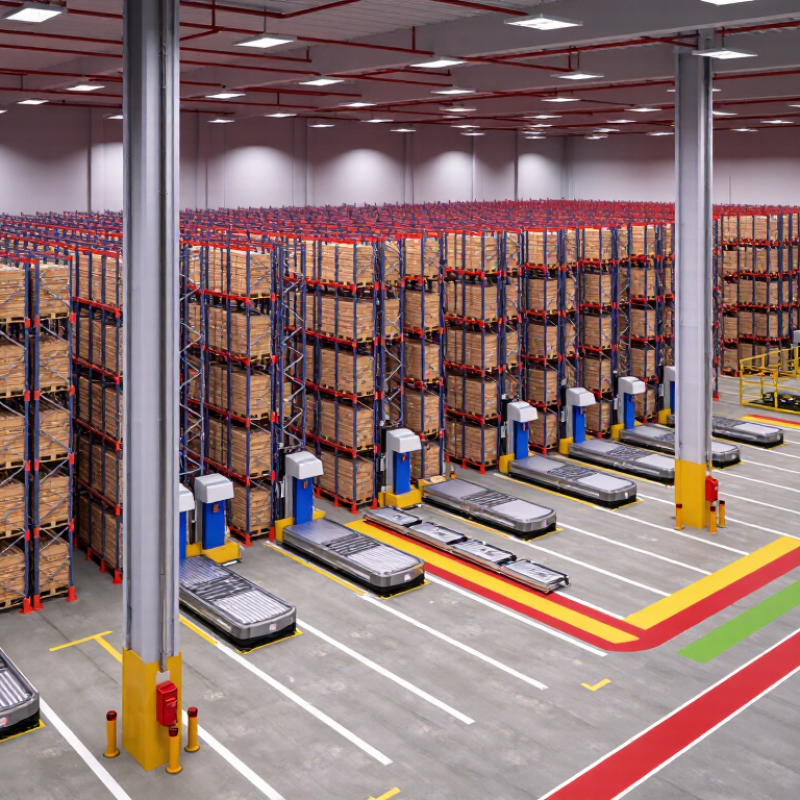
A shuttle racking system moves pallets inside deep storage lanes, rather than sending a forklift down every aisle. In a semi-automated setup, a forklift places a battery-powered shuttle on the lane rails, then sets a pallet onto it. Sensors help the shuttle travel to an open position, lift the load, and place it securely. For retrieval, it brings the selected pallet back to the lane entrance. The forklift still does the loading and collection. That detail matters: a shuttle reduces travel inside lanes, but it does not remove forklift traffic from the whole warehouse.
Lane access determines how stock rotates. A single-access lane generally suits last-in, first-out storage; access from both ends can support first-in, first-out movement. Multi-directional shuttles can travel across lanes or levels when paired with suitable transfer equipment, but add control and maintenance requirements. Small details count. Pallet condition, load stability, rail clearance, and battery charging routines all affect reliable movement. A bent pallet may snag. It happens.
MHI’s 2024 Annual Industry Report found that 55% of surveyed supply-chain professionals planned to increase technology investment over the following two years. That figure reflects broad technology spending, not shuttle-racking performance specifically. It does, however, show why warehouses are assessing automation alongside space and labor constraints. Before choosing a layout, managers should test real pallet dimensions, peak retrieval rates, and replenishment patterns. A dense lane can save floor space, yet poorly matched access rules may leave urgent stock inconveniently buried.
