What Are the 2026 Top Assembly Line Trolley Types?
Assembly lines depend on reliable material movement, and the right trolley can reduce unnecessary walking, awkward lifting, and workstation delays. In 2026, buyers may compare several practical designs: platform trolleys for bulky loads, shelf trolleys for organized parts, kit carts for prepared orders, and towable trains for moving multiple loads along planned routes. Each serves a different workflow. There is no universal winner.
This guide explores the leading Assembly Line Trolley types and the situations where each may work best. It considers details that matter on the floor: load capacity, shelf spacing, wheel material, brake access, turning radius, and aisle width. A cart that rolls smoothly on polished concrete may behave differently across joints or ramps. Small details count.
Some choices are less obvious. A larger trolley can carry more, but it may obstruct narrow work areas. A compact cart saves space, yet may require extra trips. That trade-off deserves a closer look. The guide also considers adjustable, ergonomic, and custom-configured options, while avoiding assumptions that every factory needs them. Specifications and safety requirements vary by site, so teams should confirm them with equipment suppliers and workplace specialists. The goal is a clear, practical comparison—not a promise that one design will fix every material-handling problem.
What Assembly Line Trolleys Are and How They Support Production
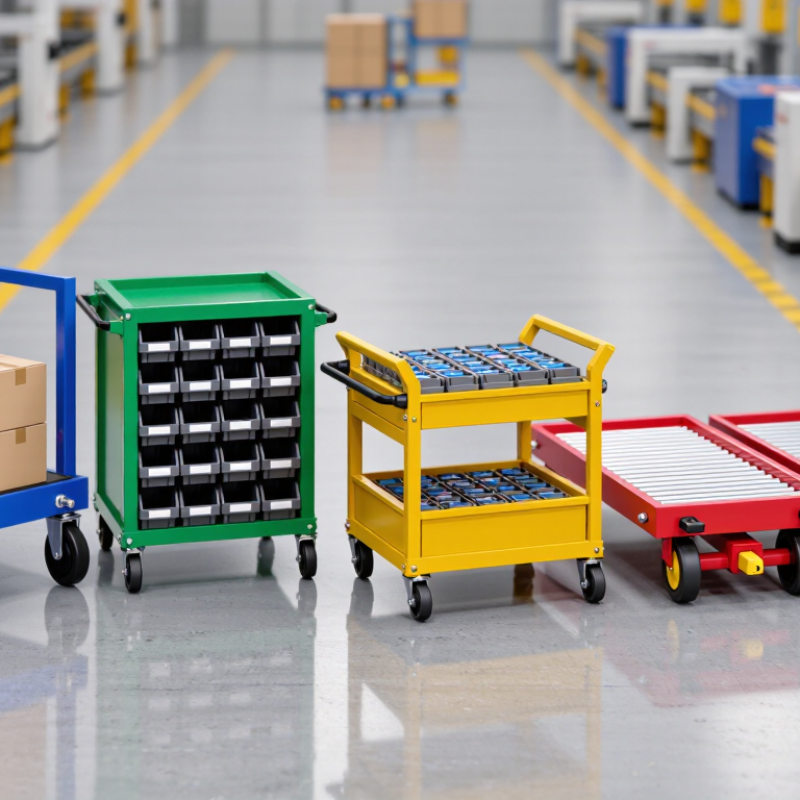
Assembly line trolleys are wheeled carriers that move parts, tools, or completed subassemblies between workstations. They can be simple flat-deck carts, multi-shelf units, kit trolleys with labeled bins, or towable carts for repeated routes. The right design depends on the load, aisle width, and how often workers need each item. Small wheels may roll smoothly on clean floors but struggle over joints or debris. Handle height and turning space matter, too.
A well-planned trolley keeps materials close to the point of use and reduces repeated trips to storage. For example, a kit cart can carry the fasteners and components needed for one production order, with separate bins for each step. Clear labels help workers spot missing parts before work begins. Keep heavy items low, secure loose loads, and check that brakes work where carts must remain stationary. Safety depends on routine.
The workflow must fit the cart. A trolley that blocks a narrow aisle can slow everyone down, even when it carries parts efficiently. In practice, the first layout is rarely perfect. Teams can trial a loaded cart along the actual route, then adjust its shelves, wheels, or handle position. Small changes often reveal practical problems early.
What Are the 2026 Top Assembly Line Trolley Types? — What Assembly Line Trolleys Are and How They Support Production
Assembly line trolleys are wheeled equipment used to move parts, tools, work-in-progress, or finished goods between storage areas and production stations. Capacity figures below are indicative ranges; actual safe working limits depend on the trolley design, load distribution, floor conditions, and manufacturer specifications.
| Trolley Type | Typical Load Capacity | Typical Configuration | Best-Fit Production Use | How It Supports Production |
|---|---|---|---|---|
| Platform Trolley | About 150–500 kg | Flat deck, four wheels, and a push handle; some models have a folding handle. | Moving boxes, bins, fixtures, or bulky components between work areas. | Provides a simple, versatile way to transport loads that do not need shelves or dedicated compartments. |
| Shelf Trolley | About 100–400 kg total | Two or more shelves, often with raised edges to help retain parts and containers. | Delivering components, tools, and small assemblies to several workstations. | Keeps materials organized and accessible, reducing repeated trips to central storage. |
| Picking Trolley | About 100–300 kg | Multiple shelves, bins, or dividers arranged for order picking and part separation. | Preparing kits or collecting mixed parts for a production order or assembly sequence. | Supports accurate, organized picking and can reduce searching and material-handling time. |
| Line-Side Kitting Trolley | About 100–350 kg | Compartmented trays, bins, or racks configured around a product or assembly sequence. | Supplying a workstation with the specific parts needed for a build or batch. | Helps present parts in sequence and can limit excess inventory at the production station. |
| Gravity-Flow Trolley | About 200–600 kg total | Inclined roller or wheel tracks that allow containers to move forward by gravity. | Line-side replenishment where containers need to be presented in a first-in, first-out sequence. | Can simplify container rotation and make the next item available at the picking face. |
| Tool Trolley | About 100–300 kg | Drawers, shelves, or holders for hand tools, gauges, and small equipment. | Assembly, maintenance, and inspection tasks that require tools close to the point of use. | Keeps tools organized and mobile, helping reduce time spent locating equipment. |
| Lift-Table Trolley | About 150–1,000 kg | Height-adjustable platform, commonly raised with a hydraulic or mechanical mechanism. | Loading, unloading, or positioning components at a suitable working height. | Can reduce repeated bending and help align materials with benches or production equipment. |
| ESD Trolley | About 100–400 kg | Conductive or static-dissipative surfaces and components; grounding arrangements vary by design. | Moving electrostatic-sensitive electronic parts and assemblies in protected work areas. | Supports electrostatic-control procedures when used as part of a properly maintained ESD program. |
| Towable Tugger-Train Trolley | About 300–1,500 kg per trolley | Designed to connect in a train and be pulled by a powered tug or other suitable towing vehicle. | Scheduled, high-volume delivery of materials along defined routes between storage and production. | Combines multiple loads into planned delivery runs and can reduce individual trips through the production area. |
| Enclosed or Cage Trolley | About 200–600 kg | Wheeled frame with mesh or solid sides; may include a closable gate or cover. | Transporting parts that need containment or added protection during internal movement. | Helps keep loads together and can reduce the risk of items shifting or falling during transport. |
