
2026 Best Pipe Swaging Machine Buying Guide
A Pipe Swaging Machine can shape tubing cleanly and consistently, but only when its capacity matches the work. This 2026 buying guide helps you compare machines against real production needs, not just attractive specifications. Start with the tube material, outside diameter, wall thickness, and forming profile. Then check whether the machine’s tooling supports those dimensions. Fit matters.
A useful manufacturing principle often associated with Taiichi Ohno, a pioneer of the Toyota Production System, is: “Where there is no standard, there can be no improvement.” Applied to swaging, that principle makes repeatability worth checking. Ask suppliers how they document setups, control stroke and pressure, and verify finished parts. A sample run can reveal marks, uneven ends, or setup changes that a brochure may not show. Small details count.
The right machine also depends on your shift pattern, operator experience, available floor space, and maintenance resources. Compare manual, hydraulic, and automated options only after defining the parts and production volume. Inspect tooling changes, guarding, controls, spare-part access, and service response. Request test pieces made from your material, then measure them against your drawings. A neat specification sheet is helpful, but it is not proof. Even careful buyers can miss a mismatch between sample conditions and daily production. Use this guide to build a shortlist, ask better questions, and judge each claim against evidence from your own application.
What a Pipe Swaging Machine Is and How the Process Works
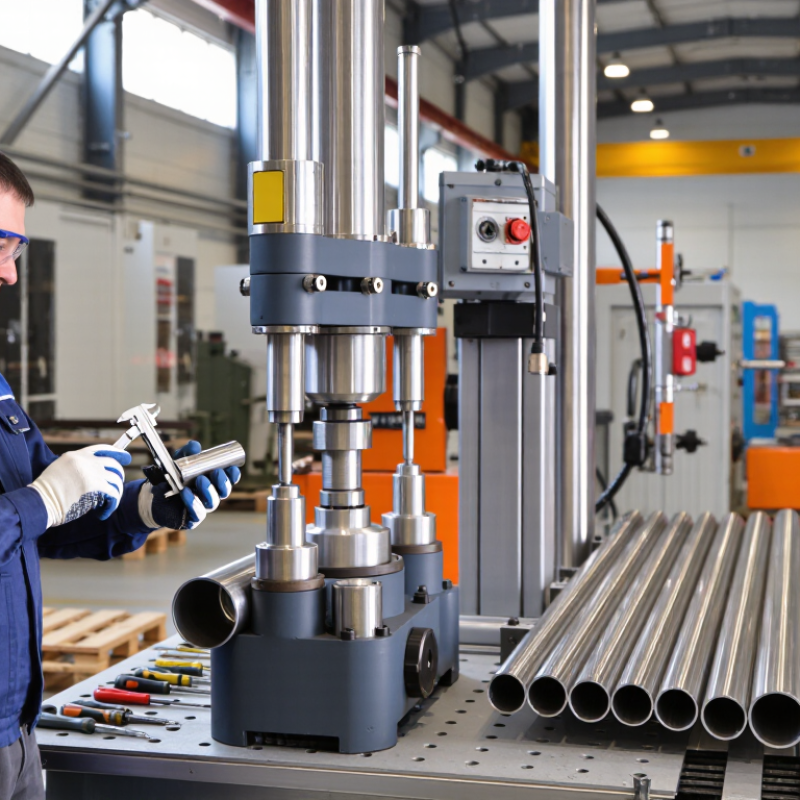
A pipe swaging machine reshapes a pipe end by compressing its wall with shaped dies. Unlike machining, the process usually forms the metal rather than removing it. The dies close around the pipe, reducing its diameter or creating a taper so the end can fit into another component. Some machines use rotating dies and repeated radial pressure; others use a press-style action. The exact motion depends on the machine and the shape required. No cutting is involved.
To begin, an operator selects dies suited to the pipe’s material, diameter, and target profile. The pipe is aligned and secured, then advanced into the forming area. Dies apply pressure in controlled steps, and the operator checks the finished end with gauges or a sample fitting. Small changes matter. Too much reduction can thin or mark the wall, while poor alignment may leave the end uneven. Results also vary with material hardness and springback, so a test piece can reveal issues before a full run. A setup may appear correct and still need adjustment; measurement is more dependable than appearance alone.
